
← Quantum Memory Matrix Research Review
AkashicNET × r/NeuronsToNirvana · QMM Companion
Could Spacetime Foam Hold a Quantum Memory?
An artwork on X traced a path from quantum foam to the cosmic web and collective consciousness. What would the first step need to become a physical model?
What Might a Memory Substrate Look Like?
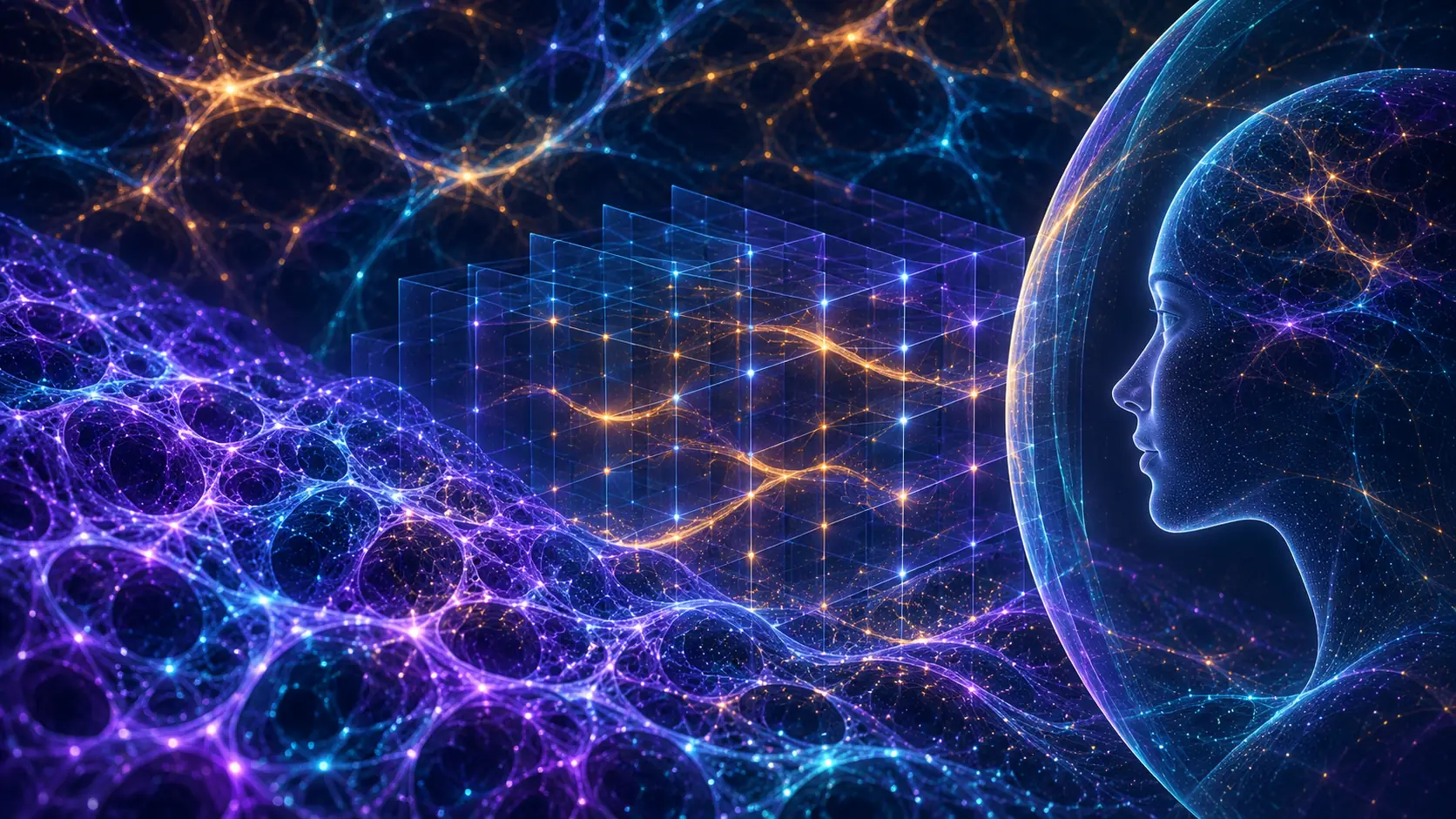
A physical substrate would need a way to write information into the geometry, preserve it as the geometry fluctuates and recover it through a measurable interaction. The illustration brings those questions into view.
From Quantum Foam to Collective Consciousness
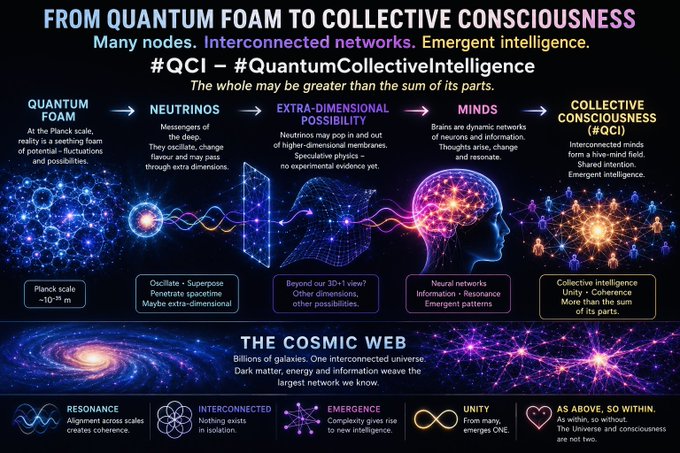
Read the Image Across Scales
- Quantum Foam
- Wheeler’s proposal concerns fluctuations of spacetime geometry, and potentially topology, near the Planck scale. For foam to serve as a memory, a model would need degrees of freedom that retain a recoverable record despite those fluctuations.
- Neutrinos
- Neutrino oscillations involve changes in the probability of detecting a given flavour as neutrinos travel. The arrows in the artwork imagine a further role for them. A carrier hypothesis would need an explicit interaction with the proposed memory and a detectable signal.
- Extra Dimensions
- Extra-dimensional neutrino models are theoretical possibilities. The artwork supplies no model for transfer between dimensions. A specific proposal would need to predict a measurable departure from ordinary oscillation physics.
- Minds and Collective Intelligence
- People can share information through communication and joint activity. A physical route from spacetime fluctuations to thoughts would require an independently measurable coupling, a readout and controls for ordinary communication.
- The Cosmic Web
- The large-scale pattern of matter in the universe gives the illustration a visual analogy across scales. A similar branching pattern supplies a question about how structures form. A shared physical mechanism would need its own evidence.
Where Would the Memory Sit in Hoffman’s Headset?
Neukart, Brasher and Marx propose that quantised spacetime can encode imprints of physical interactions. One possible extension is to ask whether a particular model of fluctuating geometry could provide the memory degrees of freedom. The extension needs a write operation, a mechanism that preserves the imprint and a readout.
Hoffman, Prakash and Prentner propose that spacetime and particle interactions arise as a projection of conscious-agent dynamics. In that framework, quantum foam could describe behaviour within the emergent spacetime interface. The deeper derivation would start from agent dynamics and explain how an observer gains access to an effective memory.
Could conscious-agent dynamics give rise to an effective quantum memory within the spacetime headset? What would that account predict about how information is stored and recovered?
Read the existing observer-traces benchmark · Explore the Hoffman conference companion
What Would Make It Testable?
- Choose a microscopic model. Specify the geometry or quantum degrees of freedom that store an imprint, their coupling to the input and how long they should retain phase.
- Derive a readout. Prepare |+⟩ and |−⟩, which have the same Z-basis probabilities. Predict the X-basis readout after retrieval for a prespecified range of storage times. Complete Z dephasing gives equal X outcomes for either input.
- Compare like with like. Use an ordinary quantum memory with matched timing and a correlated-noise model. A candidate foam mechanism needs a quantitative prediction that differs from these baselines and survives uncertainty and drift checks.
The published hardware work implements engineered quantum circuits. The phase benchmark can evaluate a specified memory channel. A physical spacetime test would additionally need an observable with a predicted effect size and a credible way to measure it.