AkashicNET × r/NeuronsToNirvana × AkashicOMNI · 13 November 2026
What Can a Trace Reveal?
Observer Windows, Quantum Memory and Testable Predictions
Hoffman’s observer windows and Neukart’s quantum memory cells meet at a practical question. When two processes produce the same record, which extra observation can distinguish them?
Research Infographic
Same Record. What Should We Measure Next?
Observer Window
Same visible transitions
Record the waiting time
In the toy models, a return takes more than two steps 0% versus 25% of the time.
A clock can distinguish this pair. A second window can help if it exposes a state or statistic where the models differ.
One Quantum Readout
Same Z-basis statistics
Prepare |+⟩ or |−⟩ and read X
Ideal coherent retrieval gives opposite X outcomes. Complete Z dephasing gives 50:50 for either input.
This separates coherent retrieval from complete dephasing for these inputs.
Two Uses of a Memory
Same single-use channel
Read X after two uses
A shared random phase flip gives +1. Independent fair phase flips give 0 in expectation.
This separates the two specified error histories. An ordinary correlated-noise model can produce the same signature.
Physical Spacetime
A proposed imprint mechanism
Derive a separate physical prediction
One candidate is a quantified black-hole ringdown deviation against a general-relativity baseline.
The timing and circuit benchmarks leave this physical question open.
The numbers describe ideal model predictions. The four panels concern different systems and different evidence.
EXPAND² · Discern
Where the Proposals Meet
Hoffman’s San Diego plenary describes a trace as the first-return transition matrix seen by an observer with access to a subset of states. The Trace Institute’s working paper proves that hidden steps can be inserted while leaving this visible trace intact. Its whitepaper presents a wider programme in which observer dynamics could give rise to spacetime and quantum physics. TSC2026 Abstract · Working Paper, §6.5 · Institute Whitepaper
Neukart, Brasher and Marx propose finite-dimensional spacetime memory cells. The later hardware study by Neukart, Marx and Vinokur reports agreement in computational-basis readouts across five engineered circuits and identifies tomography as a next step. The convergence is about what can be inferred from a partial record. Deriving a QMM cell from observer dynamics remains the AkashicNET hypothesis. QMM Theory · Circuit Study, §§2 and 5.5
EXPAND² · Deepen
A Clock Can Reveal What the Trace Hides
Take visible states A and B and hidden state H. From either visible state, go directly to A or B with probability ¼ each, or to H with probability ½. In Model A, H immediately returns to A or B with equal probability. In Model B, H stays put with probability ½ and exits to A or B with probability ¼ each. In both models the next visible state is A or B with probability ½ each, regardless of the starting visible state.
A return takes more than two steps only if the chain enters H and stays there at the next step. That has probability zero in Model A and ½ × ½ = ¼ in Model B. A clock resolving those steps separates this pair. With unknown step duration or identical observed waiting-time distributions, an expanded window or a controlled intervention must expose a further difference. Meyer · Stochastic Complementation · AkashicNET Conference Companion
What Would Constrain Experience?
Fix the mapping from reports to states, the observer window and the permitted transitions before collecting data. Compare predictions of next reports and waiting times on held-out trials with an ordinary hidden-state baseline. Specify a minimum predictive improvement and report the uncertainty. If the model can change its mapping after every result, the proposed test has no stable prediction to score.
EXPAND² · Synthesise
A Testable Hypothesis About Memory Across Two Uses
Hypothesis. If a memory retains the same phase-error state across two uses, the output preserves more X correlation than a matched memory in which the error is drawn independently on each use, even when the two single-use channels are identical.
Match single-use behaviour. Prepare |+⟩. Apply identity or a Z flip with equal probability during each use. In both branches, one use gives an average X readout of zero and preserves Z populations.
Change the dependence across uses. In the shared-error branch, reuse the same randomly chosen flip for both uses. In the independent branch, draw a fresh flip for each use. Keep qubits, gate slots, storage intervals and readout identical. Interleave the branch settings and verify the compiler retains the two intervals.
Measure the contrast. The two flips cancel in the shared branch, giving ideal ⟨X⟩ = +1. Independent flips give odd and even parity equally often, so ideal ⟨X⟩ = 0. Set an effect-size threshold and uncertainty rule before collecting data. A contrast smaller than the specified prediction counts against the tested model if the controls pass.
What the test establishes. An engineered shared-error control validates the readout. Testing an unknown memory requires controls for drift and ordinary correlated noise. A Hoffman–QMM claim needs a derivation of when the shared error should occur and an observable that differs from competing quantum-memory models. No hardware run or observer-to-QMM derivation is reported here.
Interconnected Research
Quantum Interface Theory. Robert Prentner proposes quantum instruments as a model for perception. The formalism already assumes quantum operations, so its immediate use here is to specify preparations, readouts and back-action. The origin of QMM-like memory remains a separate derivation. Prentner · §§3–4
Quantum Memory Across Time. Pollock and colleagues give an operational way to test temporal memory by intervening between measurements. This supplies a stronger follow-up when the two-use contrast could be explained by ordinary correlated noise. Chuang and Nielsen provide a benchmark for characterising a single-use channel. Operational Markov Condition · Process Tomography
Predictive Compression. Gu and colleagues construct quantum models of certain stochastic processes that use less memory entropy than their classical counterparts. That suggests another precise question for a specified trace process: what resources does each simulator need to reproduce the same prediction task? Occam’s Quantum Razor
Black-Hole Spectroscopy. GW250114 illustrates a separate physical comparison against general-relativity waveforms. To make a QMM search informative, specify the change in ringdown, its expected size and the range of events that could constrain it. LIGO–Virgo–KAGRA Summary
First-Person Reports. The Trace Institute lists a Gallimore–Hoffman–Hermansson preprint on DMT phenomenology. Its catalogue entry offers a separate use case for prospective report coding and baseline comparisons. The preprint text was inaccessible during this review. Trace Institute Publications
Compare X or XX against a dephased control and a timing-matched ordinary memory. A positive circuit result supports coherent retrieval under the tested conditions.
Specify how agent dynamics generate preparations, transformations and measurement probabilities. Compare a held-out phase or timing outcome against a matched baseline.
Choose different pulse histories that yield the same final picture under the simulator’s rules. Reveal a time series and check what can be recovered about the history.
Compare blinded target scores in randomised sending and matched no-sending trials. Preserve misses and assess leakage before interpreting any performance difference.
Keep two outcomes distinct: whether attention changes blinded target scores and where a recorded sound originated. Shared mathematical notation supplies no cross-model prediction.
Derive a numerical observable under the proposed geometry and under a specified four-dimensional baseline. Define the instrument precision and what would change the appraisal.
Time-stamp reports and define outcomes prospectively. A behavioural result would motivate an independent biological study with its own timing and molecular measures.
Use the image as a lens on interdependence and attention. Any claim that observed coincidences exceed chance needs prospective criteria, comparison cases and missed connections.
AkashicNET · Exploratory Hypothesis · 13 November 2026
Could Quantum Memory Emerge Within the Spacetime Interface?
Donald Hoffman’s ‘headset’ analogy treats spacetime as an interface. The Quantum Memory Matrix (QMM) models how physical interactions could leave retrievable quantum imprints in spacetime. The overlap is a question about how the interface might keep a record of interactions.
Hypothesis. The dynamics of conscious agents could give rise to effective memory cells that store and retrieve quantum information within the spacetime interface.
A One-Cell Benchmark
Start with two qubit states, |+⟩ and |−⟩. They give the same bit probabilities in the Z basis and opposite outcomes in the X basis. Run each through one write–retrieve cycle and measure the returned qubit in X. Ideal coherent retrieval preserves the distinction. Complete dephasing in Z erases it while preserving the Z-basis probabilities. The Bell-pair pilot uses a related comparison of XX and ZZ correlations.
What Would Test the Connection?
Specify a map from Hoffman’s published Markov dynamics to the preparations, memory evolution and measurements of a single cell. The map must explain where the relative phase is encoded and how it affects the X readout. A mapping that erases the distinction fails this benchmark. Recovering it would show that the mapping reproduces this aspect of a quantum memory channel. To distinguish the hypothesis experimentally, the mapping would need to predict a measurable result that differs from a matched ordinary quantum memory channel or the QMM circuit benchmark.
EXPAND². If two proposed dynamics give identical bit counts, X readout is the first extra observation to try. If they also agree there, compare a prespecified change in storage time or a second readout setting, chosen from a quantitative prediction. If every accessible prediction agrees, the benchmark cannot distinguish the models.
Exploratory Extension
Could an Intention Leave a Trace?
A wish, prayer or focused intention could be imagined as a pulse leaving a trace in spacetime. The published QMM describes hypothetical imprints of physical interactions. Carrying the meaning of a wish would require a way to encode that meaning, preserve it and read it back. Influencing an outcome would require a further mechanism and a prediction that could be tested.
The Intention–Awareness follow-up tests a narrower question about target matching after shared movement. The statistical simulation models trial scores, while the interactive field model illustrates a pulse and a fading trace. A replicated behavioural result would still leave the physical carrier undetermined.
EXPAND². Score all randomly assigned trials, including misses, using a frozen rule. Compare sending with a matched no-sending condition. Any repeatable difference would warrant a follow-up on the source of the information.
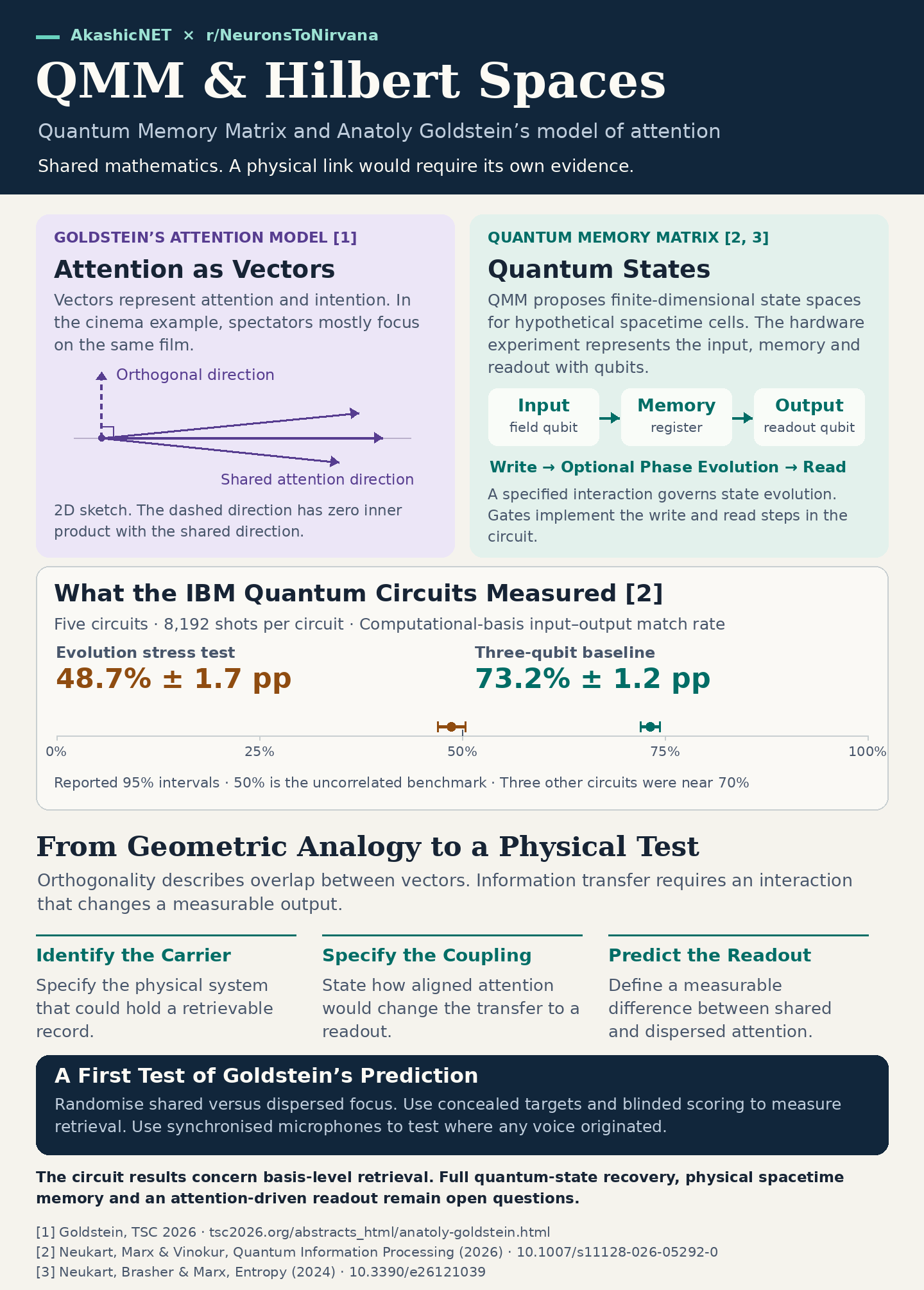
Hilbert spaces let us describe states as vectors and quantify their overlap. In Anatoly Goldstein’s TSC 2026 model, vectors represent attention and intention. In the Quantum Memory Matrix (QMM), they represent quantum states of fields and proposed spacetime memory cells. The connection between the two models is mathematical. A physical link remains speculative.
AkashicNET × r/NeuronsToNirvana. An explanatory comparison of Goldstein’s proposal and the published QMM-inspired circuits. Select the image to open it at full size.
What Each Model Describes
Goldstein’s attention model. In his cinema example, spectators focus on the film and their attention vectors cluster around a shared direction. The dashed arrow in the graphic represents a direction with zero overlap with that shared direction. Goldstein proposes that reduced competition between different foci could allow interaction with a medium. His abstract describes playing existing recordings and leaves the coupling from attention to audible speech unspecified. Goldstein’s TSC 2026 Abstract
The QMM circuit. A controlled rotation writes information from a field qubit into a memory qubit. Some circuits add phase evolution before a controlled swap transfers information to an output qubit. Across five circuits on IBM Quantum hardware with 8,192 shots per circuit, the three-qubit baseline reported 73.2% ± 1.2 percentage points and the evolution stress test 48.7% ± 1.7 percentage points. Those are reported 95% intervals for computational-basis input–output matching. Phase-coherent recovery and physical spacetime memory remain open. Published Circuit Study · Original QMM Theory
A proposed pilot would randomise shared versus dispersed visual focus, keep the cues independent of concealed targets and use blinded scoring to compare correct matches. Synchronised microphones would address the separate question of where any sound originated. Preregistration would define how to score silent trials and the minimum difference the study aims to detect. A QMM-linked explanation would also need to specify a physical carrier, how attention would couple to it and a measurable readout that distinguishes the proposed mechanism from ordinary explanations.
EXPAND². Compare target scores and microphone records under shared and dispersed attention. An attention effect on scoring and evidence about the sound source answer different questions. The shared mathematics alone gives no prediction linking either outcome to QMM.
Interconnected Research · Behavioural Evidence
Sheldrake and the Problem of Concealed Information
Sheldrake and Smart’s videotaped caller-identification study reported 122 hits in 271 trials across four participants against a 25% chance benchmark. Schmidt and colleagues reported an unsuccessful replication with a different procedure. The comparison makes trial timing, caller cues, participant-level variation and independent replication central to the design. A prospective study should preserve all guesses and misses, conceal caller identity and analyse repeated trials within participants. Sheldrake and Smart · Corrected Study · Schmidt and Colleagues · Replication Series
A second comparison concerns morphic resonance. Robbins and Roe found more recognition hits and more false alarms for genuine Chinese characters. A later study reported a failure to replicate. The useful design question is whether a result survives visually matched stimuli and a measure that separates recognition sensitivity from a tendency to say “seen before”. Neither experiment measures quantum phase or physical spacetime memory. Robbins and Roe · Recognition Study · Failed Replication
Source Audit and Review Scope
The 9 November Source Atlas snapshot contains 158 unique source families across 11 categories. This review screened all catalogue names, roles and categories for trace logic, quantum information, physics, theory and relevant discovery routes. Targeted reading followed Trace Institute (S016), PubMed/PMC (S023), arXiv (S024), Nature/Springer (S035), Frontiers (S036) and TSC2026 (S064), with SIAM, the QMM journal and LIGO as direct sources. Catalogue screening covers source families. The selected works linked above are the units of evidence.
The public Sandbox workflow supplied the sequence from the Source Atlas and evidence card to a figure-led draft. AkashicNET checked claims at source, r/NeuronsToNirvana supplied the community inquiry and AkashicOMNI’s EXPAND² method guided the alternatives and revision criteria. Source inspection covered the cited passages and abstracts. Independent review of the proposed protocol is pending.