Purpose, context & judgment
Choose the question, define useful outcomes, preserve disagreements and approve what is published.
TSC2026 · An Independent Invitation To Collaborate
Human questions. AI assistance. Shared scrutiny. Could we make consciousness research easier to explore without losing its sources, its disagreements or the people behind it?
We propose a small human–AI research commons, beginning with an Evidence Jigsaw: one question, a few traceable claims and a useful next step. Bring a public source, a practical skill or a thoughtful objection. Let’s make something we can inspect together.
Thinking Space is an existing guided worksheet. The projects below are proposals, with no confirmed team or completed evaluation. AkashicNET is independent of the conference organisers.

The Proposal · Human Direction Comes First
Consciousness conversations bring together experiments, philosophical arguments, first-person accounts and personal meaning. A useful tool should help us examine those contributions on their own terms. A reported experience matters as a report; a proposed mechanism still needs evidence. Smooth prose and an attractive image cannot settle that distinction.
Here, symbiosis means a deliberately complementary working relationship. People choose the questions, bring context and lived experience, decide what may be shared and take responsibility for interpretation. AI can suggest ways to organise material, draft comparisons and help implement the interface. People then check the sources, challenge the suggestions and decide what to keep.
The hoped-for benefit runs through the community: a researcher contributes a source, a reader exposes an ambiguity, a designer makes it easier to understand and a developer makes the improvement reusable. Each contribution should leave a clearer record for the next person. This is a design aspiration to test, not a claim that AI is conscious or that collaboration automatically produces reliable knowledge.
Choose the question, define useful outcomes, preserve disagreements and approve what is published.
Suggest candidate links and summaries, organise records and help build. Treat every generated claim as needing a source check.
Show the evidence, document corrections, credit contributors and make the next question visible.
Suggested First Build · Evidence Jigsaw
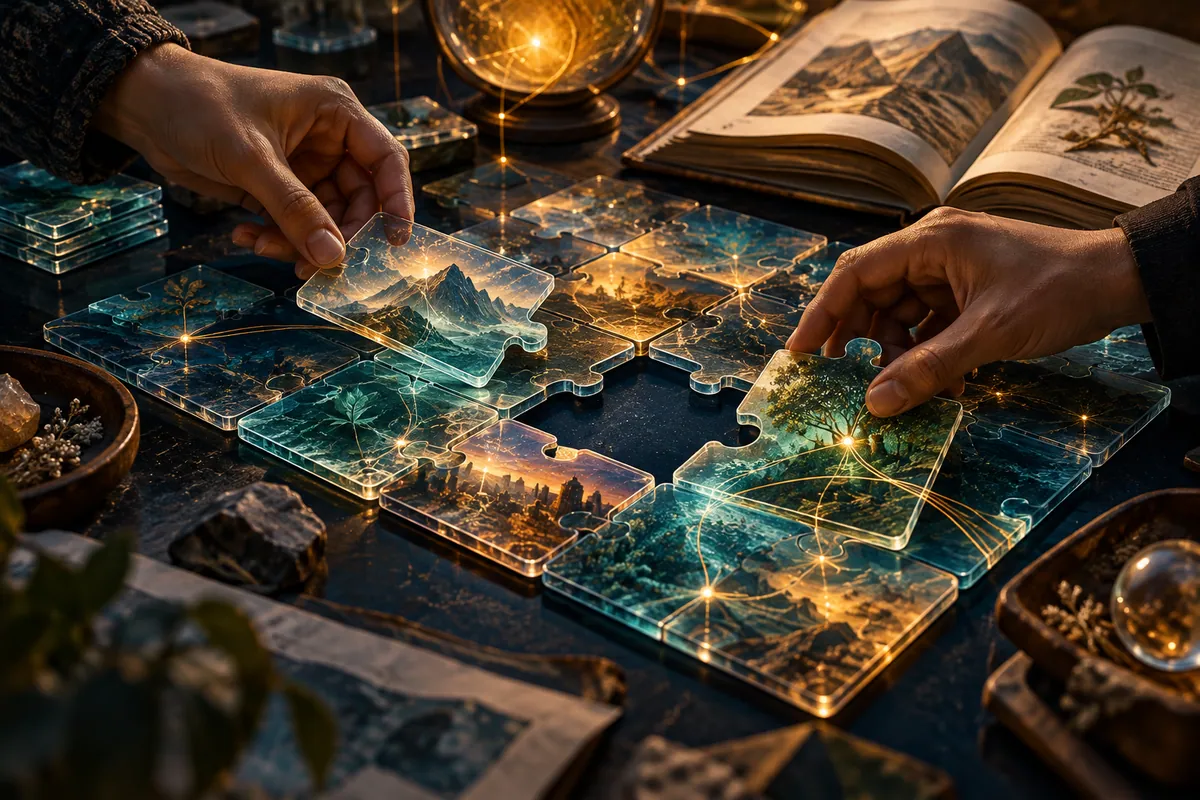
Start with one claim from a public paper or conference abstract. Create a simple explorer where every conclusion can be traced to a source, challenged by another explanation and revised when new evidence arrives.
A useful demo: select a claim and see what supports it, what remains uncertain and which next observation could distinguish explanations.
One Proposal · Four Possible Contributions
The Evidence Jigsaw is our suggested first build. The other three ideas are optional ways to extend or improve it; we are not proposing to finish all four at the hackathon. The scope and time estimates are provisional suggestions for a small team. Each can begin with paper sketches and manual records.
01 · Recommended · Half-Day Prototype
Build: three linked claim cards, a source ledger and a visible revision history. Distinguish findings, interpretation, testimony, hypotheses and speculation.
First demo: use one accessible source packet; flag every field that cannot be assessed from an abstract alone.
Useful collaborators: a researcher, a front-end developer and someone willing to challenge the reading.
Check success: a second reader can locate each cited passage and identify an unresolved question. Record disagreements instead of assigning invented confidence scores.
Start With The AkashicOMNI Researcher Kit →
02 · Existing Demo · Two-Hour Design Session
Improve: the existing worksheet that turns many thoughts into one question and a manageable next step. Try concise and expanded layouts, adjustable text and clearer source prompts.
First demo: invite a few volunteers to try one non-sensitive task, then revise one confusing screen with their feedback.
Useful collaborators: neurodivergent participants, accessibility reviewers, designers and developers.
Check success: note where people get stuck and whether the revised screen is easier to follow. Small usability feedback does not establish a cognitive or therapeutic benefit.
Try The Current Worksheet →
03 · Proposal · Half-Day Content Prototype
Build: a small comparison of how selected sources use “consciousness”, “awareness” and “meta-awareness”. Keep definitions, philosophical assumptions and measurement tasks alongside their citations.
First demo: three terms, three source-grounded perspectives and a clear “not equivalent” note wherever concepts diverge.
Useful collaborators: philosophers, neuroscientists, contemplative researchers and careful editors.
Check success: reviewers can spot a genuine disagreement without being told that a shared word proves a shared mechanism or a hierarchy of states.
Explore The Current Comparison Method →
04 · Proposal · One-Day Prototype
Build: a reusable record connecting a public abstract, personal notes, a follow-up question and an explicit sharing status.
First demo: five public links and your own notes, with an export that preserves attribution, source access and unresolved questions.
Useful collaborators: librarians, researchers, consent-minded designers and developers.
Check success: another person can tell what was actually read and what may be shared. Public metadata can be linked without copying a whole paper; private Discord messages need permission before reuse.
Explore Existing Field Notes →Possible Source Case · Added 10 October 2026
Our plasma and consciousness discussion asks what could distinguish self-organisation, intelligence and conscious experience. After hearing and reflecting on Dana Kippel’s contributions, a clarified claim could become an Evidence Jigsaw example using public or permission-cleared sources.
This remains an optional editorial suggestion. The talks have not yet been reviewed, no speaker collaboration is agreed, and organising a claim would not establish its truth. The first task would be to check that the card fairly represents the proposal and its evidence.
A Small, Reviewable First Session
AkashicOMNI v0.5.0 provides twelve perspectives plus synthesis. A small prototype can use a narrower, explicitly labelled subset. This does not make it a full implementation or establish that the method outperforms simpler reviews.
What We Would Show
The minimum result would be a single working page with three claim cards, linked source passages, alternative explanations and an exportable record of corrections. Existing Thinking Space can supply the question-setting step. The proposed evidence explorer still needs to be built and evaluated.
For each card, record who supplied the source, which material was actually read, what AI suggested and what a human reviewer accepted or changed. A volunteer who did not create the card should be able to find its evidence and explain its main limitation. Count unsupported statements, broken citations and confusing labels; record what takes too long.
If time permits, compare the page with a simple reading list using the same material. This would be an informal usability check, not a controlled study or proof of cognitive improvement. An incomplete demo that exposes a mistaken claim may teach us more than a polished screen that hides it.
What we need: one person familiar with the chosen source, one builder or designer and an independent critical reader. Roles can overlap. Agree contributor credit and any code or content licence together before releasing shared work; no project licence is imposed by this invitation.
Bring Curiosity. Bring A Different Perspective.
A public paper, a better question, a design improvement, a coding skill or a thoughtful objection. Coding is only one way to contribute.
I’m developing AkashicNET as an independent research and learning project. My invitation for TSC2026 is to explore a practical human–AI symbiosis: people lead the inquiry, AI helps organise and prototype, and every contribution stays open to scrutiny. Thinking Space is available to try; an Evidence Jigsaw is the proposed next step. What small improvement would make this useful in your work?
Share only material you are entitled to share. This page does not collect participant data or submit a project to Discord.
Official Information · Checked 9 October 2026 PDT
The official page describes a drop-in build space at the back of Sunset Ballroom Zone B (IV–V) during the 11–16 October conference. It is unavailable during concurrent sessions, Monday–Thursday, 5:00–7:05 pm PDT. There is no separate hackathon registration; this does not establish access for people without conference admission.
Projects and practical updates are coordinated in #tsc-hackathon. Bring a laptop, suitable data and your own AI subscription if using paid tools. Recheck the official page and channel before attending.
Entry & Recognition · Clarification Needed
The official page describes a winning project receiving conference recognition, a website listing and a small trophy for each team member, with no cash prize. It also describes the gathering as “not a competition”. The format therefore needs clarification.
The page does not specify a submission deadline, judging criteria or how a project enters the selection. Ask the organisers in #tsc-hackathon:
How do we submit a project for the hackathon recognition? Is there a demo deadline, and what are the judging criteria? Can an existing prototype enter if we develop it further during the conference?
These are questions for the organisers, not confirmed entry rules. Publishing this proposal does not enter AkashicNET into a competition. Source: official hackathon page ↗
Full Creation Disclosure
Human guidance and editorial direction: u/NeuronsToNirvana set the purpose, chose AkashicNET and TSC2026 as the context, requested a symbiotic proposal with many images, asked for fuller text and disclosure, and authorised publication. Those choices guide the page’s priorities and audience.
AI contribution: ChatGPT/Codex proposed and organised the project options, drafted and expanded the wording, prepared the page code and performed automated build and link checks. OpenAI’s built-in image-generation tool created all five illustrations from AI-written scene prompts following the user’s brief. This is substantial assistance, not spelling correction alone.
Source checks: the assistant read the public official hackathon page and Discord channel guide for practical details. It also inspected existing AkashicNET pages and code. The project scopes, time estimates and proposed evaluation steps are editorial suggestions. No Discord channel messages or pinned terms were accessed: the browser reached a sign-in screen. Eligibility, submission procedure, deadline, judging criteria and any additional terms remain to be confirmed with the organisers.
Review status: this is a published working proposal. Human direction and permission to publish do not amount to independent fact-checking or a line-by-line human review of the generated text. No team, organiser endorsement, accepted entry, research finding or improvement in cognition is claimed. Please challenge inaccuracies and suggest revisions.
Each image was generated separately as a landscape editorial illustration. The shared brief requested a coordinated navy, teal and amber palette, painterly detail and no logos, captions or scientific charts. The intended scenes were:
The images are metaphors, not evidence, real participants, interface screenshots or photographs of the venue. Web copies were compressed for loading. Read the exact image prompts and asset record →