
AkashicLIFESTYLE
Practical resources for everyday life, curated through r/NeuronsToNirvana. Independently created tools retain their original authorship.
Independent Resources · Initial Selection · 19 November 2026
N2N Lifestyle Library
Browse breathing, rest and sleep resources shared on r/NeuronsToNirvana. These are third-party resources, not AkashicNET-developed methods or evidence of affiliation.
This initial selection uses captured post titles. Current flair fields are absent from the available archive, so this is not a verified or exhaustive flair listing. Original posts and linked resources have not been newly appraised here; titles and availability may have changed.
- Physiological Sigh
Breathing · Huberman Lab / Mayim Bialik
Captured N2N Post Title
The Physiological Sigh: "a #breathing technique you can do anywhere, anytime to quickly reduce #anxiety & calm yourself down." (1m:33s) | @hubermanlab | Mayim Bialik (@missmayim)
- Guided Yoga Nidra
20-minute audio · Ally Boothroyd / Sarovara Yoga
Captured N2N Post Title
NSDR Yoga Nidra | 20 Minutes | Ally Boothroyd | Sarovara Yoga
- Sleep and Wake Timing
Podcast archive · Huberman Lab
Captured N2N Post Title
#Sleep Toolkit 🛠: Tools for Optimizing Sleep & Sleep-Wake Timing (1h:42m) - "a comprehensive toolkit consisting of behavioral and supplement-based tools" | @hubermanlab Podcast #84 [Aug 2022]
- Box Breathing
Breathing resource · Beckley Research
Captured N2N Post Title
Deep belly breathing or box breathing can help activate the parasympathetic nervous system, shifting the body into a state of calm and helping to process difficult emotions. | @BeckleyResearch [2025]
- Non-Sleep Deep Rest
10-minute audio · Andrew Huberman / Virtusan
Captured N2N Post Title
#NSDR (Non-Sleep Deep Rest) with Dr. Andrew Huberman (10 mins*) | Virtusan App [Sep 2022]
Listing a resource is not an endorsement of every health claim or supplement discussed. Research and appraisal workflows live in AkashicNEXUS; the existing reflection tools remain below.
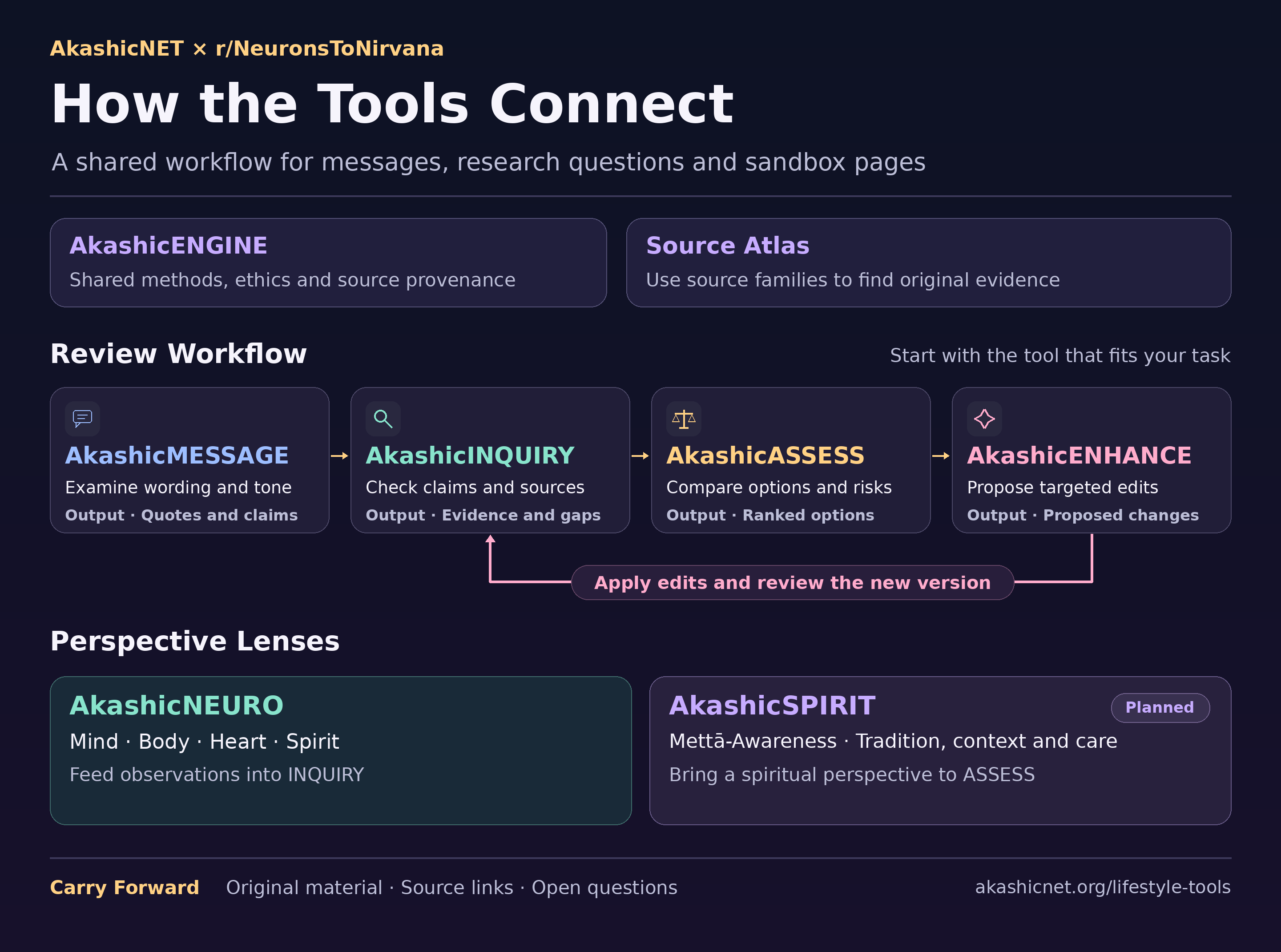
How the Tools Connect
Read a Paper
- Paper ReaderExport reading notes and source locations
- AkashicINQUIRYCheck what the evidence supports
- AkashicABSTRACTDraft the summary and claim table
- AkashicJOURNALSee an editorial preview
Review a Message
- AkashicMESSAGERecord wording, claims and context
- AkashicINQUIRYCheck claims and document gaps
- AkashicASSESSCompare response options
Resolve a Dispute or Revise a Draft
- AkashicASSESSReview disputed claims or options
- AkashicENHANCERecord changes and rerun affected checks
- AkashicINQUIRYReturn to the evidence and update the record
Check In and Read About a Topic
- Mind & BodyWrite a private note and choose a Daily MEDS reflection
- AkashicDIAGNOSISSee where the notes and public topic search go
- Source GroupsOpen provenance, public reading and official care links
For a paper or draft with an unresolved claim, follow the revision route, then update the abstract and claim table if the evidence record changes.
Optional perspectives when reviewing a case include AkashicNEURO for reported experience and AkashicSPIRIT for reflection. AkashicSPIRIT is in development.
View the Original Toolbox Infographic
Tool Catalogue
Explore practical tools, reflection frameworks and working concepts from r/NeuronsToNirvana and AkashicNET. Each entry shows what you can do with it today.
Communication and Relationships
- AkashicMESSAGE · v0.3.0 Public Beta. Review claims, evidence, tone and stakes. Quick prompt or full visual review.
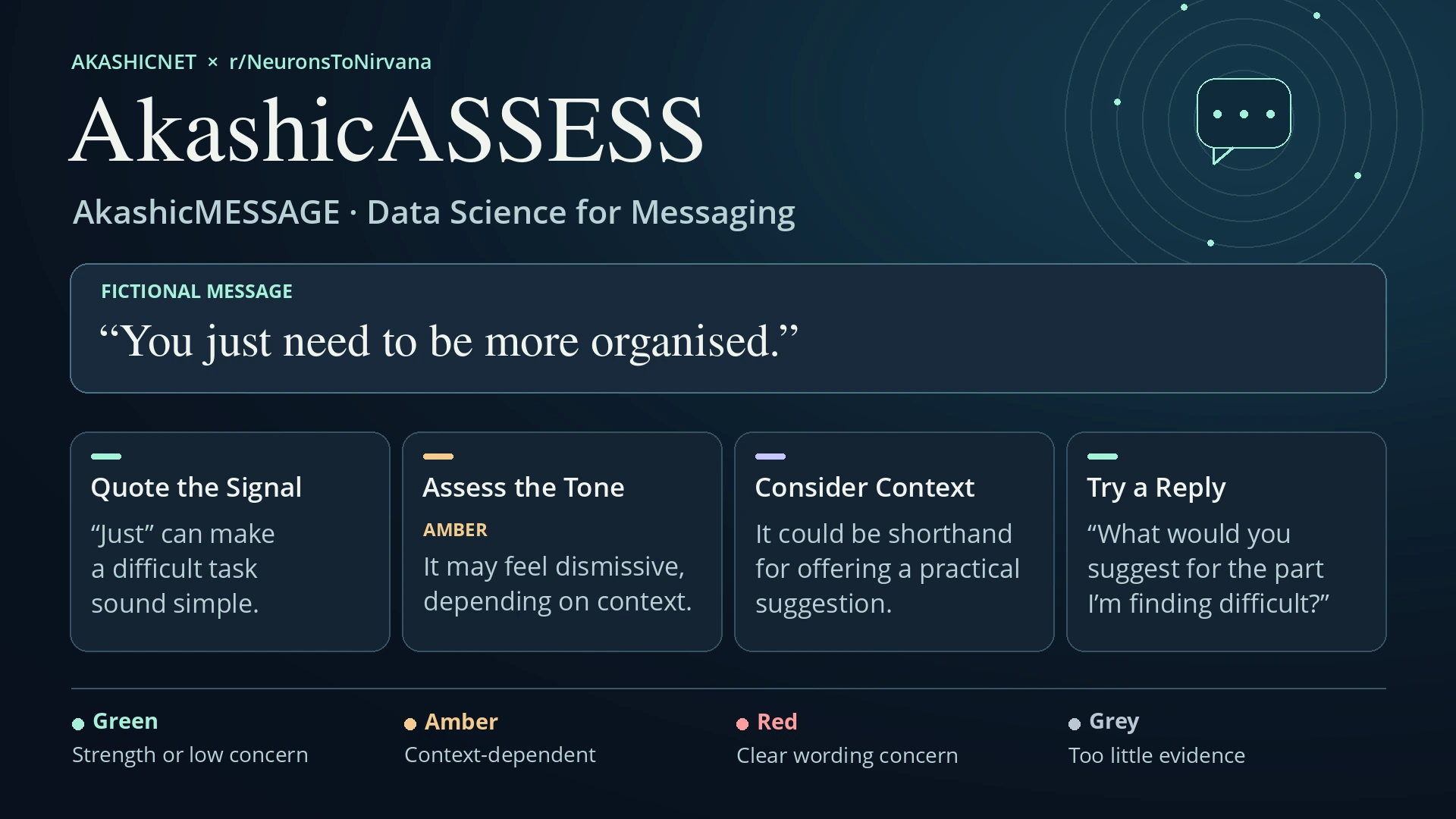
- AkashicASSESS · v0.2.0 Public Beta. Choose a response or moderation option. Compare reply options or read an example.
- Constructive Debate · N2N working framework for intellectual humility, voiced needs and how people disagree.
- The Unhurried Reply · Listening practice organised around receiving, reflecting, asking, responding and repairing.
- RELATE · Proposed AkashicOMNI branch on listening, consent, boundaries and reciprocity.
- Mettā-Awareness · Reflection practice for combining attention, discernment and goodwill.
 AkashicMESSAGE
 AkashicASSESS
Everyday Reflection and Habits
- Thinking Space · Interactive worksheet for turning competing thoughts into one manageable next step.
- 19-Lens Living Spectrum · Interactive reflection map for considering a question through different capacities and perspectives.
- Wisdom Matrix · A grid for combining different lenses and life domains to explore a question.
- Wisdom Compass · Interactive prompts on awareness, discernment, humility, compassion, integration and action.
- AkashicDIAGNOSIS · v0.1.0. Use the 47th Doctor’s private Daily MEDS check-in, see the animated data flow or browse the source groups.
- Daily MEDS · N2N habit framework for Mindfulness, Exercise, Diet and Sleep.
- AkashicNEURO · 3D Doings Mind–Body–Heart–Spirit Matrix · A four-domain check-in with Daily MEDS and research notes on flow, awe and chills. Original N2N post ↗
- Interchangeable Pyramids · A reflection tool for asking whether safety, relationships, learning, vitality, awareness or purpose needs attention now.
- Embody the Dharma · Contemplative companion on bringing the Noble Eightfold Path into everyday speech and action.
AkashicNEURO · Scope for Case Reviews
Record observable wording and first-person experience with the speaker’s attribution. A message can show that someone reported a bodily response. An individual profile or biological explanation needs an appropriate evidence base and permission for that use.
Read or Copy the AkashicNEURO Scope Prompt Manually
AkashicSPIRIT · Mettā-Awareness Edition
Under development · practice draft v0.3.0. AkashicSPIRIT starts from a spiritual and esoteric point of view. Bring a dream, synchronicity, ritual, contemplative experience or recurring symbol. Ask what it may mean and how you might live that meaning with care.
Choose a symbolic reading for personal imagery and associations, a tradition-based reading for a named teaching or a metaphysical inquiry for an idea such as an Akashic record. Name whose interpretation you are using and distinguish spiritual testimony from any claim about what caused the experience. For shamanic or Indigenous material, identify the specific community and respect its access and reuse protocols.
Start with your associations. What does this image or experience evoke for you? Which question do you want the reading to explore? Name a preferred tradition when you have one. A reading may remain uncertain when a symbol has little context or several meanings.
Quick Reflection. Return the image in the reader’s words, a chosen lens, two possible meanings and one small act of care. Full Toolbox. Add the source trail, the six-step review below and a revision record. Both modes invite the reader to keep, revise or decline the interpretation.
Proposed criteria Compassion and goodwill · Humility and discernment · Cultural context and consent · Embodied practice · Integration into everyday care. Prompts would invite readers to ask who is affected, what a teaching means in its own setting and what practical act of care could follow.
Starting points from AkashicNET × r/NeuronsToNirvana include Mettā-Awareness, the Wisdom Compass, Unity of Wisdom and Embody the Dharma.
The draft asks what the person experienced, what the named tradition invites them to consider and what they can say truthfully, beneficially and at an appropriate time. Keep spiritual meaning and causal claims distinct. A practical outcome can be to pause.
Planned Practice · From Presence to Care. AkashicINQUIRY007 (17 November 2026) draws on Thích Nhất Hạnh’s teaching on loving-kindness, compassion, joy and equanimity in the Plum Village tradition of Vietnamese Zen Buddhism. Ask what kind of presence would be welcome. Offer one specific act of care that the other person can freely decline, then notice what happened. Keep the spiritual meaning separate from any observation about behaviour.
Planned Practice · Interdependence and Goodwill. AkashicINQUIRY008 (17 November 2026) reads Indra’s Net as an image of interdependence in Huayan Buddhism. Use it to ask who helps sustain a situation and how you could respond with care. The page’s Pachamama imagery, personal reflections and discussion of a measured atmospheric resonance each have their own context.
Worked Example · At the Threshold. AkashicINQUIRY012 · Addendum v1.0.0 (18 November 2026) reads its doorway and notebook through goodwill, equanimity and remembrance. It offers a freely declined act of care and records the full Toolbox review across 19 lenses.
Planned Practice · Goodwill Across Perspectives. The Mettā-Awareness reading in AkashicINQUIRY009 (17 November 2026) applies Buddhist goodwill to a contemporary science-fiction discussion. Ask whose perspective is missing and invite a different reading. This is an editorial reflection. The inquiry’s proposed tests of immersion and learning are still open.
Run the Esoteric Reading Through the Toolbox
Example. A recurring doorway in a dream could suggest a transition. Ask what the doorway evokes for you and whether it points towards entering, waiting or setting a boundary. A next step might be to ask someone if they have time to talk, then respect their answer.
Planned Practice · From Seeking to Care. AkashicINQUIRY014 (18 November 2026, companion v1.1.0) reads Daniel Schmidt’s recollection of unity and spiritual striving through non-dual self-enquiry. The account includes a Vipassana retreat. Ask what you hope to recover, what you notice now and whether an ordinary act of care is welcome today. Let ongoing practice and rest have room. This is an optional interpretation of one autobiographical account. Any lasting change in conduct remains an open question.
Reflection Prompt · Meaning in Context. The 19 November AKN24 edition introduced Guillery Sollier, Duclos and Merlet’s conceptual framework, accepted 18 November 2026. It discusses Buddhist and yogic practices in Western clinical settings. For this spiritual reflection, ask whose teaching you are using, how you would describe the experience, what it means to you and how the practice affects daily life. Give any distress or need for support its own description. This adapts questions from the accessible abstract into a reflection prompt. The authors’ framework awaits validation. Buddhist no-self, Zen kenshō and Advaita accounts of Self retain their particular contexts.
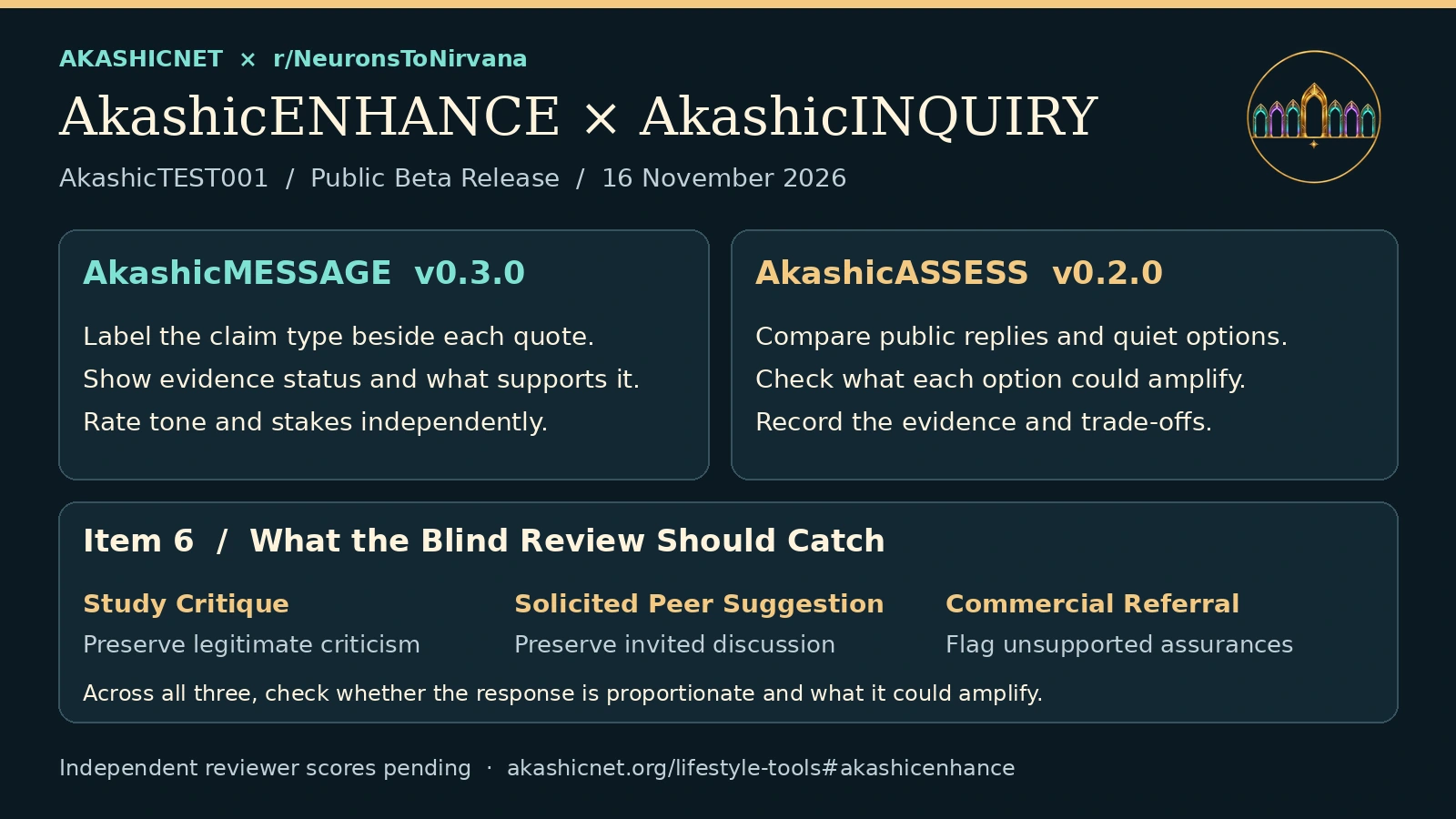
AkashicENHANCE Review · v0.2.0 → v0.3.0 · 19 November 2026
This editorial revision keeps the spiritual and esoteric orientation and adds a shorter route into the practice. The copyable prompt asks for the reader’s associations, states the chosen lens and records what could change the reading.
- Reader’s words. Begin with the supplied account and the person’s own associations before adding symbolic meanings.
- Attribution. Mark each material interpretation as personal symbolism, attributed teaching, spiritual testimony or metaphysical hypothesis. Give a source locator or mark the attribution unresolved.
- Choice. Offer a contrasting reading and let the person revise or decline both. Use spiritual language as an invitation to explore.
- Revisit. Choose a date to ask whether the reading remained meaningful and whether the proposed act of care was welcome. Record any feedback and what you would change.
Worked rerun. Earlier wording offered “a doorway suggests transition”. The revised reading first asks what the doorway evokes for this reader. A threshold could invite a new beginning or a welcome boundary. The reader chooses whether either fits. An action might be to ask if a conversation is welcome. A later check records the answer and any changed interpretation.
Manual prompt review. Checks covered an ambiguous symbol, an unsourced teaching and an account about another person. The revision specifies how to retain ambiguity, flag unresolved attribution and respect permission. These are editorial checks. Reader reception and independent evaluation are pending.
Planned Practice · Stillness, Enquiry and Care · Integrated 20 November 2026. SAMĀDHI000 was published on 19 November 2026. Choose one passage or film scene and name its source and lens. Ask what became noticeable, what spiritual meaning it holds for you and what freely offered act of care might follow. Keep Patañjali’s account of samādhi, early Buddhist right concentration and David Lynch’s Transcendental Meditation interpretation in their own contexts. The Awaken The World film is a contemporary contemplative interpretation. Similar language does not establish that these traditions make identical claims.
Planned Practice · Connection Into Care. The IONS reflection added 19 November 2026 invites a spiritual reading of felt interconnectedness through Buddhist mettā, understood here as goodwill. Offer a second possible reading grounded in the person’s own associations. Choose one welcome act of listening, patience or practical help and revisit whether it was helpful. This adapts published spiritual testimony into an optional reflection; it does not validate an experience’s cause or claim that samādhi guarantees compassionate behaviour. The source’s speaker identity and exact transcript remain unresolved. Record observations and later actions separately in AkashicNEURO.
Status. These are additions to the planned practice entry, not a software release or evidence of effectiveness. AkashicSPIRIT remains under development, practice draft v0.3.0. SAMĀDHI001 and HIERATIC021 retain their own planned or preview status. Existing Restricted and HOLD designations remain in force.
Planned Practice Additions · 21 November 2026
Indra’s Net · Distinct Voices, Shared Origins. AkashicINQUIRY018 (editorial review 20 November 2026) uses the Huayan Buddhist image as a contemporary reading exercise. Choose two passages, name their speakers and traditions, then ask where their meanings differ. Sikh divine-light language, Schrödinger’s philosophical account of mind, Planck’s philosophical priority claim and Ramanujan’s reported religious meaning are not interchangeable evidence for one consciousness. Trace whether two links share an original source. Keep the numbers 7, 13, 19 and 1729 as this edition’s mnemonics, not evidential weights. Its reader test remains proposed.
Wonder and Proof. The AkashicSPIRIT reading in AkashicINQUIRY017 (20 November 2026) treats wonder as motivation and humility as a guide to attribution. Ask what a mathematical idea means to you, then keep that answer apart from what was formally checked. Ramanujan’s devotional context belongs to the attributed account; it does not validate a present proof claim. This is a reflective application. AkashicNEURO was not applicable to the case because the reviewed material contained no neural or physiological measurements.
Shamanic Reflection · Notice, Question, Put Into Practice. The 33-question checklist incorporates nine additional questions in the accepted web change of 21 November 2026; the original N2N checklist is dated 4 July 2025. Use one memory: distinguish details recorded at the time from later recollections, consider another interpretation, ask who welcomes what you hope to offer and seek feedback on one small act of care. This is the curator’s contemporary spiritual self-reflection, not a universal Indigenous initiation map, a credential or a rank. Name a specific community and its permissions before invoking its teachings.
Meaning Near Death. AkashicINQUIRY020 (21 November 2026) presents personal accounts of meaning alongside a separate question about clinical timing. A reader may use Buddhist mettā or their own named tradition to explore what care means after such an account, without attributing that tradition to its speaker. Respect another person’s consent. Record the act of care separately from any conclusion about survival after death; the latter remains unresolved.
These are additions to the planned practice entry. AkashicSPIRIT remains under development, practice draft v0.3.0. Earlier additions are retained; Restricted and HOLD work keeps its authorised scope.
Read or Copy the AkashicSPIRIT Reflection Prompt Manually
Inquiry and Research
- AkashicINQUIRY · Mettā EXPAND² v0.2.0 Public Beta. Check a claim, review the evidence or audit the inquiry itself.
- AkashicABSTRACT · v0.1.0. Draft or audit a research abstract with a claim-to-source table.
- EXPAND² v0.1 · Two passes, Discern and Deepen, followed by a synthesis. AkashicMESSAGE uses this name for its detailed visual review.
- AkashicOMNI v0.5.0 · Twelve perspectives and a synthesis for examining a question, comparing interpretations and deciding what to do next.
- PRISM Inquiry Module · Draft transfer format for moving a research record from Thinking Space into another review.
- AkashicTRACE · Published research companion with source-linked appraisals and testable claims about consciousness and perception.
- N2N Noetic Operating System · Practice for turning a reported experience into a question, considering explanations and choosing a test or next step.
- From “Psi” to Precision · N2N lifestyle tools overview, indexed in the community archive.
- Synchronicity Reflection · Prompts for exploring a meaningful coincidence, recording what happened and considering other explanations.
- Consciousness Evidence Trail · Worked examples for examining the distance between an observation and a claim.
 AkashicABSTRACT
Explore more in the N2N framework map and subreddit searches for how-to posts and checklists.
Commands and Results
Choose a command, open its copyable prompt and add the material you want reviewed. Each option applies a different part of the methodology.
AkashicMESSAGE
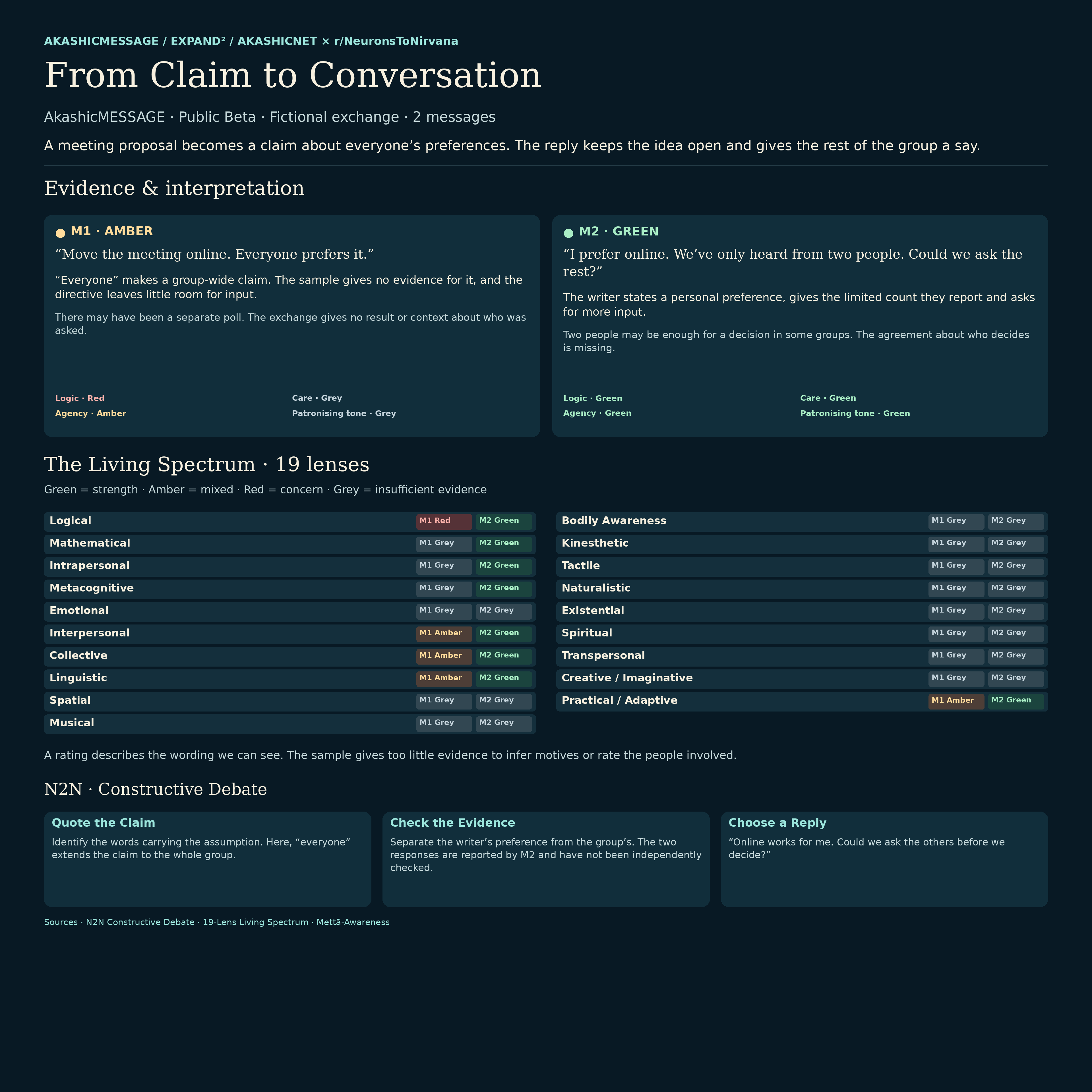
- Run AkashicMESSAGE. Uses short quotes, claim and evidence labels, separate tone and stakes ratings and, where useful, a constructive reply.
- Include the 19 Living Spectrum Lenses. Adds a lens-by-lens view to the quick review, with Grey where the wording gives too little evidence.
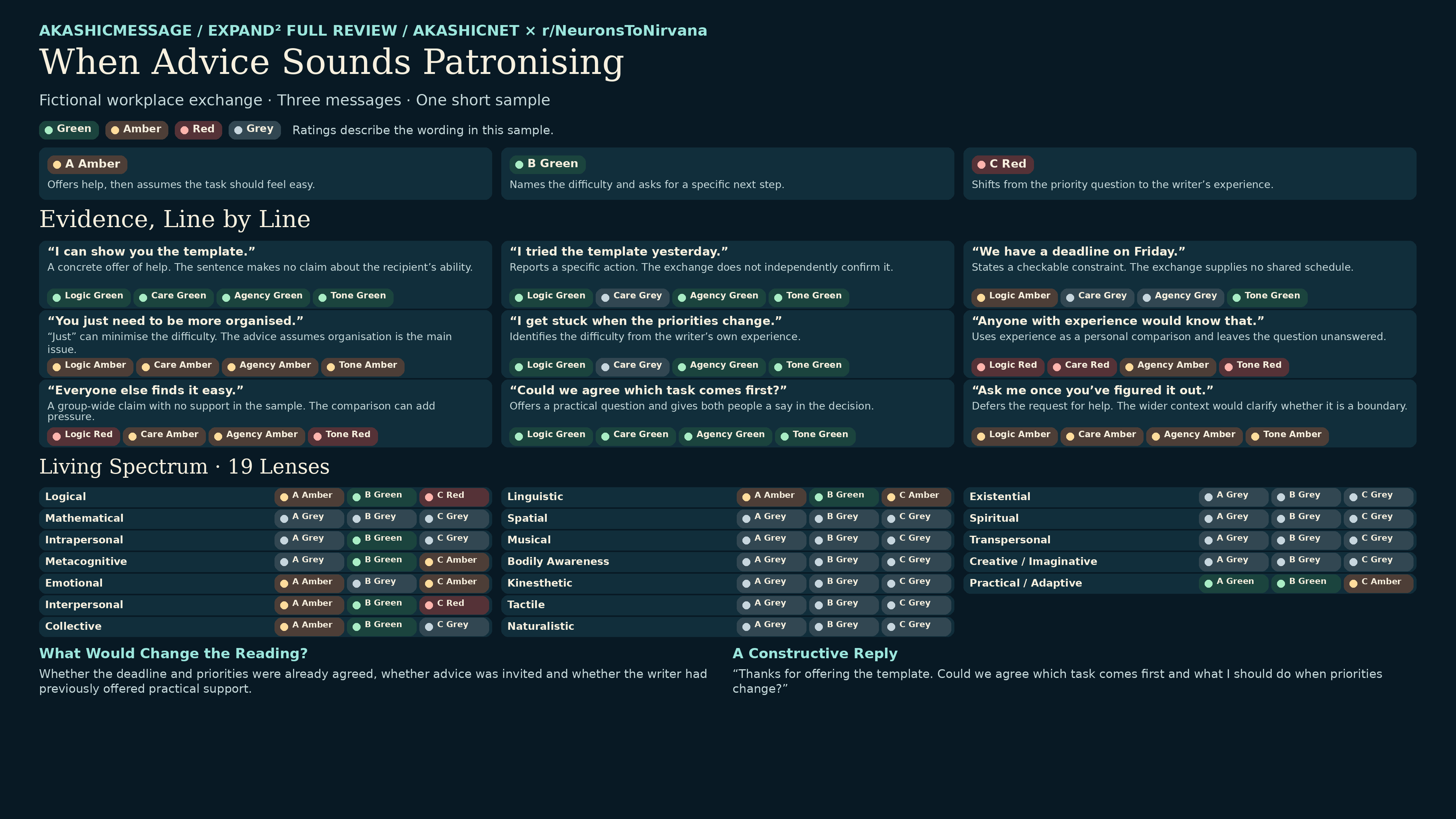
- Run a Full AkashicMESSAGE Review. Uses line-by-line evidence and all 19 Living Spectrum lenses to return a written assessment and, where supported, a widescreen EXPAND² visual.
- Include a Separate Hawkins Themes Panel. Adds an optional spiritual reading of relevant wording to the full review.
AkashicASSESS
- Use AkashicASSESS to Compare Reply Options. Compares public replies, no reply and quiet moderation where available. Explains likely amplification, the evidence for each option and when a public draft would help.
AkashicINQUIRY
- Run an AkashicINQUIRY Claim Check. Uses the five Mettā EXPAND² fields to return a concise answer, its basis and what would change it.
- Run a Full AkashicINQUIRY Evidence Review. Uses Discern, Deepen and synthesis to return a source table, competing explanations and a proposed test or check.
- Run an AkashicINQUIRY Self-Review. Checks the inquiry’s own reasoning and returns an audit, a revised answer and a record of proposed changes.
AkashicABSTRACT
Draft or Review an Abstract. Returns a concise summary, a claim-to-source table and unresolved checks.
Thinking Space
Turn a tangle of thoughts into one manageable next step.
Write a few words below to get started, then follow the prompts.
Opening your thinking space…
What is this for?
Use this when you have competing ideas, a decision to make or a question you want to explore. Write what is on your mind, choose a question, consider what you know and pick one small action. Skip any prompt that does not help.
Example: “Too many hackathon ideas” → “Which could I demonstrate?” → “Sketch one screen on paper.”
This is a guided worksheet. It does not generate answers or analyse what you write.
Optional research tools let you record sources, consider other explanations and share a fuller record. AkashicOMNI v0.5.0 is the method: 12 perspectives + synthesis. Thinking Space is the tool. Everyday sessions can use a narrower scope.
This is an independent first draft for the TSC2026 mini-hackathon. It includes adjustable text, optional detail and no time limit. Co-design and effectiveness evaluation with neurodivergent users have not yet been completed.
 AkashicENHANCE × AkashicINQUIRY