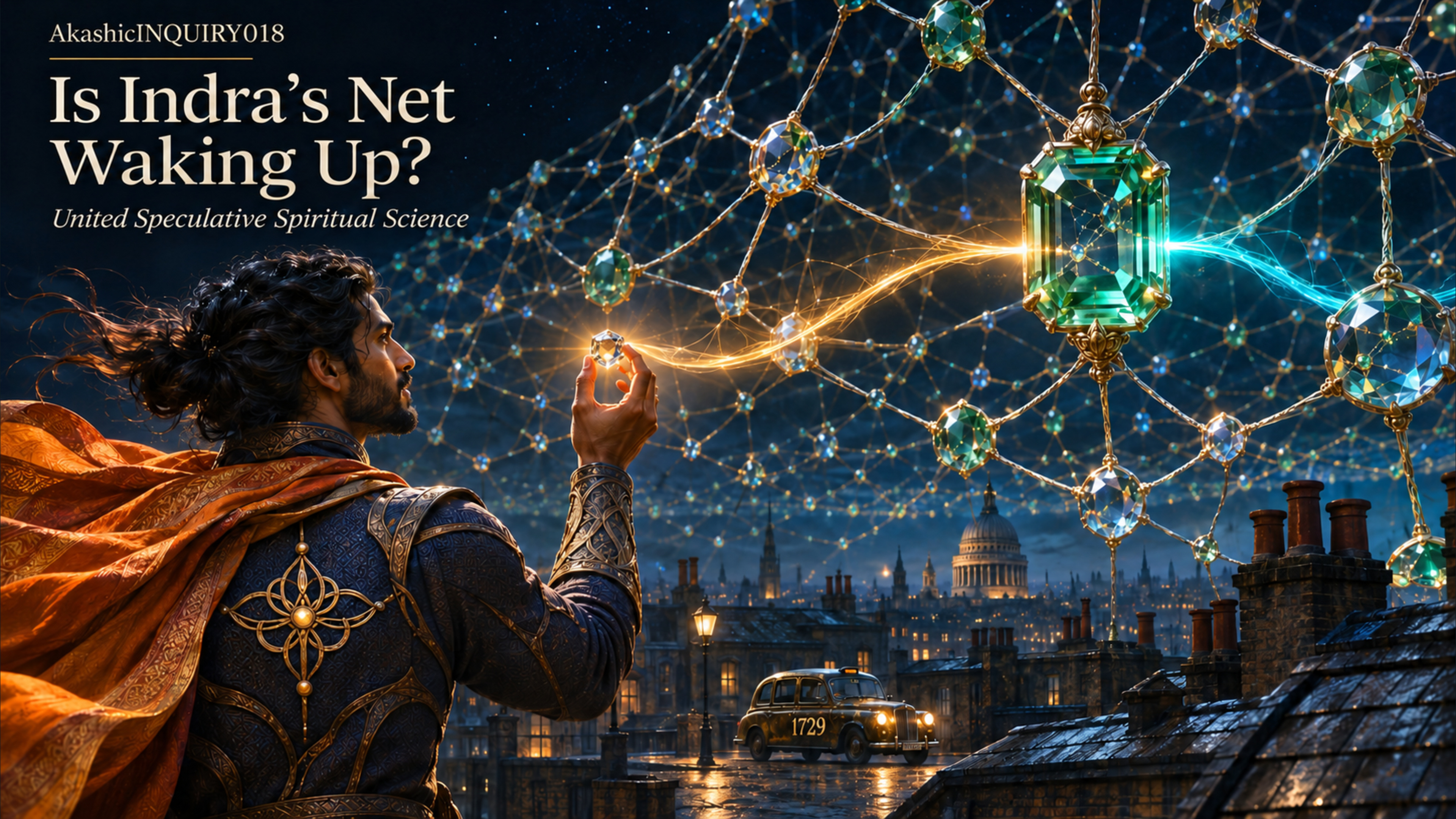
In the Huayan Buddhist image, each jewel reflects the others. Read these inquiries as jewels for a moment. When one lights up, which detail do you notice in its neighbour that you would otherwise have missed?
Our tagline is a contemporary AkashicNET reading of this image. Each jewel reflects its neighbours from a different position. Likewise, two people can attend to different details in the same scene and help each other see more. Here “infinite” expresses room for difference. “Waking up” is our speculative reading. An observable change is smaller and more interesting to test: a reader spots that two apparent witnesses share a source, or revises a question after following a connection.
Imagine two branches of a family tree meeting at one grandparent. Now imagine two headlines about a mathematical proof. One links to a press report, the other to a commentary. Both lead to the same proof archive. Reading 016 beside 017 changes a question you can ask of either: how many paths have I followed, and how many origins have I found?
Current answer. The cross-reading produces a specific editorial correction: a second route can reveal a dependency we missed. Whether readers make more accurate judgements with these pairings is unknown. Whether the universe itself is becoming aware is a philosophical question that this exercise leaves open.
Proposed reader test. Randomly assign readers to the same short cases with either a paired inquiry and its cross-question or an equal-length explanation without the pairing. Before and after reading, ask each person to classify the sources as independent, shared or uncertain, give a reason and rate their confidence. Include genuinely independent sources so that calling everything dependent cannot earn a high score. Set the answer key, primary comparison and decision threshold before collecting responses.
More correct classifications on unseen cases would support the reading method. Greater confidence with unchanged accuracy would count against the claim that it improves judgement. Even a positive result would concern the readers and task studied. The proposed comparison has no participant results.
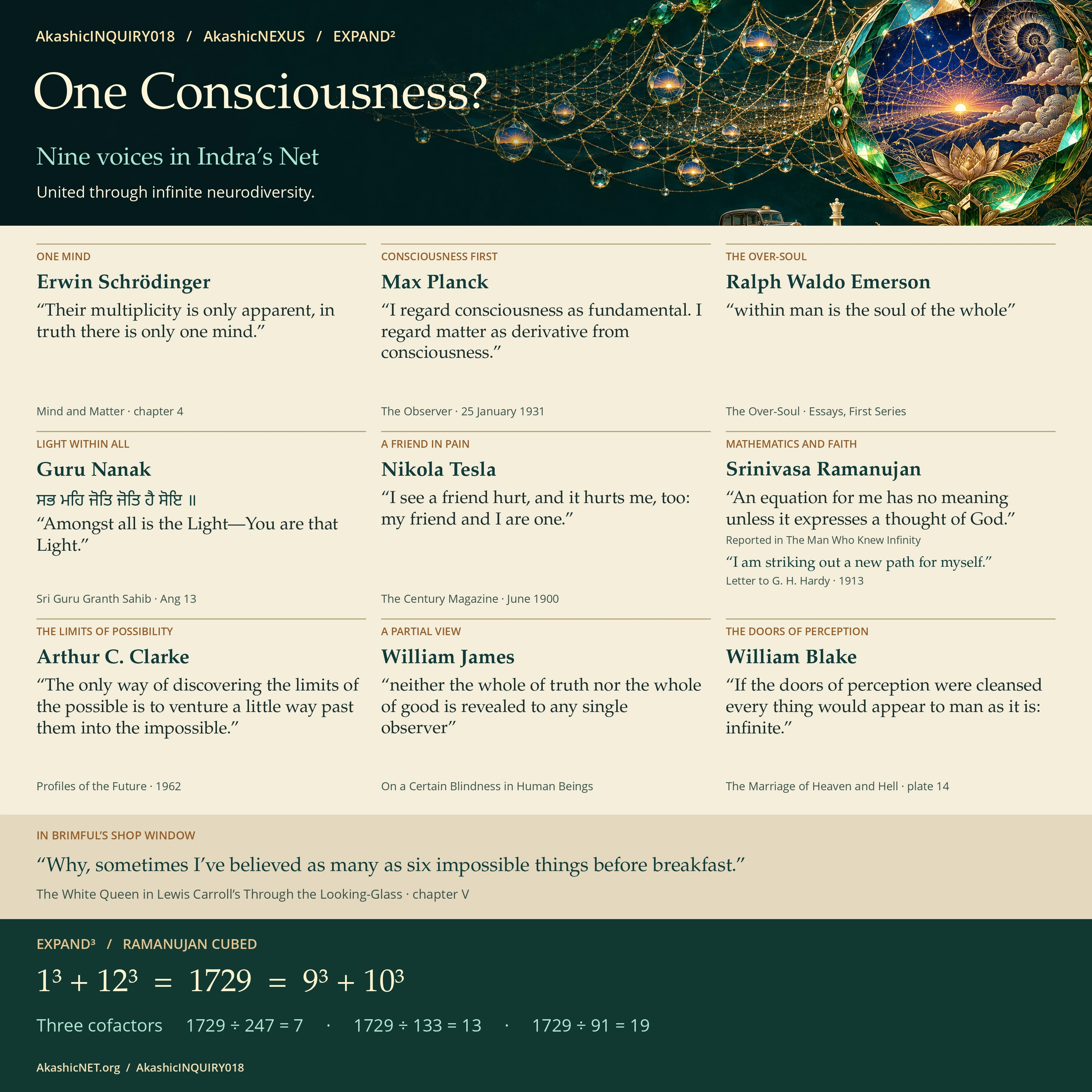
When two people see the same jewel from opposite sides, what do they share? Schrödinger gives one answer about mind. Planck asks which comes first, consciousness or matter. The poets, mathematician and spiritual teacher bring other questions to the net.
Open the full-size quotation poster · EXPAND² pairs two readings. In this EXPAND³ edition, a third question follows: how far does the comparison hold?
Erwin Schrödinger
“Their multiplicity is only apparent, in truth there is only one mind.”
Robert Kanigel reports this remark to a friend in his biography. It concerns what mathematics meant to Ramanujan. His surviving letter to Hardy offers a first-hand comparison.
Try reading Tesla beside Schrödinger. Could you feel a friend’s pain and still believe the two of you have distinct minds? Return to the two quotations and see which one your answer addresses.
Clarke, James and Blake appear in the opening and cover caption. The tenth voice is the White Queen speaking to Alice in Brimful’s shop window.
One Taxi, Two Ways Home
1³ + 12³ = 1,729 = 9³ + 10³
The smallest number expressible as two positive cubes in two distinct unordered ways also factors as 7 × 13 × 19. The earlier Ramanujan Cubed square recovered 7 from 13 × 19. Taking the other pairs in turn gives three exact cofactors.
7 = 1,729 ÷ 247. Who or what is the original source?
13 = 1,729 ÷ 133. What else could produce the same observation?
19 = 1,729 ÷ 91. Which check could change the answer?
These questions are this edition’s mnemonics. The numbers carry no evidential weight. For example, two paths through a family tree can end at one grandparent. Two links to a proof can likewise end at one archive. In both cases counting paths answers a different question from counting independent origins.
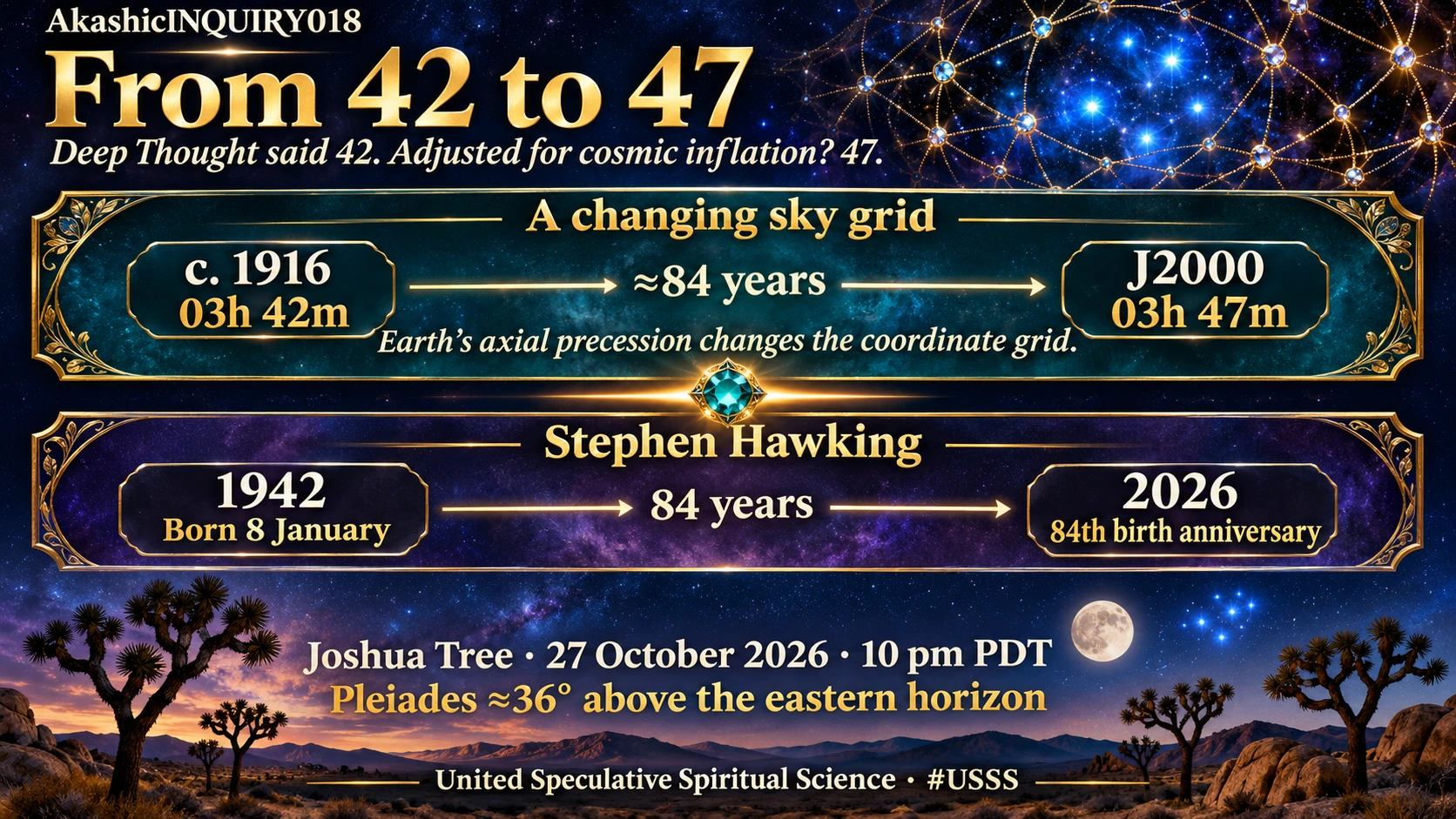
Deep Thought said 42. Adjusted for cosmic inflation? 47. The first number comes from Douglas Adams’s fiction. The punchline is AkashicNET’s. What prompted a second look was finding 47 in a place a reader can check: the catalogue entry for the Pleiades, or Messier 45. BBC · Deep Thought gives its answer · SEDS · Messier catalogue by right ascension.
One direction, three sky grids. Right ascension works like longitude on the sky, expressed in hours, minutes and seconds. The adopted cluster centre has right ascension 03h 47m and declination +24° 07′ on the J2000 grid. J2000.0 is a reference instant, noon Terrestrial Time on 1 January 2000. As Earth’s rotation axis slowly changes direction, the equator and zero point used to label the sky change too. US Naval Observatory · J2000.0.
Circa 1916 · 03h 42m on the mean grid of that year, calculated backwards.
1 January 2000 · 03h 47m on the reference grid, using the rounded catalogue centre.
27 October 2026 · About 03h 48m 36s on the mean grid of that date. A chart set to J2000 still shows 03h 47m.
The Joshua Tree sky, 27 October 2026. At about 10 pm Pacific daylight time, the cluster stood roughly 36° above the eastern horizon, calculated for the Joshua Tree area. NASA singled out 27–28 October for the bright waning Moon’s close passage by the Seven Sisters. The sky report corroborates the conjunction; a claim about a lunar halo would need its own observation. NASA/JPL · October 2026 skywatching guide.
How the 84-year estimate was calculated
We held the catalogue direction fixed, applied the IAU 1976 precession rotation from J2000 to the mean equator and equinox of each date and solved for right ascension 03h 42m. The crossing falls near Julian year 1915.92, about 84 years before J2000. The calculation omits stellar proper motion and short-period nutation. Choosing a different point in this extended cluster changes the crossing date. The digits describe a choice of coordinates; they cannot date a physical journey or measure cosmic expansion. NASA · GEONS precession equations.
The Hawking echo. Stephen Hawking was born on 8 January 1942. His 84th birth anniversary fell on 8 January 2026, and his doctoral thesis was titled Properties of Expanding Universes. That 84-year interval runs from 1942 to 2026. The sky-grid calculation runs from about 1916 to 2000. Their shared number is the synchronicity. Precession explains the changing sky address; cosmic inflation supplies the wordplay. Stephen Hawking Estate · Biography · NASA · Cosmic inflation.
AkashicENHANCE EXPAND²
Start with INQUIRY to widen the question. Use TRACE to follow the two routes back to their origins. Pass that finding to ENHANCE and revise one sentence or one proposed test. Use TEST when an actual comparison can be run.
Reusable Component Prompt
Choose one numbered inquiry and quote a scoped claim with its source and date. Discern: find a second route to the claim or a rival explanation. TRACE: name the earliest identifiable source for each route and any shared witness, dataset, text or model. Mark independence as established, shared or unknown, with a reason. Deepen: specify an observation that could separate the readings and the result that would weaken the preferred one. ENHANCE: write the original wording and the revised wording, name the check actually performed and preserve the outstanding uncertainty. If the connection is spiritual or poetic, attribute it and mark it #USSS where appropriate. Return the two routes, dependency finding, revision and next check.
Read the Inquiries in Pairs
Editorial review dated 20 November 2026. The catalogue includes method record 000 and entries 001–017, including the planned 011 and draft 013. Each entry gives the starting claim, an alternative reading and a concrete next check. The evidence and release status belong to the linked editions.
INQUIRY000 · Method
The Research Method
A report, a press release and a paper can look like three witnesses.
Widen
Trace each claim to its original work. Two reviewers can check an extraction independently even when both read the same study.
Deepen
Record the number of independent works alongside the number of links. Carry unresolved disagreements into the synthesis.
A change in fringe visibility admits several explanations, including optical drift and choices made during analysis.
Widen
Use 006 to specify exactly what changed in the apparatus. Treat the fringe model and the attention experiments as different kinds of record.
Deepen
Compare masked attention and control intervals using a fixed outcome and a drift monitor. A similar shift in both weakens an attention-specific reading.
The surfer reaches the same crossing again. Has the same event occurred twice?
Widen
Label crossings by both position and lap number. The position repeats while the ordered pair changes. Indra’s Net adds a second reading about relations.
Deepen
Show three crossings and the rule for the next one. An indefinitely extendible rule makes a different claim from a recording of infinitely many laps.
An impression can feel newly received even when its detail was encountered earlier.
Widen
Study A varies prior exposure. Study B scores locked choices against independently selected concealed targets. A four-way choice gives a one-in-four baseline under equal assignment.
Deepen
Keep source judgements and target hits in different columns. Log first-report time, target generation, feedback and misses.
Changed firing in tracked mouse neurons and changes in dendritic spines are two possible descriptions of plasticity.
Widen
Record the animal, neuron, time point and endpoint for each study. Repeated observations of one neuron belong together.
Deepen
Align the time points, then ask whether both measures came from the same cells. Without that link the proposed firing–structure relationship stays open.
Previously, the guides already asked for alternatives, provenance and a before-and-after record. This combination adds one shared question at the handoff: do the two routes depend on the same source? The answer now travels with the wording revision.
Worked edit for 016. “Different branches confirm different ancestors” becomes “Different branches may reach the same ancestor. Count distinct people separately from positions in the tree.” For 017, the parallel edit is “The archive and challenge checks passed. The edition still awaited a complete solution check.”
How to test the upgrade. Give masked reviewers matched excerpts with two independent sources, two retellings of one source or unclear provenance. Compare the existing prompt with the new combination. Score correct dependency judgements, missed links and false claims of independence. This edition records an editorial application. Reader benefit and independent performance are open questions.