N2N Signal & Synthesis · Research Note
Psilocybin Across Time
What changed when researchers found the same mouse neurons again a day later?
Preprint posted · N2N synthesis
Original study: DeWeese et al., Tracking single neurons across days reveals acute and persistent effects of psilocybin in the mouse brain. bioRxiv; not peer reviewed.
Could Next-Day Brain Activity Relate to Integration?
Community question ·
A reader on r/NeuronsToNirvana asked whether the changes in firing might relate to how people make sense of a psychedelic experience and put insights into practice.
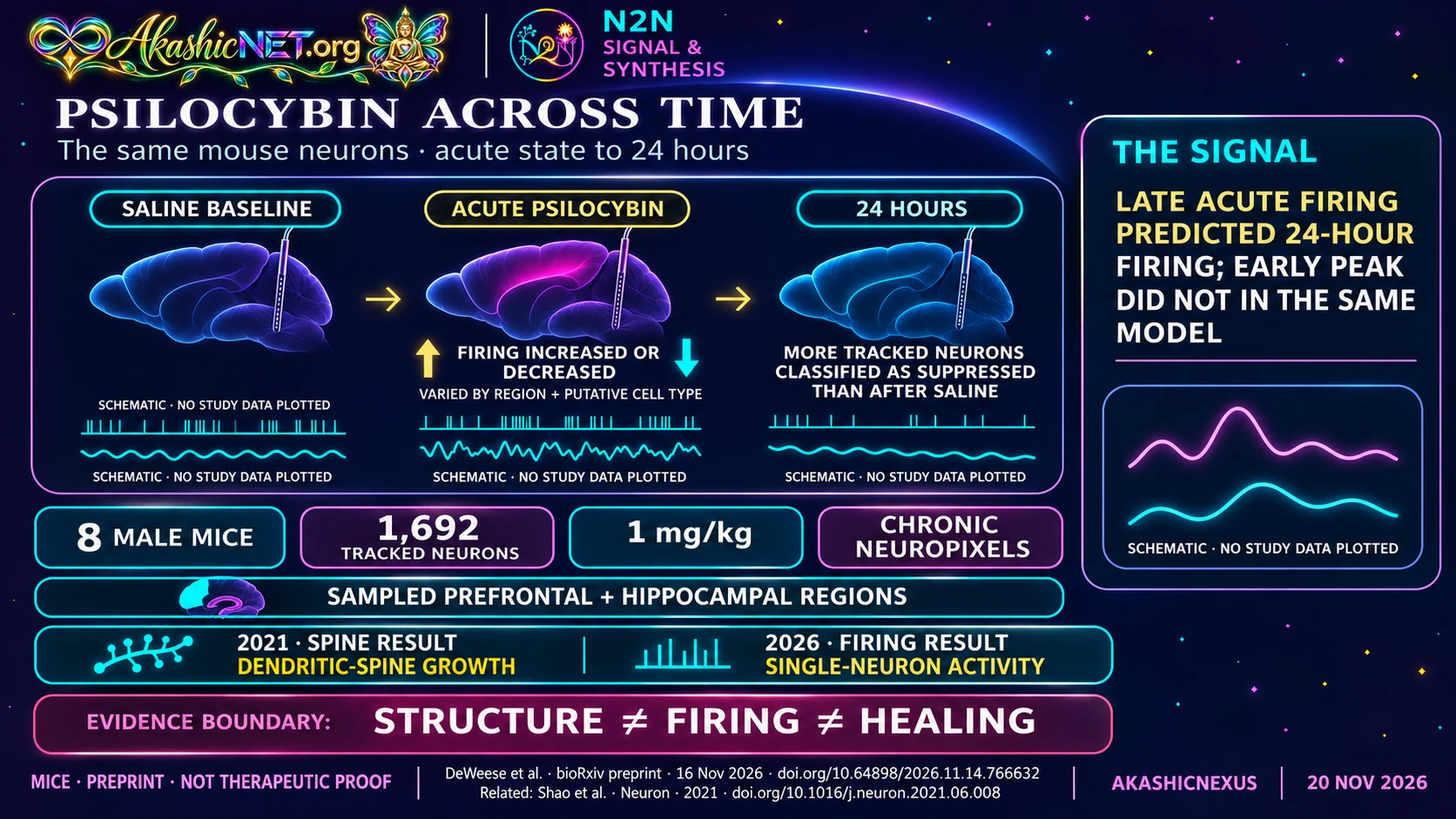
What the mouse study found: In the authors’ model, a neuron’s firing late in the acute response was associated with its firing 24 hours later. Firing at the early peak showed no clear association in that model. This does not establish that the late response was a better predictor than the early one.
🟣 Future hypothesis: The mouse study did not measure psychological integration. A human study could record brain activity before and after a session and ask participants to describe a specific insight and whether they acted on it over the following weeks. Do changes in activity track what people put into practice? Even an association would leave open whether one caused the other.
What the Two Studies Measured
The 2021 study measured dendritic-spine remodelling, excitatory synaptic currents and stress-related behaviour. The spine result most relevant here was a roughly 10% increase in size and density within 24 hours, with some remodelling persisting for a month. The new preprint tracks electrical firing from the same neurons across baseline, the acute drug period and 24 hours later.
The two studies therefore address connected but distinct levels of neural plasticity:
| Study | Direct Measurement | Main Timescale | What It Can Establish |
|---|---|---|---|
| Shao et al. 2021 | Dendritic-spine size, density and formation | 24 hours to one month | Structural remodelling in mouse frontal cortex |
| DeWeese et al. 2026 | Single-neuron firing using chronic Neuropixels probes | Acute period to 24 hours | Longitudinal changes in activity among tracked mouse neurons |
Neither study establishes a human antidepressant mechanism. More spines do not necessarily mean more firing and lower firing does not necessarily mean reduced plasticity. Structure, activity, behaviour and clinical benefit are related questions that require separate measurements.
AkashicNEXUS Bounded Run
1. AkashicMESSAGE · Scope
The material is a preclinical neuroscience preprint involving eight male mice. The synthesis must retain the animal model, small biological sample, fixed treatment order and lack of therapeutic behavioural measurement. The 1,692 tracked neurons are repeated observations nested within eight animals, not 1,692 independent biological subjects.
2. AkashicINQUIRY · Research Question
Question: Does psilocybin alter the firing of identifiable neurons after the acute drug period has ended?
Current answer: The preprint reports that it does within sampled prefrontal and hippocampal regions in this mouse preparation. Acute firing changes were bidirectional and varied by putative cell type and region. At 24 hours, a greater share of tracked neurons was classified as suppressed than after saline. In a model containing both early and late acute responses, only the late-response coefficient was statistically distinguishable from zero when predicting 24-hour firing.
What would change the answer: replication with larger independent cohorts, counterbalanced or parallel controls, both sexes, molecularly identified cell types and behavioural measurements.
3. AkashicTRACE · Provenance
- The posting date was checked against bioRxiv’s directory. The authors’ abstract was read in an indexed copy.
- The secondary methods summary reports eight adult male mice, 1 mg/kg psilocybin, three preceding saline-baseline days and 1,692 analysed units.
- The current synthesis does not claim a complete independent reanalysis of the raw data or full preprint.
- The 2021 comparison paper was checked through its peer-reviewed Neuron record and full PubMed Central manuscript.
- The related 2025 Nature study was checked through its journal and PubMed records. A publisher correction exists and is cited below; the accessible correction record did not state the corrected detail.
- A related 2026 chronic-stress mouse study remains a preprint and is labelled accordingly.
- No correction or withdrawal was found for the new preprint as of 20 November 2026.
4. AkashicAUDIT · Claim Boundaries
| Claim | Classification | Status |
|---|---|---|
| Psilocybin produced both increased and decreased acute firing among tracked neurons | Direct study result | Supported within the reported design |
| At 24 hours, a greater share of tracked neurons was classified as suppressed than after saline | Direct study result | Supported within the reported design |
| In a joint model, the late-response coefficient predicted 24-hour firing while the early-response coefficient was not distinguishable from zero | Modelled association | Supported, pending peer review and replication |
| The same neurons were followed across sessions | Methodological strength | Supported by the longitudinal recording and matching procedure |
| The 24-hour effect represents a therapeutic reset | Causal or clinical interpretation | Not established |
| Suppression caused antidepressant benefit | Causal or clinical interpretation | Not tested |
| The result applies to human brains | Generalisation | Not established |
5. AkashicASSESS · Editorial Decision
Decision: Suitable for a new N2N Signal & Synthesis post if it is presented as an update to the earlier mouse-plasticity coverage, not as a first discovery that psilocybin has lasting neural effects.
The strongest editorial contribution is the distinction between structural plasticity and activity dynamics. The headline should use “mouse neurons”, “24 hours” and “preprint”. It should avoid “healing”, “rewiring the human brain”, “reset” and claims of an antidepressant mechanism.
6. AkashicSPIRIT · Meaning Boundary
The difference between acute and later activity patterns may prompt questions about integration or reorganisation. That connection belongs in explicitly labelled N2N synthesis. The observed suppression classifications do not establish a globally quieter brain, identify a biological mechanism for psychological integration or validate spiritual or metaphysical claims.
7. AkashicENHANCE · N2N Synthesis
The signal is not simply that psilocybin “activates the brain”. Individual neurons moved in different directions during the acute period. A day later, a larger share of tracked neurons was classified as suppressed than after saline. This suggests that the acute peak and the after-state are dynamically distinct within the recorded regions.
Read alongside the 2021 dendritic-spine study, the more interesting question is how structural growth and later firing patterns interact. New or enlarged synaptic connections need not produce a uniform rise in firing. They could support redistributed, more selective or homeostatically regulated activity. The present preprint cannot distinguish those possibilities.
8. AkashicTEST · Discriminating Follow-Up
A stronger experiment would preregister parallel saline and psilocybin groups in male and female mice, tag neuronal cell types molecularly, retain longitudinal Neuropixels recording and add behavioural measurements. A 5-HT2A antagonist condition could test receptor dependence. Combining spine imaging and firing measurements in the same animals would directly test whether structural growth predicts activation, suppression or redistribution.
9. AkashicSTATE · Current Position
State: Provisional research signal.
Strength: Direct longitudinal single-neuron measurement with within-animal comparison.
Constraint: Preprint, eight male mice, fixed order, nested observations, indirect cell typing and no therapeutic behaviour.
Public-synthesis status: Suitable with the stated boundaries. Independent evidence and performance review remain pending.
10. AkashicLEDGER · Record
- 2021: The earlier r/microdosing post discussed structural dendritic-spine growth after psilocybin in mice.
- 2025: A peer-reviewed Nature study linked lasting psilocybin effects in mice to pyramidal-tract neurons and 5-HT2A receptors; a publisher correction followed.
- 2026: A separate chronic-stress mouse preprint reported structural plasticity and enhanced fear extinction after psilocybin.
- 16 November 2026: DeWeese et al. preprint posted.
- 20 November 2026: AkashicNEXUS bounded synthesis prepared. No canonical truth status or human causal claim created.
11. AkashicABSTRACT · Public-Safe Summary
A new preprint followed 1,692 neurons in eight male mice before, during and 24 hours after psilocybin. Acute firing changes varied across sampled prefrontal and hippocampal regions and putative cell types. At 24 hours, a greater share of tracked neurons was classified as suppressed than after saline. The result extends earlier mouse work on structural plasticity by measuring neural activity across time. It does not show that suppression is therapeutic, explain human psychedelic integration or establish a clinical mechanism.
Related Evidence Lineage
- Shao et al. (2021), peer reviewed: Psilocybin induces rapid and persistent growth of dendritic spines in frontal cortex in vivo. This is the earlier structural-plasticity paper discussed in the 2021 Reddit coverage. https://doi.org/10.1016/j.neuron.2021.06.008
- Shao et al. (2025), peer reviewed: Psilocybin's lasting action requires pyramidal cell types and 5-HT2A receptors. This adds cell-type and receptor evidence for lasting effects in mice. https://doi.org/10.1038/s41586-025-08813-6
- Publisher Correction (2025): Correction to the 2025 Nature paper. The accessible record confirms the correction but does not expose the corrected detail. https://doi.org/10.1038/s41586-025-09671-y
- Knox et al. (2026), preprint, not peer reviewed: Structural plasticity and enhanced fear extinction following psilocybin in chronically stressed mice. https://doi.org/10.64898/2026.04.21.720014
- DeWeese et al. (2026), preprint, not peer reviewed: Tracking single neurons across days reveals acute and persistent effects of psilocybin in the mouse brain. https://doi.org/10.64898/2026.11.14.766632
The earlier Reddit item located during TRACE covered the 2021 paper in r/microdosing. It should not be described as an earlier r/NeuronsToNirvana synthesis without a verified N2N link: Read the 2021 r/microdosing discussion