

 AkashicINQUIRY005
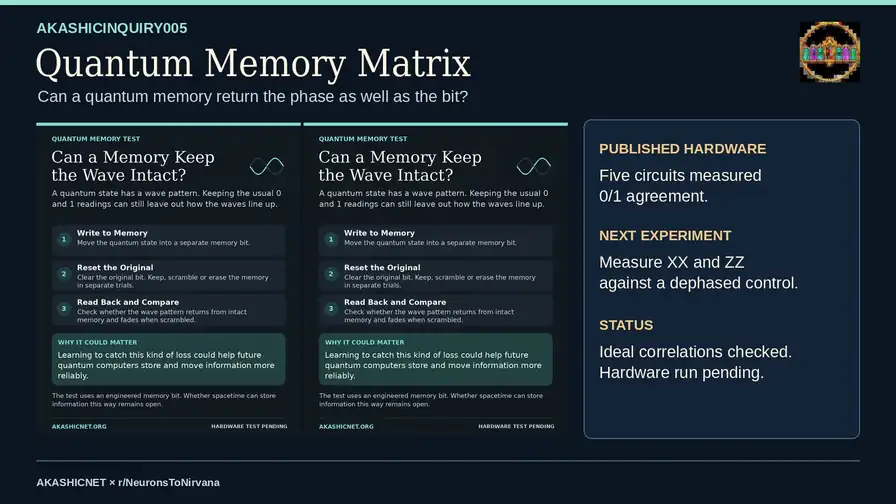
Can a quantum memory return the phase as well as the bit? Two qubit states can give exactly the same 0/1 statistics and still carry different information. AkashicINQUIRY005 asks what the published Quantum Memory Matrix circuits measured and how a phase-sensitive follow-up could tell the difference.
The Proposal and the Measurement
Florian Neukart, Reuben Brasher and Eike Marx proposed in 2024 that quantum fields could leave readable imprints in hypothetical spacetime cells. In July 2026, Neukart, Marx and Valerii Vinokur reported five QMM-inspired circuits on IBM quantum hardware. The circuits implemented local write, evolution and read operations. The paper reports computational-basis agreement, correlation and mutual information, including a baseline agreement of 0.732 ± 0.012. The authors distinguish their retrieval measure from quantum-state fidelity. The physical proposal about spacetime cells remains open. 2024 Theory Paper · 2026 Hardware Paper
Why Matching Bits Can Miss the Phase
Prepare |+⟩ = (|0⟩ + |1⟩)/√2 and |−⟩ = (|0⟩ − |1⟩)/√2. Both give 0 and 1 equally often in the Z basis. In the X basis they give opposite outcomes. If a memory returns the same output for both preparations, the output has lost the distinction that their relative phase encoded. The circuit’s readout basis and the output register it exposes are therefore part of the claim.
A Phase-Sensitive Pilot
Prepare a Bell pair between a reference qubit and a system qubit. Write the system into a memory qubit with a SWAP, preserve a defined interval and read it back with a second SWAP. Keep the reference untouched throughout. Interleave measurements of XX and ZZ for each of the three circuit conditions. A balanced mixture of the two write–read branches gives the dephased comparison.
| Condition | XX | ZZ |
|---|---|---|
| Direct Bell reference | +1 | +1 |
| Coherent write–read | +1 | +1 |
| Phase-flipped write–read | −1 | +1 |
| Balanced mixture of the two branches | 0 | +1 |
The prediction is that the balanced mixture suppresses XX while preserving ZZ within a prespecified tolerance. The plan calls for 1,536 pilot shots and 26,112 total if both comparison blocks proceed. A local state-vector calculation reproduced the ideal correlations. Hardware execution is pending. Before the run, check the executed layout and timing, including whether both SWAPs survive compilation. The two correlators test the proposed phase contrast. A full claim about arbitrary-state recovery would need additional measurements or a justified channel model. Phase-Recovery Protocol
What Would Move the Inquiry Forward?
- Reconstruct the published result. Obtain the exact logical and executed circuit definitions, raw joint counts, shot-selection and resampling rules and calibration records. The paper describes shot-based analysis and refers to OpenQASM listings. Its Data Availability statement says that no datasets were generated or analysed. The public record inspected here leaves access to the original records unresolved.
- Run the pilot and share the counts. Freeze the thresholds and matching rules first. An independent analyst should be able to reconstruct XX and ZZ, check the realised memory interval and report uncertainty using the same raw records.
- Identify a QMM-specific prediction. Compare the circuit with a timing-matched ordinary quantum memory. A spacetime claim would need a physical observable for which the QMM model gives a distinguishable prediction.
Related Inquiry 004 · Hawking at 50 · Four Dimensions and Information Recovery · Conceptual Field Simulation