A TSC2026 discussion proposal: where AkashicNET meets consciousness research, wisdom communities, evidence maps and open metadata, and how these resources could connect responsibly.
By AkashicNET · 1 Oct 2026 · Prepared for AkashicNET · AI-assisted research and synthesis · 19 min read including captions and sources
Independent discussion material; no conference acceptance or institutional endorsement implied.
Independent discussion proposal · Six captioned visuals · Source-linked comparison
Conceptual artwork imagining research, contemplation, creativity, community and Earth in conversation. It depicts no scientific mechanism or institutional partnership.
Discussion Proposal · TSC2026
A small shared catalogue, with clear boundaries
Discussion question: could researchers, reference editors, wisdom communities and citizen curators help readers move between their resources through a small, traceable catalogue of public scholarly records?
AkashicNET proposes starting with selected publications connected to a few clearly defined questions. Each record would retain its original publication link, verified identifier, discovery trail, source type, review status and independently written limitations. Reports of experience, philosophical interpretations and experimental findings would remain distinguishable.
The first deliverable would be an inspectable pilot rather than a combined copy of other platforms’ databases. Reusable metadata could come from appropriately licensed indexes, with provider-specific exceptions checked. Text, images, participant accounts and substantial collections would require their own permission basis. Possible collaboration would be agreed with the relevant people, rather than inferred from shared interests.
Five questions to take into a conversation
Which original publications and stable identifiers are the best starting points for a bounded pilot?
Which metadata fields may be reused, through which interface, with what attribution and limits?
How should corrections, contrary findings, duplicates and uncertain interpretations be recorded?
What could a citizen curator contribute usefully, and which judgments need specialist review?
What small demonstration would help researchers assess whether this approach saves time and improves traceability?
Suggested first conversation: IONS, based on the historical connections documented below. SAND speakers and Psi Encyclopedia contributors offer further possible introductions, without implying they represent their organisations in any proposed collaboration.
Status: an independent AkashicNET proposal for discussion around TSC2026. It has not been presented here as a submitted or accepted conference contribution. No TSC, IONS, SPR, SAND or other platform endorsement is implied.
01 · Main Assessment
A promising combination in an existing field
AkashicNET has substantial relatives on the web. Science and Nonduality (SAND) brings together science, wisdom traditions, direct experience, art and community. The Consciousness Library organises scholarly research. IONS conducts research and offers experiential programmes. Psi Encyclopedia provides specialist reference articles. Noeticmap connects experience reports, literature and visual exploration. Spiritual Evidence Map explores claims and interpretations through a provisional scoring framework.[4–13]
The distinction worth developing is AkashicNET’s proposed combination: interdisciplinary curation, discoverable source relationships, uncertainty, evidence categories, cultural context and compassionate purpose. Its public pages explicitly describe these commitments. Their effectiveness must be demonstrated through reliable records and consistent review, rather than inferred from the presence of labels.[1–3]
Assessment: AkashicNET’s breadth and interpretive approach are promising. Established neighbours offer specialist resources that it can draw upon. No exact full equivalent was demonstrated in this scan, but the scan does not establish global uniqueness, superior accuracy or superior research quality.
02 · Scope and Method
What this comparison can establish
This report uses public homepages, About pages, methods, policies and terms consulted on 1 Oct 2026. It separates each organisation’s published descriptions from this report’s comparative judgments. It covers six neighbouring projects and two scholarly metadata providers, with a limited historical check of their TSC connections.
The comparison concerns purpose, discoverability, source handling, publishing activity, reuse and maturity. It does not test every search feature, audit every study assessment, inspect internal databases or independently verify organisational registration claims. Update schedules are reported where stated; a stated schedule is not proof that every item is current.
Collection sizes are deliberately not ranked. A scholarly article, Reddit URL, first-person account, topic page and extracted finding are different units. Larger counts alone do not demonstrate greater coverage, better evidence or fewer duplicates. The same source appearing through several platforms remains one underlying source.
Operator identities are distinguished from technical hosting providers. This report verifies some named operators from their own disclosures; it does not identify origin servers or cloud-hosting arrangements.
03 · AkashicNET Today
Current public capabilities and developing ambitions
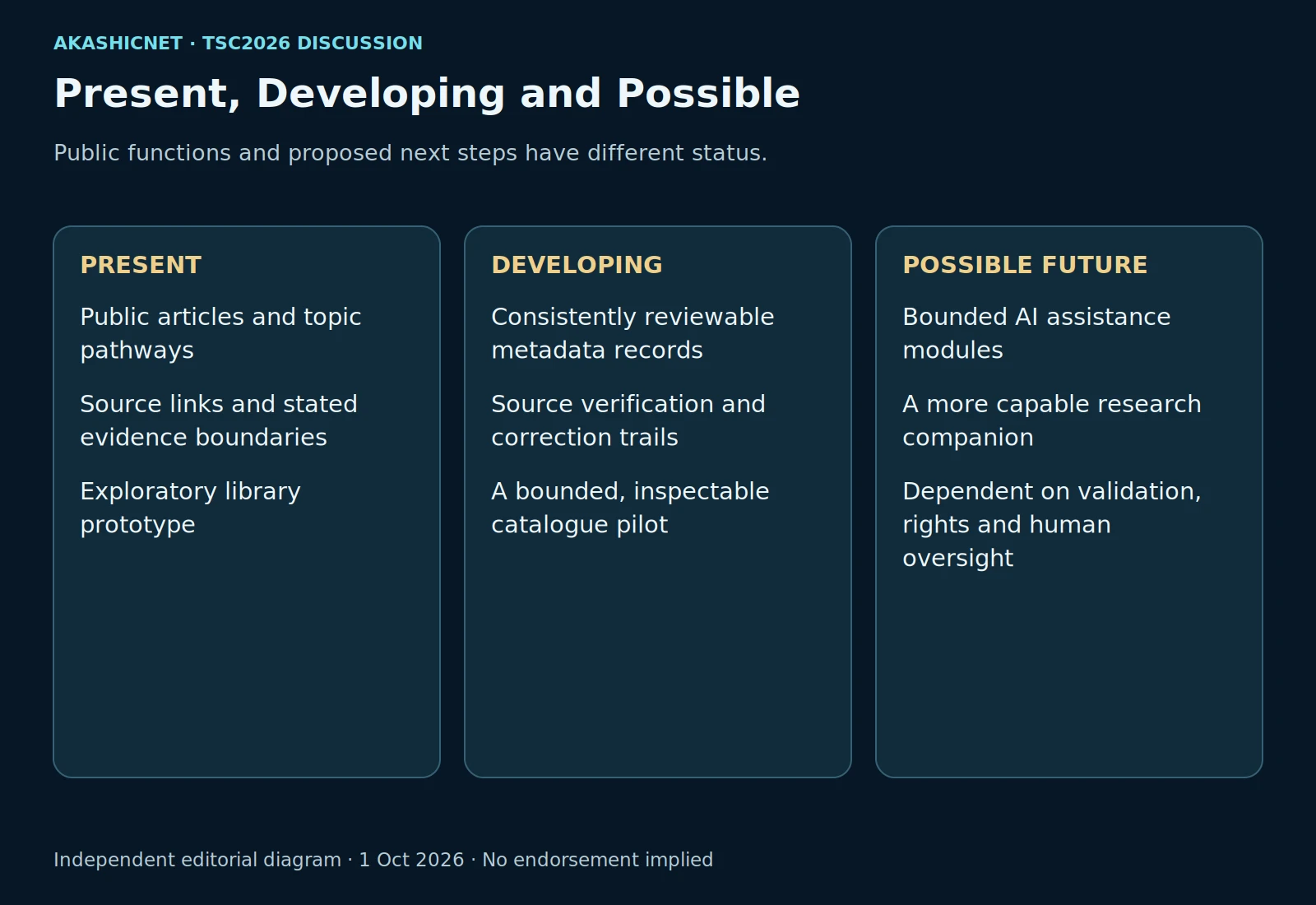
AkashicNET describes itself as a citizen data-science project connecting consciousness research, community knowledge, contemplative wisdom, creativity and planetary understanding. Its About page makes clear that lived meaning and scientific evidence receive different treatment, and that resemblance creates a candidate for review rather than an automatic accepted relationship.[1]
AkashicLIBRARY is explicitly presented as an exploratory prototype. Its current public pathways include consciousness, noetic inquiry, reincarnation, historical archives, sacred spaces and testimony. It defines linked, metadata-only, open-licence import and excluded/on-hold states, and proposes source maps, competing views and version histories.[2]
The technology landscape page states that AkashicNET has no native AI engine. It presents AkashicOMNI as a human-led assessment framework and modular AI assistance as a possible direction. A published beta or pre-release designation does not make every proposed feature production-ready.[3]
Public functions, developing work and possible future capabilities are shown separately. This map describes the report’s assessment and proposals, not completion percentages.
04 · Comparative Overview
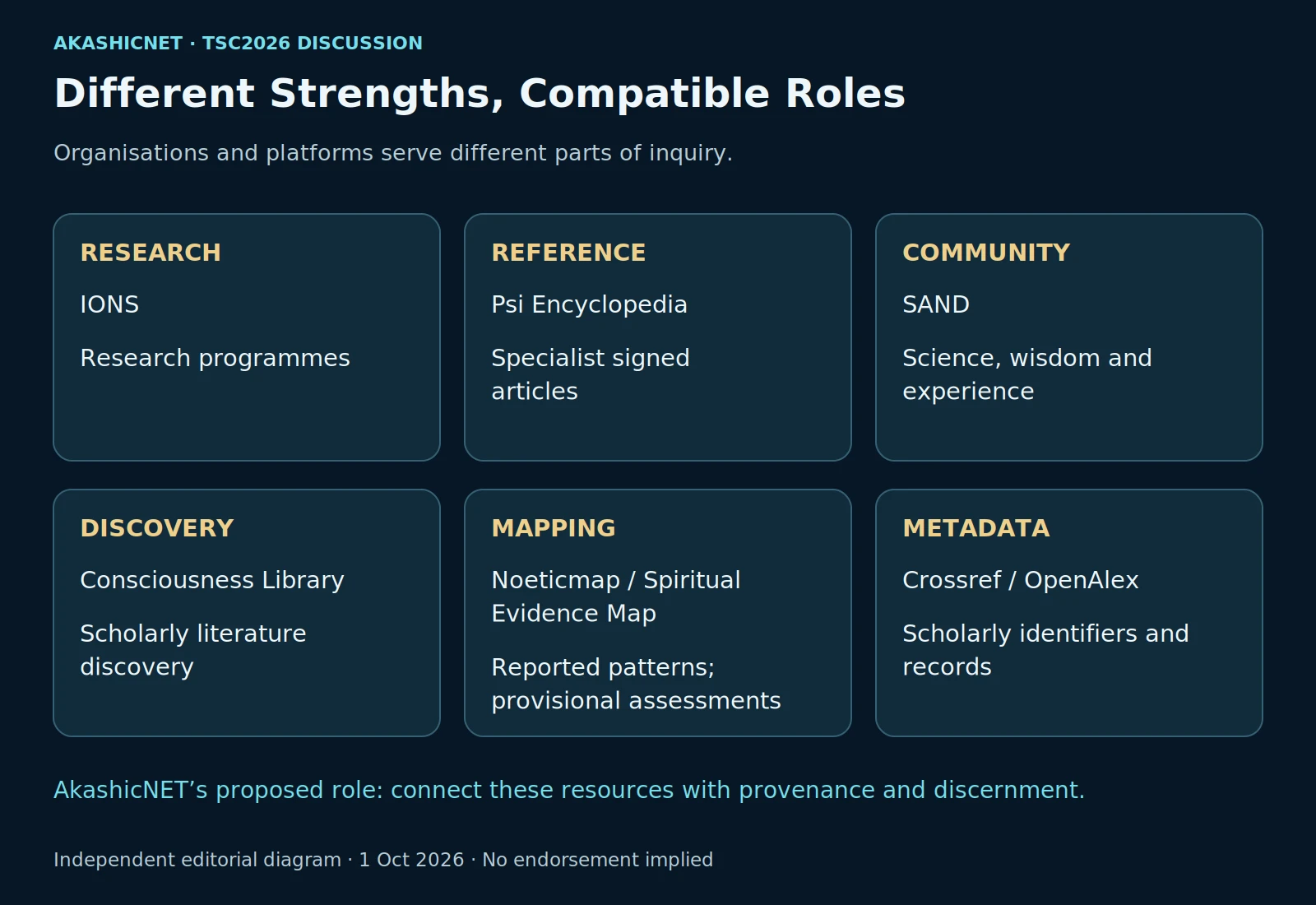
Different strengths, compatible roles
Qualitative comparison based on public descriptions [1–16]
Project
Primary contribution
Useful overlap
Distinct role for AkashicNET
The Consciousness Library
Literature discovery and automated study synthesis
Research search, topic organisation and source-linked explanations
Add cultural, experiential and question-centred context after checking the original studies
SAND
Science, wisdom, direct experience, arts and community
Broad contemplative and compassionate orientation
Develop structured source records and explicit reviewable relationships
IONS
Research programmes and experiential exploration
Consciousness, noetic experiences and interconnectedness
Contextualise findings alongside limitations, independent scrutiny and other approaches
Psi Encyclopedia
Signed specialist reference articles
Psi, NDEs, reincarnation, historical cases and research methods
Connect specialist articles to primary publications and wider questions
Noeticmap
Experience databases, literature and visual mapping
Patterns across reports and research
Preserve differences between reported similarity, corroboration and evidential support
Spiritual Evidence Map
Provisional mapping of phenomena and interpretations
Source trails, alternatives and uncertainty
Retain evidence categories and narrative justification without borrowing unvalidated scores
Crossref / OpenAlex
Reusable scholarly metadata
Identifiers, citations and research discovery
Build topic tags, assessments and humane navigation on top of the records
The table describes complementary functions. It is not a league table and does not imply partnership, endorsement or equal evidential quality.
A map of complementary roles, based on public descriptions. Placement is not a ranking, validated quality assessment or partnership claim.
05 · Neighbouring Projects
Six projects worth learning from
Literature Discovery
1. The Consciousness Library
Operator: Mindscape Collective; its About page names Mike Elliott as founder and executive director. The platform covers psychedelics, meditation, dreaming, consciousness and related scholarship, with searchable records, topic synthesis and study details.[4]
Strength to learn from: turning literature into accessible, navigable research records. Its methods distinguish collected source metadata, AI-extracted facts and automated synthesis. Importantly, it states that syntheses are not reviewed by a person before publication. This makes them useful discovery aids, with original-paper verification still needed.[5]
AkashicNET opportunity: preserve those discovery links, obtain reusable citation details, and contribute independently reviewed interpretation, community context and explicit open questions. Copying its summaries or importing its whole collection is a separate rights issue.[6]
Science, Wisdom and Community
2. Science and Nonduality (SAND)
Operator: Science and Nonduality, which identifies itself as a US nonprofit. Its activities combine spiritual inquiry, scientific exploration, social healing, artistic expression and community learning. It is the closest neighbour in overall spirit among the projects examined.[7]
Strength to learn from: accessible conversations across traditions, emotional relevance and community participation. Its courses, films and podcasts offer multiple ways into complex subjects.
AkashicNET opportunity: bring that accessibility together with a more structured public catalogue, source classifications and review histories. Emotional resonance can invite inquiry; the evidence assessment still needs its own justification. Member recordings and purchased resources are not automatically available for republication.[8]
Research Organisation
3. Institute of Noetic Sciences (IONS)
Operator: the Institute of Noetic Sciences. Its mission combines scientific exploration with personal discovery, and it describes research into experiences and questions associated with interconnectedness.[9]
Strength to learn from: an institutional research programme, named researchers, published work and ways for people to participate. Its organisational mission is also a perspective to record, rather than a substitute for evaluating a particular study.
AkashicNET opportunity: connect IONS publications to original methods, independent criticism, replication questions and alternative accounts. Classify an event announcement, experience workshop, blog interpretation and research publication separately. Record what a study tested before relating it to a Big Question.
Specialist Reference
4. Psi Encyclopedia
Operator: the Society for Psychical Research. It provides signed articles across psi, consciousness, survival questions, reincarnation, historical cases, methods and sceptical perspectives. Its About page identifies its editorial history and current management.[10, 11]
Strength to learn from: specialist authorship, reference trails and historical depth. Its editors explicitly describe limited staffing and the time required to incorporate new findings; readers should check each entry’s dates and underlying sources.[11a]
AkashicNET opportunity: use it as an attributed secondary reference and a route to primary literature. Preserve the distinction between the encyclopedia’s account, a case report’s observations and an interpretation about consciousness. This report does not claim to have verified its registration in AkashicNET’s internal source registry.
Experiences and Mapping
5. Noeticmap
Operator: a named accountable person or institution was not verified from the pages checked. Its public research dashboard advertises experience analysis, scholarly literature, researcher profiles and visual tools. It explicitly describes experiences as subjective reports and disclaims proof of metaphysical claims.[12]
Strength to learn from: making report patterns and research relationships easier to explore visually. A cluster can suggest a question without establishing that accounts are independently corroborated or that a particular mechanism caused them.
AkashicNET opportunity: link to the platform and scrutinise methods before borrowing conclusions. Its terms retain original authors’ rights, restrict commercial harvesting and excessive automated use, and require permission for copying parts of the service. Do not treat educational purpose as blanket import authorisation.[12a]
Provisional Evidence Map
6. Spiritual Evidence Map
Operator: not verified from the pages checked. Its stated approach separates reported phenomena from their larger interpretations and makes source trails, objections and score revisions visible.[13]
Important limitation: the homepage describes provisional editorial scores, while the About page calls its scores placeholders illustrating methodology. That difference should be resolved before using the numerical scores as substantive evidence assessments.[13a]
AkashicNET opportunity: learn from the phenomenon-versus-interpretation distinction and traceable objections. Develop explicit review criteria with reasoned assessments. Do not import provisional scores as scientific findings or claim that this comparison validates the map.
06 · Past TSC Connections
Shared researchers, distinct organisations
The Science of Consciousness (TSC) archives reveal connections to this ecosystem through earlier conference editions. The strongest direct organisational trail is IONS. SAND and Psi Encyclopedia also connect through named people. A shared speaker, an indexed paper, a conference interview and an official organisational role are different relationships.
Confirmed historical examples; not an exhaustive attendance census
Source
Edition and documented connection
What this establishes
IONS
2020: a workshop on interconnectedness listed Helané Wahbeh, Cedric Cannard, Garret Yount, Arnaud Delorme and Dean Radin. 2022: Radin and Julia Mossbridge joined the Consciousness and Non-Locality workshop; IONS also listed Wahbeh as a presenter. 2024: IONS announced science-team presentations and workshops led by Delorme and Thomas Brophy. [19–21]
Recurring IONS-associated participation; the 2024 event page is an announcement rather than an independently verified record of every completed talk.
SAND
2020: Donald Hoffman appeared in TSC’s Reality / Illusion plenary with Keith Frankish. SAND publishes a Hoffman video on conscious agents and spacetime. [19][22]
Verified speaker/content overlap. These records do not establish that Hoffman represented SAND at TSC.
Psi Encyclopedia / SPR
2022: Dean Radin and Stephan Schwartz appear in the non-locality workshop programme. Both are listed as Psi Encyclopedia contributors. [19][23]
Contributor overlap. An official encyclopedia or SPR presentation was not established by this check.
Consciousness Library
No direct historical presentation by the platform or its team confirmed in this search.
Unconfirmed. Indexing work by a TSC speaker would be a bibliographic connection, not proof of platform participation.
Noeticmap
No direct historical TSC presentation or organisational presence confirmed.
Unconfirmed; operator identity and a complete attendance history remain unresolved.
Spiritual Evidence Map
No direct historical TSC presentation or organisational presence confirmed.
Unconfirmed; absence of a search match does not prove nonattendance.
Where to browse past talks
Start with the University of Arizona conference archive and the 2024 recordings and interview collection. The latter links conference interviews with Donald Hoffman, Thomas Brophy, Jonathan Schooler and Tam Hunt, alongside session recordings. An interview should be catalogued as an interview, not substituted for a research paper. [24]
What this means for AkashicNET
Recommended first conversation: IONS, given the documented participation across several editions. Possible discussion topics include finding original publications, obtaining verified metadata, how contested findings are reviewed, and whether any selected resources carry explicit reuse permission. This is a proposed contact route, not an existing partnership.
For future records, distinguish institutional participation, speaker overlap, reference contributor and indexed author, with an edition, source URL and verification date. Conference participation does not establish scientific validity, independent replication, institutional endorsement or reuse rights. Several appearances by the same researcher remain connected to the same person and underlying studies.
Scope: primary TSC archive, IONS event notices, SAND’s video collection and Psi Encyclopedia’s contributor roster checked on 1 Oct 2026. These are confirmed examples from 2020, 2022 and 2024, not a complete survey of every edition. Later affiliations do not automatically establish what role a person held at an earlier conference.
07 · Open Metadata Foundations
Discover through one site; verify through another
Crossref and OpenAlex offer a practical foundation for scholarly source records. Crossref explains that almost all its metadata is reusable without restriction, while abstracts retain the copyright and licence of the publisher or author. Its public REST API provides structured bibliographic records. OpenAlex releases its research metadata under CC0; access products and service limits are separate questions from the data licence.[14–16]
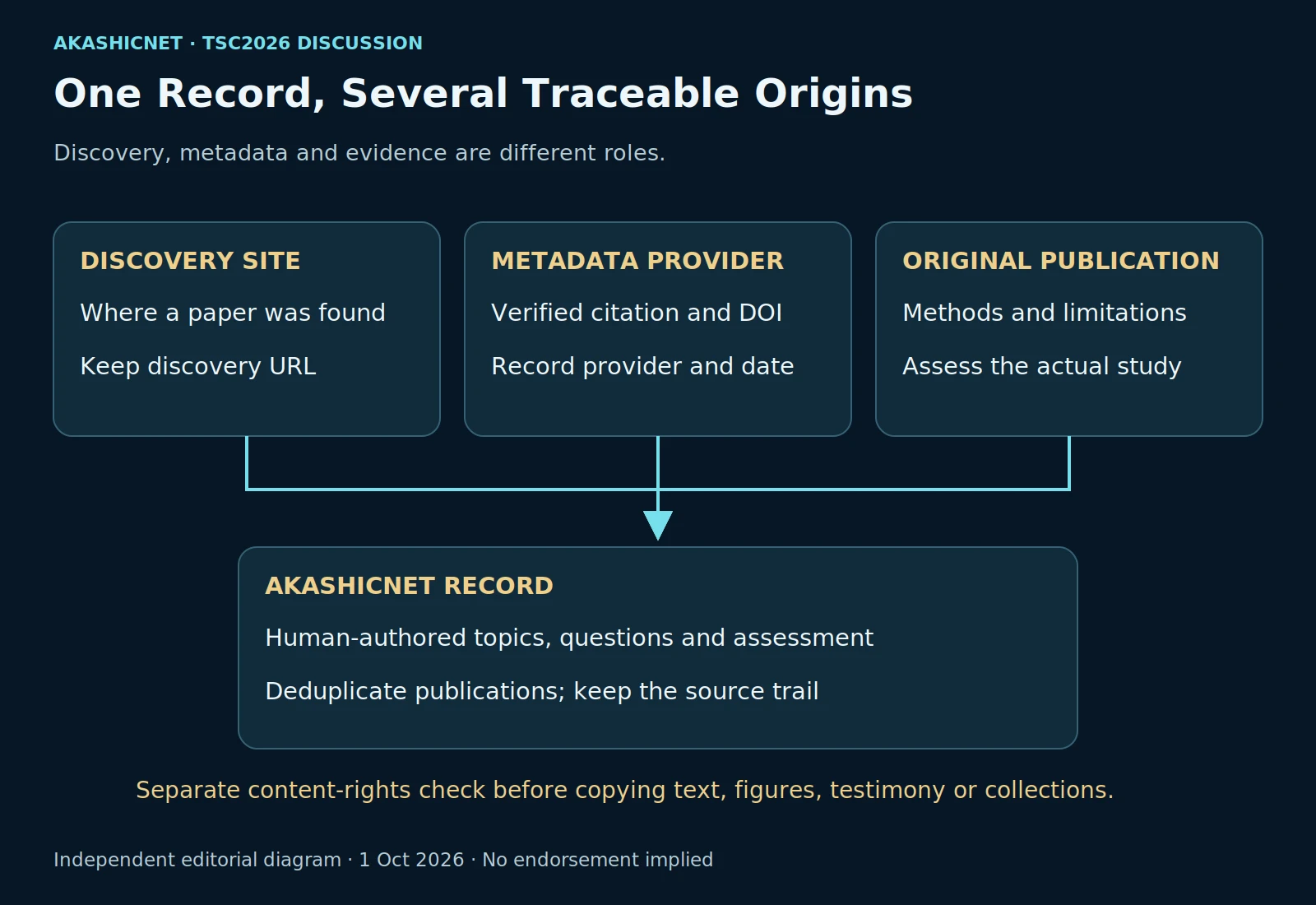
A record can preserve several distinct origins: the platform that helped discover it, the metadata provider, and the original publication. For instance, a paper encountered through Psi Encyclopedia can retain that discovery trail while its DOI, authors and journal details are verified through Crossref and its findings are assessed from the paper itself.
A proposed provenance workflow. Several platforms linking to one publication do not create several independent studies. Content rights require a separate check.
Suggested record fields
Identity:source_id, DOI or other stable identifier, canonical URL, title, creators, venue and publication date.
Provenance: discovery URL, metadata provider, verification date and a revision trail.
Assessment: an independently written description, study limitations, alternatives and links to counterevidence.
Rights: metadata permission basis, separate content licence, attribution requirements and permitted publication scope.
Relationships: candidate links with recorded reasons; acceptance requires the applicable human review.
These are proposed logical fields, not a claim about the current repository schema. Existing contracts should be inspected before implementation. Unknown dates, licences and findings should remain unknown.
08 · Updates and Reuse
Public access and reuse are separate questions
Stated activity and rights signals checked on 1 Oct 2026
Site
Update information found
Reuse position found
Consciousness Library
Continuous research collection; daily trial refresh; synthesis regenerated once over 30 days old [5]
Original platform content protected; no blanket licence to reproduce summaries found [6]
SAND
Monthly new courses and community conversations; other publishing varies [8]
All rights reserved; public and member-only access differ [8]
IONS
Ongoing posts; monthly blog digest, not a guaranteed posting interval [9a]
All rights reserved; no blanket republication permission found [9a]
Psi Encyclopedia
Updates as staff capacity permits; editors acknowledge delays [11a]
SPR copyright; all rights reserved [11]
Noeticmap
No dependable update schedule verified
Restrictions on copying, commercial harvesting and excessive automated use [12a]
Spiritual Evidence Map
Policy describes a monthly editorial loop; delivery not independently verified [13]
No open reuse licence found on the examined pages
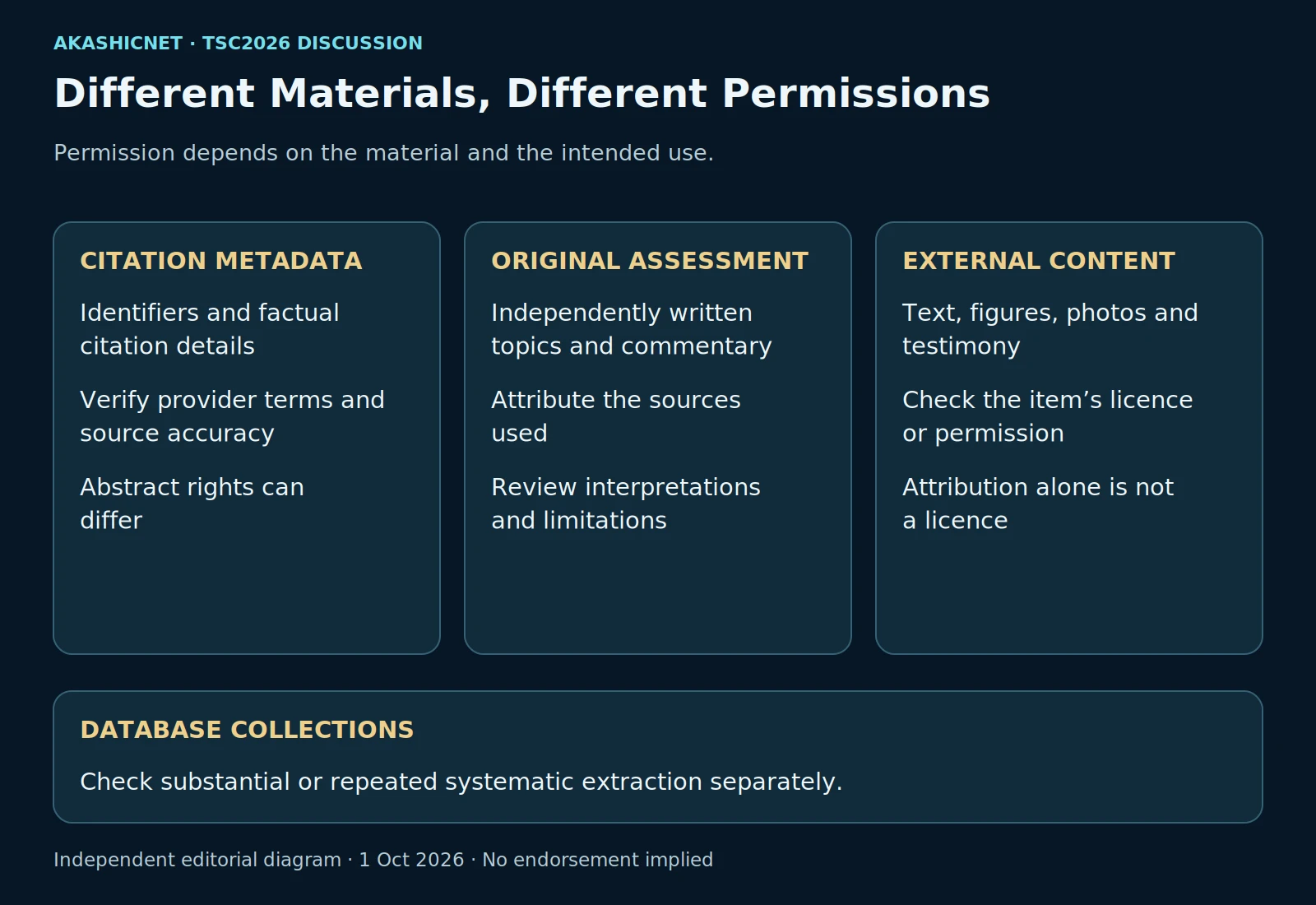
Individual factual citations and independently created topic tags differ from copying expressive text or extracting a protected collection. Copyright generally protects expression rather than facts and ideas. German database law can also restrict substantial extraction and repeated systematic extraction of smaller portions when the statutory conditions are met.[17, 18]
For selected records, use source URLs and verified bibliographic information, then write a genuinely independent description. For copied abstracts, images, testimony or substantial datasets, verify the relevant licence, permission or applicable legal exception. Attribution is essential provenance but is not itself a reuse licence. Automated access also requires its own terms and interface checks.
This is a practical rights assessment, not item-specific legal clearance. No permission requests were sent, and no source databases were imported for this report. The bibliographic licence of an index does not automatically license the full text, figures or other material it links to.
A practical permissions map, not item-specific legal clearance. Free reading access and attribution do not themselves grant republication or database extraction rights.
09 · Development Priorities
Make the distinctive approach demonstrably useful
The most valuable next phase is a searchable, inspectable catalogue that helps a reader move from a question to its sources and understand why a connection was made. The recommendations below are proposals, not completed work or a promised release schedule.
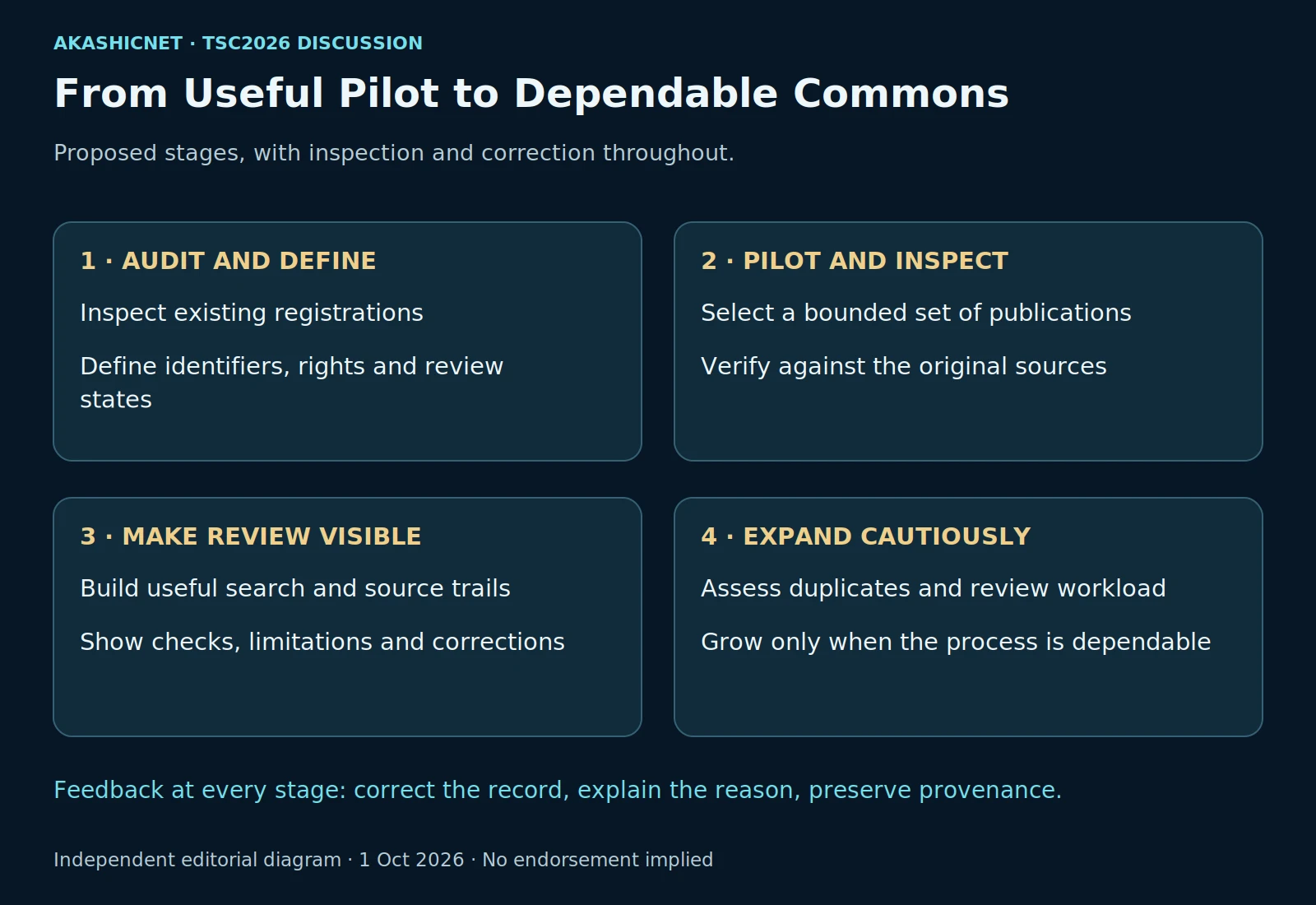
Audit existing registrations. Check which providers and publications are already present before creating duplicate entries. Distinguish a platform record from the publications discovered through it.
Define the record contract. Specify required identifiers, provenance, rights states and review statuses. Preserve missing data rather than filling it by inference.
Build a bounded pilot. Select relevant publications from a few questions, obtain reusable metadata and compare the result against the original sources. Keep the selection criteria visible.
Strengthen discovery. Add useful filters for topic, source type, year, review status and evidence category. Show the underlying record and source links beside any summary.
Make review visible. Record what was checked, by whom or by which method, when it was checked and what remains unresolved. Labels should lead to explanations.
Expand after inspection. Measure metadata completeness, duplicate detection, correction handling and review workload. Increase coverage once the method proves dependable.
Useful checks before scaling
A small inspected sample should answer: Can every record be traced to a publication? Do identifiers and author details agree? Are independent studies distinguished from repeats and commentary? Are contested interpretations presented as interpretations? Can a correction be made without erasing the earlier rationale? Are rights states tied to the specific material?
These checks evaluate the project’s process. They do not give a scientific conclusion extra weight simply because the catalogue is technically well organised.
A proposed development sequence, not a release schedule. Expansion depends on validation, rights and sustainable review capacity.
10 · Positioning and Transparency
A connection project with accountable judgment
Suggested positioning: “A living knowledge commons connecting research, wisdom and experience through provenance, discernment and compassionate purpose.”
This wording describes an intended contribution without requiring a claim of global uniqueness. AkashicNET’s broad scope can make unusual connections discoverable. Those connections become useful when readers can examine their basis, their competing explanations and their limits.
The main risks to address are an overwhelming front page, uneven review depth across topics, duplication of sources, and visual or spiritual framing being read as an evidential conclusion. A clearer starting route, reliable metadata and explicit assessment histories would strengthen trust.
Contribution and evidence transparency
The user supplied the project context, comparison questions and request for this report. AI assistance located public sources, organised the comparison and drafted the synthesis. External pages supply the attributed descriptions, policies and licence information. The judgments about closeness, strengths, gaps, contact priorities and development priorities are analytical interpretations. Historical TSC links are grounded in the separately cited archive and organisational records; unconfirmed participation is not treated as established absence.
No contribution percentages or platform grades are supplied because no reproducible attribution or scoring method was applied. The hero is AI-generated conceptual artwork. The five diagrams are editorial visuals created from the report’s distinctions and proposals; they are not measurements or validated scientific models. Diagram labels were checked and the images visually inspected. This publication does not establish source-ingestion permission, institutional affiliation or a change to a Big Question’s evidence status.
For public use, recheck policies and any newly added factual claims at publication time. Publish unresolved operator identities and inconsistent scoring descriptions as uncertainties rather than guessing.
11 · Sources
Primary pages and policy references
Consulted on 1 Oct 2026. Descriptions and policies can change. AkashicNET’s self-description informs the capability account; it is not independent proof of uniqueness or performance.
[1]AkashicNET: About — mission, evidence boundaries and possible outcomes.