What it does
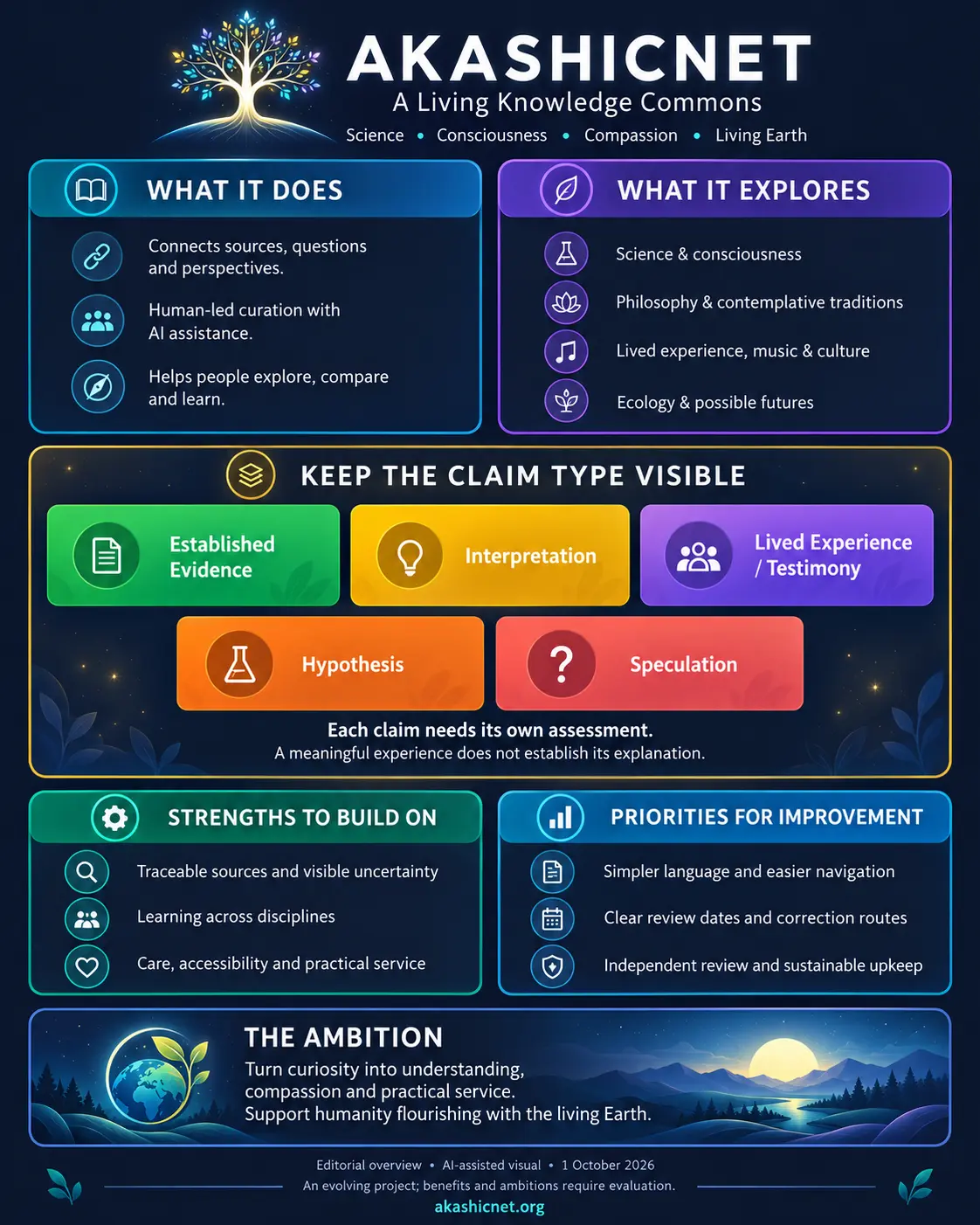
Human-led curation with AI assistance connects sources, questions and perspectives. Public topic pages and reading pathways offer ways to discover material and follow ideas back to their origins.

📚🌍 Visual introduction · 1 October 2026
A living knowledge commons connecting science, consciousness, contemplative traditions and lived experience, with care for the living Earth.
Its purpose is to help people explore, question, compare and learn. Its wider ambition is to turn curiosity into understanding, compassion and practical service.
Purpose and scope
Human-led curation with AI assistance connects sources, questions and perspectives. Public topic pages and reading pathways offer ways to discover material and follow ideas back to their origins.
Consciousness and science; philosophy and contemplative traditions; lived experience, music and culture; ecology and possible futures. Connections open questions while differences between sources and traditions remain visible.
Five claim types
These labels describe different kinds of statements. They are not a single ladder of reliability, and the colours are navigation aids rather than scores. Each claim needs its own assessment.
Findings supported by substantial, relevant evidence. Check the source, scope and remaining uncertainty; this label does not mean absolute certainty.
An explanation or reading of evidence, ideas or traditions. Other interpretations may fit, and cultural context matters.
What someone reports experiencing. The experience can be meaningful while its cause or wider explanation remains uncertain.
A proposed explanation to investigate. State what observations would support it, challenge it or distinguish it from alternatives.
An exploratory possibility with limited grounding. Metaphor and imaginative artwork should also be identified explicitly.
Editorial assessment
This is a bounded editorial self-assessment. It does not rank AkashicNET against other sites or claim an independent audit of the whole collection.
Recommendations · Proposed next steps
Offer a short introduction, familiar language and clear routes into topics. Test whether new readers can find a source and understand a label without help.
Distinguish publication dates, page edits and actual evidence reviews. Keep correction routes visible beside claims and sources.
Seek relevant subject expertise, respectful cultural input and reader feedback. Record what was reviewed and what remains unresolved.
Prioritise useful, well-maintained pathways. Check links and revisit claims before expanding faster than review capacity allows.
These priorities are recommendations, not a claim that every improvement is complete. Reader feedback can help decide what would make the greatest practical difference.
Suggest a correction or improvement · Accessibility information
The ambition
AkashicNET aims to support love, peace and human flourishing in relationship with the living Earth, expressed here through the language of Pachamama. These are values and aspirations; practical benefits require evaluation.
Explore. Question. Connect. Learn. Serve.
Personal foundation · Lived commitment
The creator describes AkashicNET as rooted in Bodhisattva vows to understand and live the Dharma, with a personal shamanic practice involving ceremonial rapé. The intention is to let learning become compassionate service and care for others.
This describes a personal spiritual motivation. It does not establish scientific claims, confer authority to represent Buddhist or Indigenous traditions, or recommend substance use. The project’s claims remain open to evidence, correction and independent scrutiny.
This enhanced edition develops a visual supplied by the project’s creator. It replaces a claim-type hierarchy with distinct categories, restores lived experience and testimony, removes unsupported superiority comparisons and adds practical improvement priorities.
Context: About AkashicNET, Living Knowledge Commons, Evidence Guide and Project Status. These project pages describe its own purpose and practices; they are not independent validation.
Human contribution: project direction, source visual and editorial request. AI contribution: wording, synthesis, design and implementation. No measured contribution percentages are claimed. Publication date: 1 October 2026.