Version
Identifies a particular release of a component or package. Existing component versions stay intact until their definitions or implementation change.
AkashicNEXUS v0.1.0
AkashicNET × r/NeuronsToNirvana
AkashicNEXUS connects the workflows.
AkashicSTATE makes their state legible.
Explore the seven editions, understand the maturity ratings and see what would turn a manually coordinated toolbox into a reusable package.

Three Fields, Three Jobs
Identifies a particular release of a component or package. Existing component versions stay intact until their definitions or implementation change.
AkashicNEXUS v0.1.0Names the proposed maturity band and its visual identity. Advancement requires evidence, rather than a colour change.
Bronze EditionA scoped assessment against the 1–10 maturity rubric, with its basis, limitations and next evidence recorded.
Provisional 6/10The workflow diagram keeps its separate v0.2.0 identifier. Package releases, framework releases, content editions and BQ evidence levels are distinct fields. There is no automatic equivalence between v0.6.0 and Level 6.
Seven Named Editions
This is a proposed maturity framework adopted for this reference edition. Stone, Iron and Copper are retrospective judgements. Bronze is provisional. No formal historical pass dates have been invented.
Concept & Foundations
The purpose, intended users and boundaries are recorded. Inputs, outputs and components are beginning to take shape.
Met Retrospectively
A written purpose, scope, named user problem and initial component inventory.
Definitions and source snapshots support this judgement. No historical pass certificate was created.
Defined Components
Components have explicit roles, inputs, outputs and boundaries. A coherent specification exists before dependable execution is claimed.
Met Retrospectively
Component contracts, source locators, unresolved fields and examples of intended use.
Named components and operating guidance exist. Independent component validation remains incomplete.
Connected Prototype
Selected components connect into a usable prototype. Handoffs can be followed and outputs reused, with manual intervention still expected.
Met Retrospectively
A working map, reusable guidance, linked records and demonstrated partial handoffs.
The published map and linked coordination workspace support this assessment. They do not prove unattended execution.
Integrated Working Prototype
The workflows form an integrated working system with review, source trails, versioned records and reuse. Important handoffs remain manual.
Provisionally Met
Linked input/output contracts, before-and-after records, discrepancy handling and preserved previous runs.
Current NEXUS position. The public guide and private coordination workspace exist; systematic end-to-end validation is still pending.
Verified End-To-End Workflow
Representative tasks complete from input to checked delivery. Changed inputs produce a traceable rerun and the previous output remains available.
Not Yet Demonstrated
Observed end-to-end runs, delivery receipts, failure handling and a changed-input rerun.
Target criteria only. No pass date is assigned.
Reliable Connected Execution
Tools exchange structured outputs reliably. Dependency changes identify stale outputs and trigger controlled reruns, with effective HOLD and access controls.
Not Yet Demonstrated
Repeatable adapter runs, dependency checks, retries, access tests and measured failure recovery.
Automatic execution across the full toolbox has not been established.
Validated Living Ecosystem
Adaptive routing is independently compared and sustained operation is demonstrated across varied workflows. Recovery, oversight and reproducibility remain explicit.
Not Yet Demonstrated
Independent evaluations at Level 9; sustained reproducibility, reliability and recoverable failures at Level 10.
An aspiration with evidence requirements, not a claim of perfection.
A Scoped Design Assessment
These preserve the provisional ratings discussed during design. They are judgements from the definitions and implementations reviewed, without independent scoring. They measure maturity, rather than truth, spiritual attainment or the quality of a person.

Communication & Attribution Lens
v0.4.0-beta.1
Structured claim separation and attribution guidance is available.
Demonstrate consistent attribution across varied messages with independent checks.
Meta: Not Assessed · Mettā: Not Assessed
Overall maturity is not reused as either mode score. No independent validation is claimed.
Existing Source & Context
Research & Evidence Lens
v0.3.0-beta.1
Question, evidence, limits and reopening guidance connect to the working workflow.
Reproduce evidence appraisals and independently check source-to-claim links.
Meta: Not Assessed · Mettā: Not Assessed
Overall maturity is not reused as either mode score. No independent validation is claimed.
Existing Source & Context
Decision & Comparison Lens
v0.3.0-beta.1
Options, prerequisites, decisions and reopening conditions have a defined record.
Compare recorded decisions with observed outcomes and plausible alternatives.
Meta: Not Assessed · Mettā: Not Assessed
Overall maturity is not reused as either mode score. No independent validation is claimed.
Existing Source & Context
Revision & Improvement Lens
v0.2.0-beta.1
The contract preserves findings, before-and-after changes, rationale and rechecks.
Demonstrate improvements through masked comparisons without introducing unsupported claims.
Meta: Not Assessed · Mettā: Not Assessed
Overall maturity is not reused as either mode score. No independent validation is claimed.
Existing Source & Context
Spiritual & Reflective Lens
v0.3.0-draft.1
The draft separates personal meaning, attributed traditions and factual claims.
Evaluate attribution, consent, interpretative boundaries and practical usefulness.
Meta: Not Assessed · Mettā: Not Assessed
Overall maturity is not reused as either mode score. No independent validation is claimed.
Existing Source & Context
Summary & Synthesis Lens
v0.1.0
A summary and accompanying claim-table contract preserve uncertainty and source locators.
Independently verify summary fidelity across varied inputs.
Meta: Not Assessed · Mettā: Not Assessed
Overall maturity is not reused as either mode score. No independent validation is claimed.
Existing Source & Context
Perspective-Transfer Lens
Numbered Edition Not Recorded
A draft perspective-transfer route is recorded; a numbered edition is unresolved.
Settle the specification and demonstrate useful transfers without changing evidence status.
Meta: Not Assessed · Mettā: Not Assessed
Overall maturity is not reused as either mode score. No independent validation is claimed.
Existing Source & Context
Layered Synthesis Framework
Numbered Edition Not Recorded
A foundations-to-synthesis route is recorded with an unresolved numbered edition.
Define the layers and handoffs and evaluate worked examples.
Meta: Not Assessed · Mettā: Not Assessed
Overall maturity is not reused as either mode score. No independent validation is claimed.
Existing Source & Context
Integration Lens & Bounded Experiment
Numbered Edition Not Recorded
Integration guidance exists around a bounded linked experiment.
Demonstrate versioned integration across multiple workflows beyond that experiment.
Meta: Not Assessed · Mettā: Not Assessed
Overall maturity is not reused as either mode score. No independent validation is claimed.
Existing Source & Context
Multiple-Perspective Framework
v0.5.0
A versioned multiple-perspective framework and bounded synthesis route are available.
Compare perspective selection and synthesis with independent reviewers.
Meta: Not Assessed · Mettā: Not Assessed
Overall maturity is not reused as either mode score. No independent validation is claimed.
Existing Source & Context
Mind–Body–Heart–Spirit Companion
Numbered Edition Not Recorded
A mind, body, heart and spirit companion has a recorded role and boundaries.
Settle the operating specification and evaluate representative examples.
Meta: Not Assessed · Mettā: Not Assessed
Overall maturity is not reused as either mode score. No independent validation is claimed.
Existing Source & Context
Research-Trace Companion
Numbered Edition Not Recorded
The source-to-question research-trace role is defined.
Demonstrate stable source-to-claim tracing with integrity and missing-source checks.
Meta: Not Assessed · Mettā: Not Assessed
Overall maturity is not reused as either mode score. No independent validation is claimed.
Existing Source & Context
Evaluation & Test Framework
Numbered Edition Not Recorded
Review and comparison protocols exist, with actual method and outcome fields.
Complete independent reviews and record disagreement, errors and repeatability.
Meta: Not Assessed · Mettā: Not Assessed
Overall maturity is not reused as either mode score. No independent validation is claimed.
Existing Source & Contextv0.2.0
The working sequence defines routes, shared records, checks and reopening rules.
Verify end-to-end routes and dependable reopening after a source or asset change.
Meta: Not Assessed · Mettā: Not Assessed
Overall maturity is not reused as either mode score. No independent validation is claimed.
State & Assessment Definitions
Orchestration Workspace
v0.1.0
The map, lens contracts and linked coordination workspace provide an integrated foundation.
Demonstrate reliable execution, dependencies and reruns across connected components.
Meta: Not Assessed · Mettā: Not Assessed
Overall maturity is not reused as either mode score. No independent validation is claimed.
State & Assessment Definitionsv0.1.0-draft.1
This first draft defines its fields, assessment modes and its own record. It is a metadata specification, without an executing assessment service.
Validate real state records, preserve assessment history and test independent interpretation of the rubric.
Meta: Not Assessed · Mettā: Not Assessed
Overall maturity is not reused as either mode score. No independent validation is claimed.
State & Assessment DefinitionsAkashicSTATE · v0.1.0-draft.1
AkashicASSESS makes an assessment. AkashicSTATE preserves the result, its scope and its evidence. It records version, edition, maturity, validation, dependencies, visibility, HOLD, recommendations and review history.
Examines definition quality, versions, evidence, dependencies and reproducibility. Applying AkashicSTATE to itself is a meta operation.
Current Separate Score: Not Assessed
Examines care, agency, cultural attribution, accessibility and respectful uncertainty. It is a practice and review lens across every layer.
Current Separate Score: Not Assessed
Meta and Mettā are modes, not extra editions or higher ranks. Scores stay separate and require evidence. Missing evidence is recorded as Not Assessed, rather than zero. Irrelevant criteria need an explicit applicability rationale.
These anchors define a proposed rubric. Applying it consistently and validating its usefulness remain open work.
These anchors define a proposed rubric. Applying it consistently and validating its usefulness remain open work.
AkashicSTATE Applied To AkashicSTATE
The Architecture
NEXUS is the orchestra as a whole. Components are its instruments, workflows are its scores and a run is a performance. People remain the conductors, setting purpose and approving the outcome.
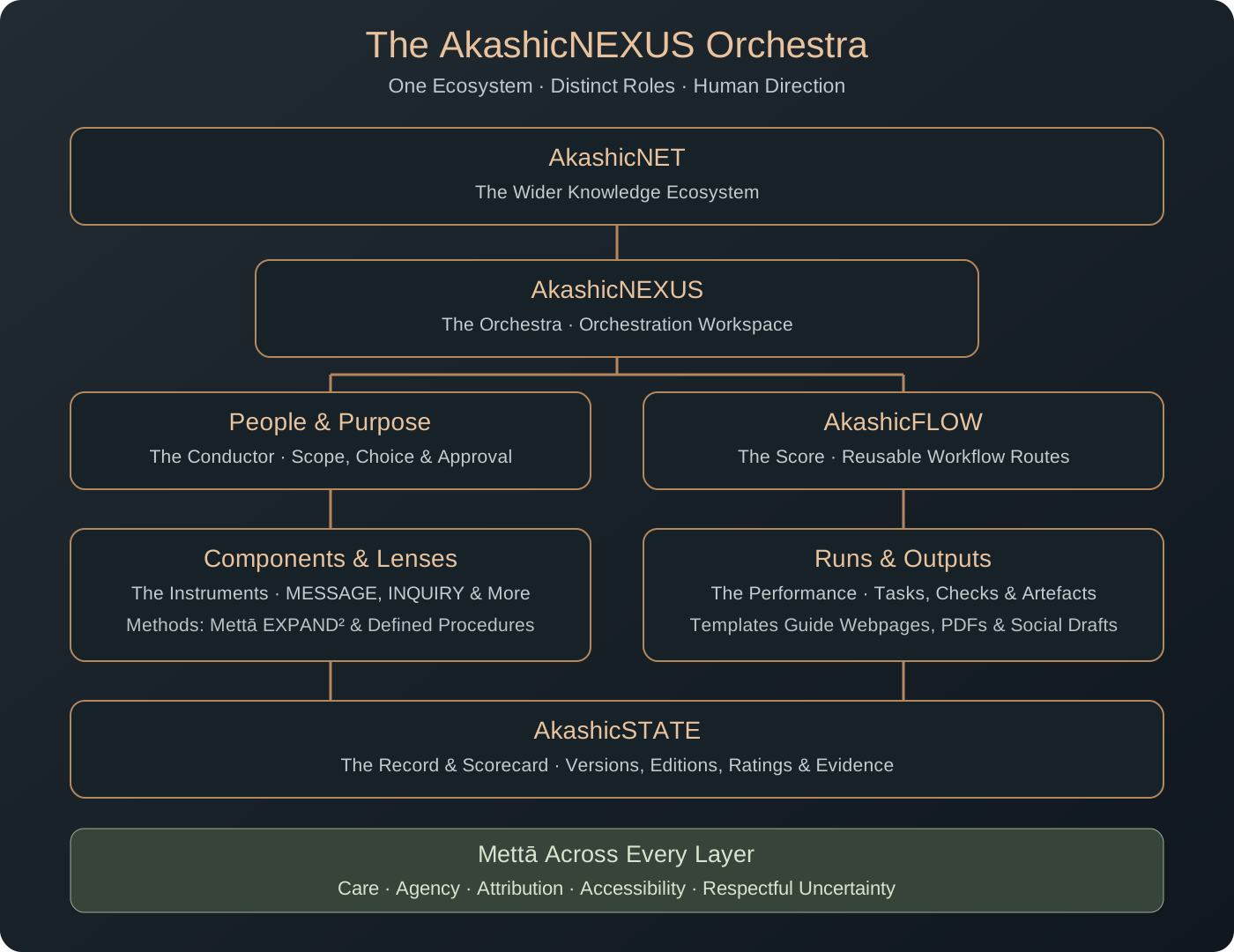
Mettā applies across every layer. These layers describe the scale of work; they are separate from the seven material editions and the maturity rubric.
Portable Today · Executable In A Future Release
The reference package includes this webpage, the workflow map, sigils, component guidance, preserved source locators, rating definitions, an AkashicSTATE template and three proposed test cases.
Download Reference Package · v0.1.1This is a static reference package and deployment blueprint. It does not install a ChatGPT plugin, execute model calls, connect private accounts or publish on someone’s behalf. Source destination pages have not been freshly re-audited for this export.
editions.html.index.html for the full workflow and reusable guidance.Public reference pages work locally. The hosted ZIP download and external sources require network access; private workspaces may also require sign-in.
These are planned capabilities with no committed deployment dates.
Yes. OpenAI’s current plugin architecture combines skills, MCP tools and optional interfaces. A future NEXUS plugin could expose the runner and state records through those tools. A ZIP of reference files alone does not implement that integration.
OpenAI Plugin Documentation · Reusable Instructions · MCP Server & UI
Documentation checked 19 November 2026. Availability and publishing requirements should be rechecked before implementation.
Proposed Acceptance Tests
These cases have not been run. They test workflow usefulness and reliability. Commercial demand, willingness to pay and profitability require separate evidence.
NEXUS-TC01 · Not Yet Run
Input: One agreed research question, a supplied source set and a target webpage brief.
Source-linked appraisal, webpage draft, PDF draft, visual brief and Reddit/X drafts.
Every checkable claim has a locator or is flagged unresolved; versions and credits match; drafts and actual delivery are distinguished; missing-source input triggers HOLD.
Use the same input and source access for a manual baseline. Record review time, unresolved claims, correction effort and independent reviewer disagreements.
Actual Result: Not Recorded
Run Date: Unassigned
NEXUS-TC02 · Not Yet Run
Input: One existing article, its source list, image credits, embeds and intended audience.
Before-and-after report, discrepancy register, proposed fixes and separately recorded browser checks.
A prepared fixture exposes a missing source, missing credit, stale asset, broken embed and duplicate placement; every planted issue is flagged or explicitly recorded as missed. No browser pass is inferred from text review.
Compare the baseline and NEXUS review against a pre-agreed issue key. Count issues caught, missed, introduced and falsely flagged, plus time and correction effort.
Actual Result: Not Recorded
Run Date: Unassigned
NEXUS-TC03 · Not Yet Run
Input: Two test accounts, one restricted sample project, agreed roles and a versioned source change.
Configured workspace specification, role matrix, templates, onboarding and rerun history.
Unauthorised access is denied; HOLD blocks delivery; retries do not duplicate publication; a source change marks dependent outputs stale; previous records remain available; unknown dates stay blank.
Run the same acceptance checklist twice and record support interventions. Access and deployment tests require an implemented sandbox; documentation alone cannot pass them.
Actual Result: Not Recorded
Run Date: Unassigned
Assessment Basis & Source Trail
The ratings are provisional design judgements recorded in the 19 November 2026 discussion. Existing component definitions and versions are preserved from the published NEXUS source snapshot. Unknown editions, missing checks and future dates remain unresolved.
The Bronze sigil is original AI-generated artwork. The orchestra diagram is a native vector architecture map. Neither claims traditional attribution. Names, quoted source material and third-party content retain their existing rights; distribution is not a blanket third-party reuse licence.
v0.1.0-alpha.1 · Evidence, workflow and resource records. A browser-local builder exports draft JSON with missing measurements kept unknown. Environmental estimates require explicitly supplied energy, factor and scope.
No maturity score is assigned to this new alpha. Existing NEXUS and STATE ratings remain unchanged.
AkashicSTATE · Review All 18 Components
18 classified records · Existing provisional scores retained · FOOTPRINT and TIER unassessed · Meta and Mettā unassessed
The Source Atlas implementation and operational source records remain in the owner-only sandbox. Public citations and credits remain visible. Advanced source adapters, connected execution, managed reviews, telemetry and team operations require separate development and access controls.
Run Protocol · 19 November 2026
After every AkashicNEXUS or AkashicSTATE run, including reruns, finish with a Post-Run Human Review handoff. Invite Jatinder Sahota to review as Creator / Owner-Reviewer. This is a separate human review; creator involvement means it is not independent external validation. Offer an answer-free packet where suitable and record whether answers were actually hidden, seen or unknown. Record the run ID and edition, scope, reviewer role, method, date, judgements, disagreements and reasons, corrections and rechecks. Keep Owner Review and Independent External Validation as separate statuses; use Pending until actual evidence supports another status. Preserve dated before-and-after records in AkashicLEDGER or the current versioned record. Owner review may support a justified AkashicSTATE reassessment but never raises ratings automatically. Respect the authorised audience, private source metadata and existing HOLD boundaries. This adds a required handoff, not a new publication permission gate.
Required Closing Record: Owner Review: Pending / Completed / Declined / Deferred. Independent External Validation: Pending / Completed / Not Applicable (with reason). Include the actual reviewer role and evidence; never infer completion from silence.