Taxicab 1729
1729 = 1³ + 12³ = 9³ + 10³
There are two distinct unordered positive-cube pairs and no smaller repeat. The finite check above verifies both parts.
Historical and mathematical source
 Page Language · Google Translate
AkashicINQUIRY1729
From two sums of cubes to the notebooks that changed mathematics. What can happen between seeing a pattern and proving it?
AkashicNET × r/NeuronsToNirvana × AkashicNEXUS
Explore the Equation Ledger
Equal Sums of Cubes
1³ + 12³ = 9³ + 10³
G. H. Hardy recalled visiting Ramanujan in Putney in a taxi numbered 1729. Ramanujan recognised it as the smallest positive integer expressible as a sum of two positive cubes in two distinct ways. Bernard Frénicle de Bessy had published the equality in 1657. Ramanujan had written it down before coming to England and developed ways to find more equal sums of cubes.
Ono and Trebat-Leder followed those constructions into arithmetic geometry. Their work connects Ramanujan’s families of cubic identities to elliptic curves and a K3 surface. The published erratum credits earlier work on the taxicab number and clarifies the relationship between those contributions.
Hardy’s account and earlier attribution · The 1729 K3 surface · Erratum and prior work

The Manuscript Record
Results in the three earlier notebooks, using Bruce C. Berndt’s counting convention. The manuscripts preserve only a handful of proof sketches. In an oral history Berndt estimated that at most about half a dozen of the earlier claims were incorrect.
Results in the later manuscript discovered by George Andrews in 1976, as estimated by Berndt. The 138-page manuscript includes identities, exploratory work and incomplete formulas.
These are counts of results within two manuscript collections. The exact number of proved, corrected, fragmentary and open claims across them remains unverified here. Examples can be counted individually or as instances of a theorem, and papers and letters can repeat a notebook entry. Andrews and Berndt’s fifth and final Lost Notebook volume documents proofs for the mock theta assertions in the lost notebook and Ramanujan’s last letter.
Berndt’s notebook overview · Oral history · Later manuscript estimate · Lost Notebook, Part V
Browse the Trinity College CatalogueAkashicNEXUS Ledger
Each entry records the type of claim and the evidence for its present status. The filters apply to the entries below. The manuscript counts above cover the larger collections.
1729 = 1³ + 12³ = 9³ + 10³
There are two distinct unordered positive-cube pairs and no smaller repeat. The finite check above verifies both parts.
Historical and mathematical sourcep(5n+4) ≡ 0 (mod 5)
p(7n+5) ≡ 0 (mod 7)
p(11n+6) ≡ 0 (mod 11)
For every non-negative integer n, the stated partition count is divisible by the corresponding prime. For example, p(4) = 5, p(9) = 30 and p(14) = 135. Here p(n) counts unordered partitions of n.
Ramanujan’s papersp(n) ∼ exp(π√(2n/3)) / (4n√3)
Hardy and Ramanujan showed that the ratio of p(n) to this expression tends to one. An asymptotic result specifies long-run behaviour. Rademacher later gave an exact convergent series.
Hardy and Ramanujan’s paper1/π = (2√2 / 9801) ∑n≥0 (4n)! (1103 + 26390n) / [(n!)⁴ 3964n]
Taking only the first term and then inverting gives 3.141592730… for π. The series comes from Ramanujan’s work on modular equations and elliptic functions.
Ramanujan’s 1914 paper∑n≥0 qn²/(q;q)n = 1/[(q;q⁵)∞(q⁴;q⁵)∞]
With |q| < 1, the two sides encode the same count in different ways. One counts partitions into parts that differ by at least two. The other counts partitions into parts congruent to 1 or 4 modulo 5. Here (a;q)n is the product of 1 − aqj over j from 0 to n − 1.
NIST Digital Library of Mathematical FunctionsRamanujan sent examples to Hardy in his final letter. Sander Zwegers showed in 2002 how adding a non-holomorphic correction restores modular transformation behaviour. The final Andrews–Berndt volume proves the mock theta assertions in the manuscript and letter.
Andrews and Berndt, Part VBerndt proved the first two claims on this page. The third is false as written and true in a limiting form. The limiting statement gets a separate verdict because its hypotheses and conclusion differ.
Berndt’s proofs and correctionThe third notebook gives four polynomial identities and gestures towards a general method. Berndt points to S. Bhargava’s theorem as a possible reconstruction. The modern theorem is proved. The historical inference about Ramanujan’s method remains tentative.
Berndt’s discussionτ(n) ≠ 0 for every n ≥ 1?
This is Lehmer’s conjecture. Ramanujan’s own bound |τ(p)| ≤ 2p11/2 for primes p was proved by Deligne. An open question about the same function has a different author and proof history.
Variations of Lehmer’s conjectureTa(7) asks for the smallest positive integer with seven distinct representations as a sum of two positive cubes. A candidate gives an upper bound. Proving minimality requires ruling out every smaller candidate.
Taxicab sequence and boundsHOMESENSE1729 · Dune Companion
A cubic identity, wind-shaped ridges and sand on a vibrating plate each reveal structure through a different mechanism. Here’s what the mathematics and observations actually tell us.
Ramanujan worked with families of solutions to a³ + b³ = c³ + d³. Requiring each side to have a fixed value gives two equations in four variables. Ono and Trebat-Leder studied a family of associated surfaces. A smooth complex K3 surface has two complex dimensions, or four real dimensions. That count describes the mathematical object.
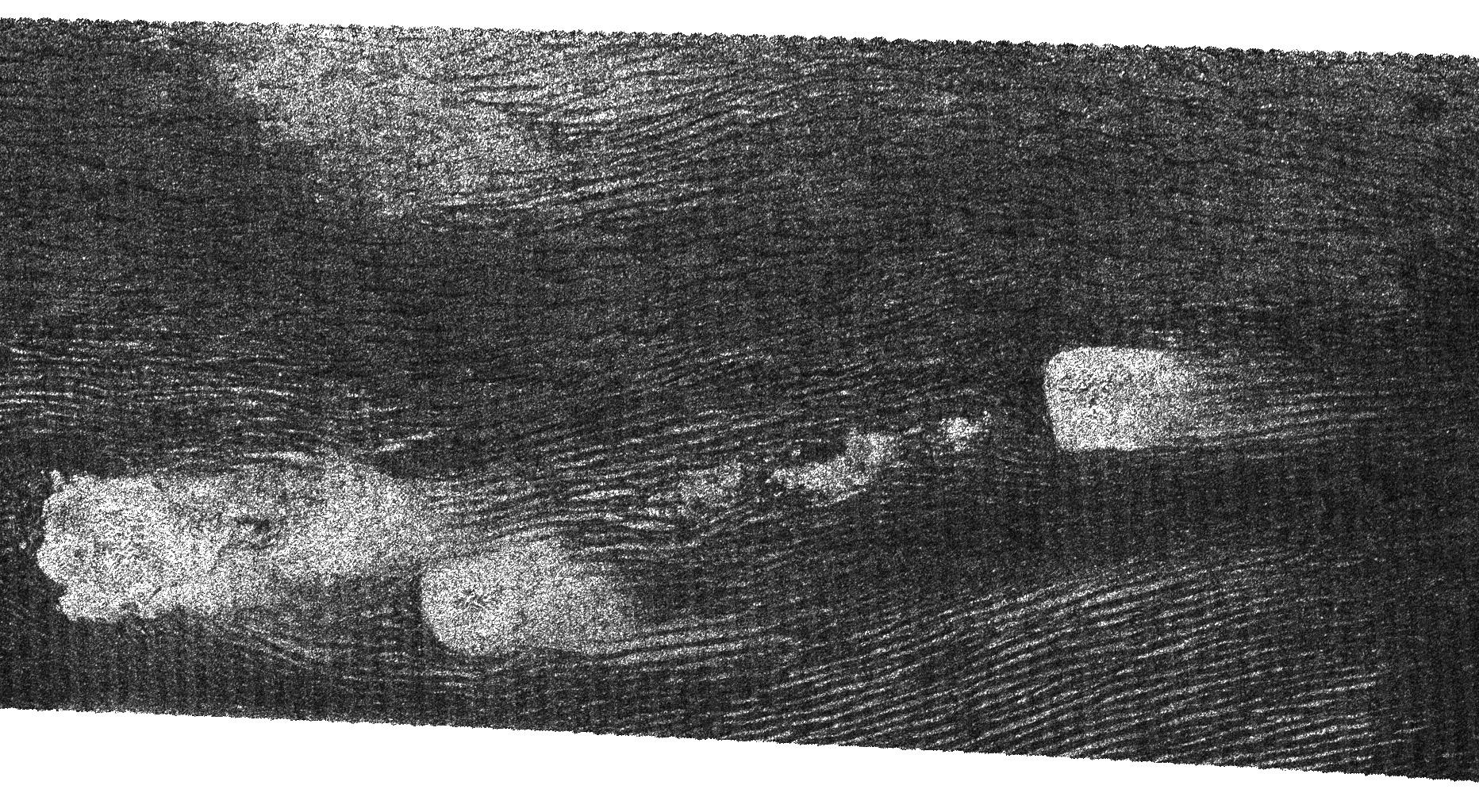
Read the paper and its appendixCassini’s radar revealed long, dark ridges interpreted as longitudinal dunes on Titan, Saturn’s largest moon. Their shapes and orientation help scientists investigate how sediment moves and how wind and terrain shape a landscape. The radar sees through Titan’s haze and records the surface response.
Drive a plate at a resonant frequency and sand gathers along the nodal lines where the plate barely moves. Change the shape, supports or frequency and the pattern can change. Mandala-like symmetry provides a visual bridge to sacred geometry. The plate experiment traces the symmetry to vibration and boundary conditions.

The Mettā Verse · 1729
Maitrī is Sanskrit for friendliness or loving-kindness. Its Pāli counterpart is mettā. In this inquiry, 1729 supplies the image of two paths meeting and maitrī supplies the practice. Try directing the same wish for wellbeing towards someone close to you and towards someone you barely know.
Loving-kindness terminology · Mettā-Awareness · Dune 1729, the science-fiction companion
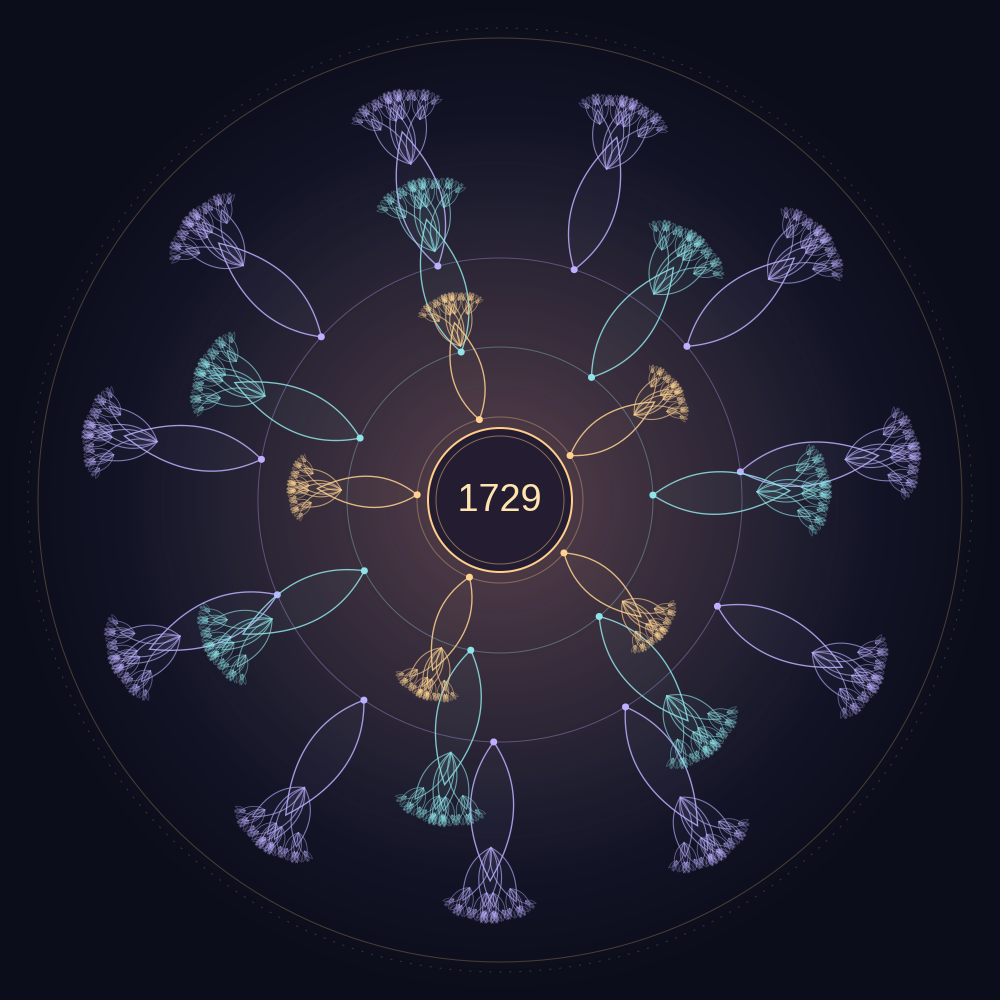
The Geometry of the Mettā Verse
Three rings carry five, seven and eleven petal clusters. Within each cluster, the blade-like motif repeats at smaller scales. The pale outer ring picks out the eleven-fold layer while the seven- and five-fold layers sit closer to the centre.
HOMESENSE900 Companion
AkashicNET Lunar-Base Concept. A prior independent design exercise explored autonomous operations, local resource use and power resilience. Engineering viability and NASA involvement remain unverified. NASA publishes its own Moon Base architecture and schedule.
The Science of Mysticism
Ramanujan’s accounts of Namagiri belong to the story of how he understood inspiration. An equation’s proof gives readers a separate way to test its truth. Ramanujan’s work lets us ask both how an insight feels to the person having it and what another person needs to verify the result.
AkashicNET’s Ramanujan Hub · The Science of Mysticism · A Trip to Infinity on r/NeuronsToNirvana
Count each statement at the level its evidence supports. Page 199 gives a test case of three original claims and one corrected version.
Creative Companion · HOMESENSE900 × AkashicINQUIRY007
Two imagined scenes carry the story between editions. The lunar banner pays tribute to Mitchell and the IONS inspiration. The neon Munich poster turns Hardy’s cab number into a visual link from License to Love to Ramanujan.