
Independent AkashicNET Companion · 11–16 October 2026
Research & Talk Notes
Speaker ideas, research companions and questions to investigate.
17 October 2026 · Archive & Conference Companion
From Stargate to TSC2026
Remote viewing, intention and nonlocal minds: five programme connections, three essential distinctions and a guide to the four books and free archives.
Selected sources examined; full archive review pending.
Explore the Evidence & Open Questions →Consciousness & Wisdom Watch · 16 Oct 2026
From Altered States to Lasting Change
Three developments, three evidence categories: preliminary human findings, a theoretical model and personal testimony. What persists beyond an intense experience?
Independent thematic reading · Empirical Preprint · Theoretical Interpretation · Personal Testimony
Read the three developments & BQ questions →16 October 2026 · Conference Insights
Conscious Beings, Living Worlds
New scientific questions and emerging answers that resonate with ancient traditions. A plain-language synthesis of being and doing, panpsychism, animism, tulpas and the major compiled talks.
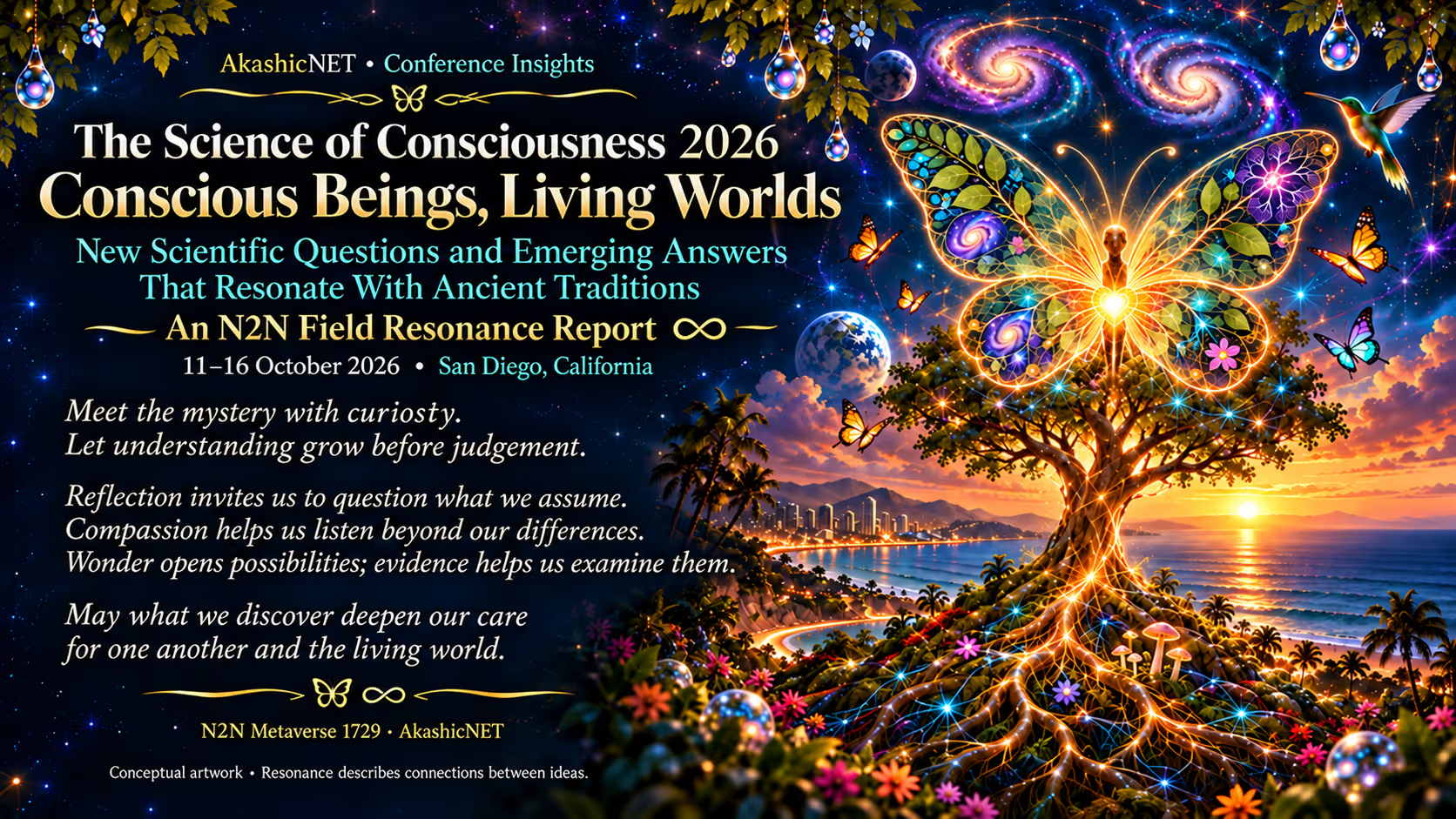
Explore the Overview & Expand the Hero →
Independent synthesis through 15 October. Findings, interpretations and open questions remain distinct. AI-generated symbolic artwork.
New Research Reading: Hide Saegusa · Awakening & the Question of Transmission
MICHAEL LEVIN · 15 OCTOBER 2026 · RESEARCH FOLLOW-UP
When Thoughts Become Thinkers
Speculating on the speculative: seven recent studies, constructive proposals about identity and mind-sharing, and a first experiment on where an interface’s apparent agency comes from. Grounded in bioelectricity, learning and dynamical systems.
AKN24 · 16 OCTOBER 2026 · 2 MIN BRIEFING
Remembered Spaces, Brain Rhythms & a Research Correction
Exploratory NDE research, animal studies of behavioural control and brain rhythms, a supplementary-file correction, NOAA’s dated forecast and Friday’s TSC programme.
DONALD HOFFMAN · 15 OCTOBER 2026 · RESEARCH COMPANION
From Observer Windows to Testable Predictions
Trace logic, hidden states and observer clocks: a worked example, complementary research and a proposed open benchmark.
JONATHAN SCHOOLER · 15 OCTOBER 2026 · TALK REFLECTION
The Kite of Consciousness
Nested observer windows, subjective time and connected minds. Explore the talk’s metaphors, the existing N2N / MultidimensionalCUT connection, and what remains an open research question.
GIULIO TONONI · 15 OCTOBER 2026 · IIT & AI
Being, Doing and Consciousness
What a system does and whether it experiences: IIT, the felt structure of space, and an AkashicNET reflection on why performance is not the measure of a life.
TSC2026 Epiphany · Personal Philosophical Reflection · 13 October 2026
Body, Mind & Reality
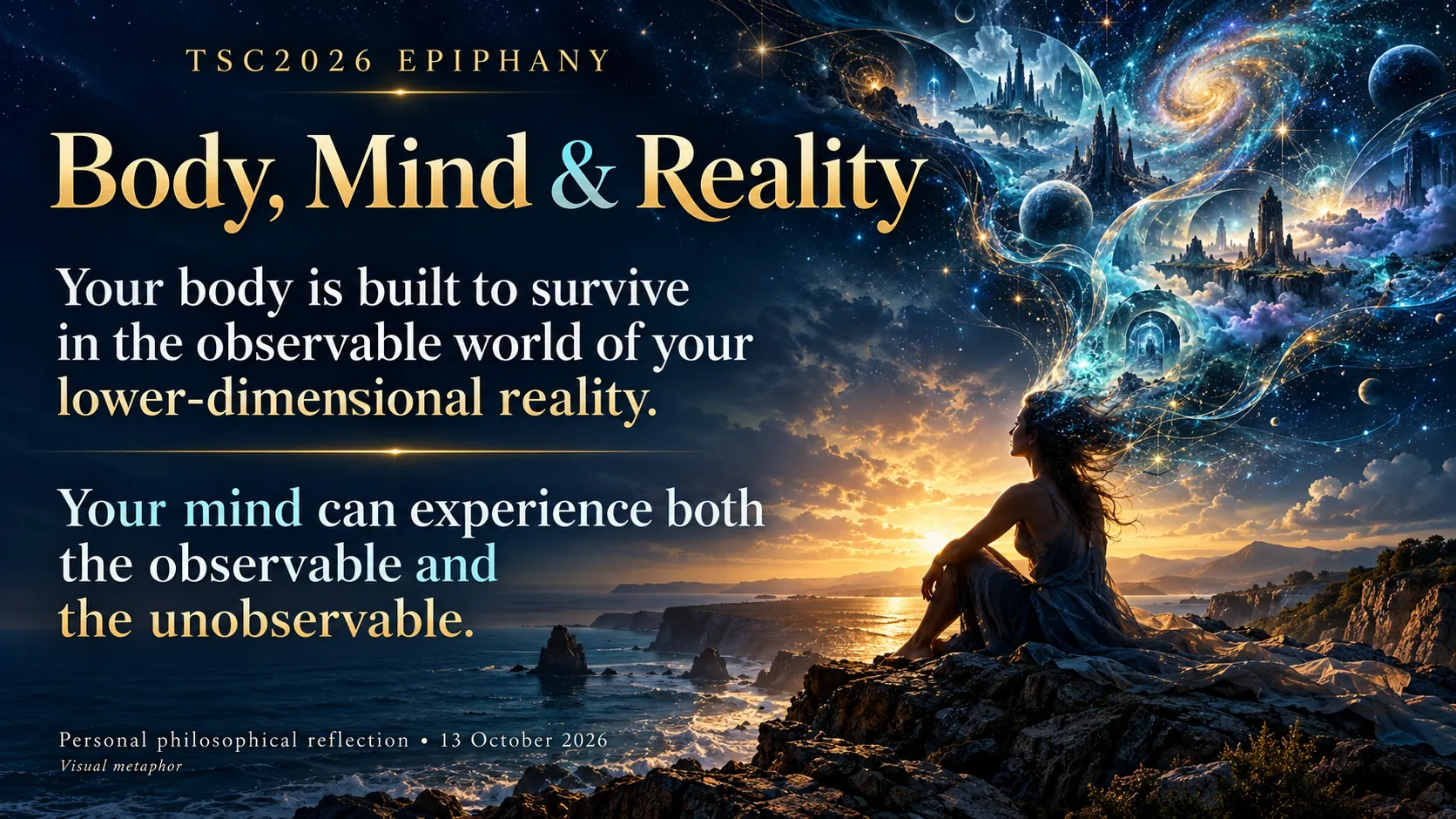
“Your body is built to survive in the observable world of your lower-dimensional reality.”
“Your mind can experience both the observable and the unobservable.”
How much of reality does our experience reveal, and how much does it leave out?
The wording expresses a personal philosophical perspective. “Lower-dimensional” and “unobservable” are used as metaphors here. An inner experience can be meaningful while what it represents remains uncertain. This reflection is not an experimental finding or an official conference statement.
New · 14 October 2026 · TSC2026 Inspired Q&A
Diane Hennacy: Unfiltered Consciousness
Toroidal fields, ion signalling and CSF flow: a question about measuring the proposed mechanism and distinguishing filtering from brain-generated consciousness.
Read the Q&A & Expand the Visual →
Independent commentary. Related research is labeled experimental physiology, hypothesis or preprint modeling; a toroidal consciousness mechanism is not established.
New · 13 October 2026 · Research Analysis
Past-Life Memory, Time & Awareness
A discussion brief for Saeedeh Sadeghi: the reported timing pattern, planned studies of memory and identity, and the distinction between externally measured time and hypothetical subjective duration.
Read The Analysis & Questions for Saeedeh →
Independent AkashicNET analysis. Observational evidence; mechanism unresolved. Includes a proposed provenance and replication contribution.
TSC2026 · 13 October 2026 · Current Research Discussion
Mitochondria, Microtubules & Consciousness
Many mechanisms, one experience? Neven’s anesthetic isotope programme raises questions about spin chemistry and cellular energy. Compare mitochondria, microtubules, receptors, membranes and brain networks through multi-perspective, meta-perspective and mettā lenses.
Read the evidence comparison, intention research limits and questions →
Conference findings · Proposed mechanisms · Independent source comparison. No quantum generator of experience or intention-driven co-creation is established here.
AkashicNET × AkashicOMNI · 13 October 2026
Does Pleasure Drive Evolution?
Farhan Lakhany’s critique of the Quantum Pleasure Principle raises three questions: can molecules be agents, how could pleasure change their behaviour, and how could values relate to physical spacetime patterns?
Our conference analysis compares these arguments with research on pleasurable chills, bodily feedback and meditative self-transcendence. Feeling, motivation and mechanism remain distinct claims.
Read the analysis, twelve-perspective review and research questions →
Theoretical proposal · Philosophical critique · Source-linked interpretation. The analysis does not establish a quantum explanation of chills.
HIERATIC · Contemplative Synthesis · 12 October 2026
Distinct Selves, Shared World
Independence and interdependence · The Science of Consciousness 2026 [San Diego · 12 October 2026]
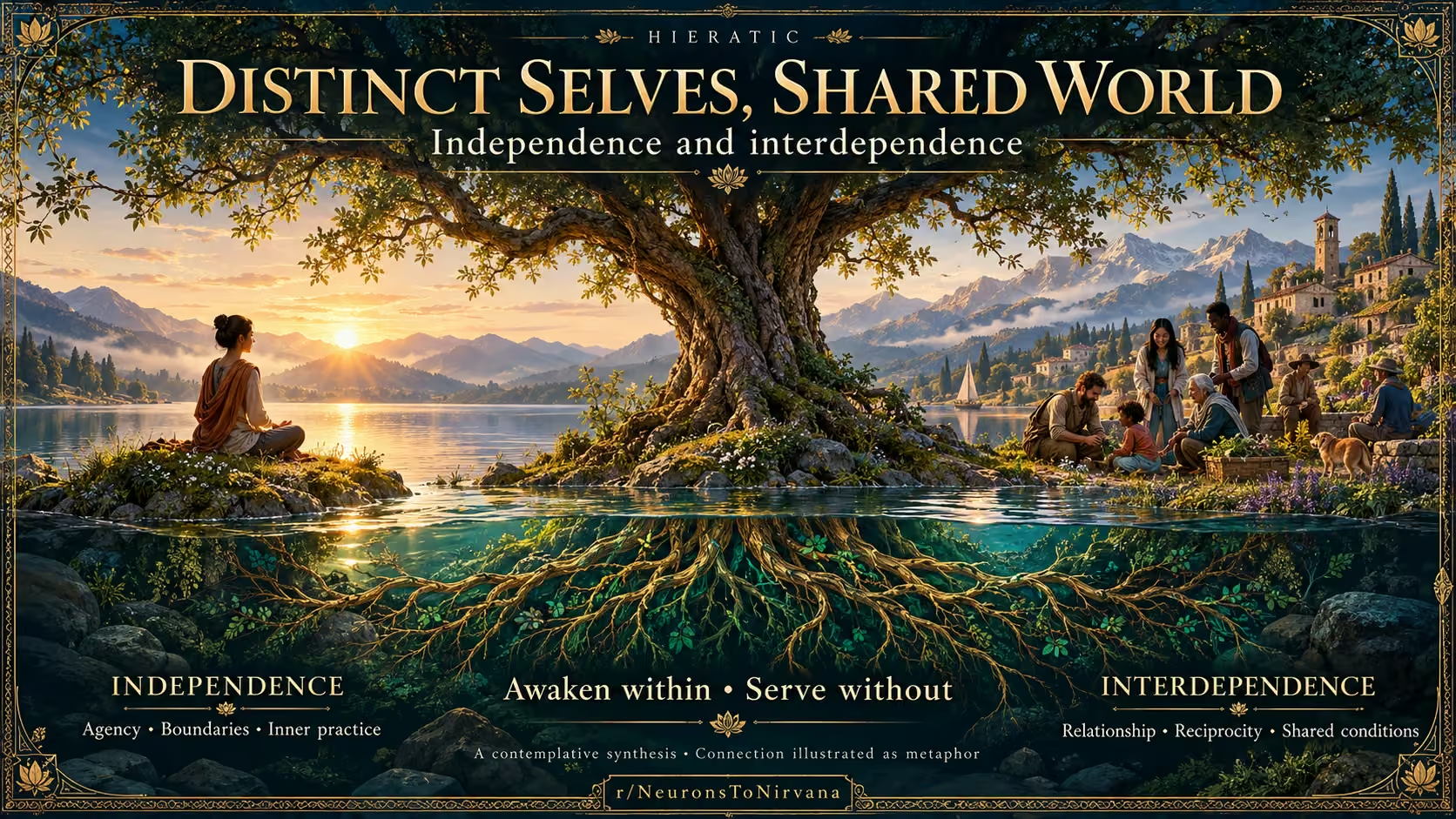
Individual agency and healthy boundaries can coexist with belonging and mutual care. Inner practice is personal, while everyday life unfolds through relationships, communities and the living world.
This independent reflection grew from a conversation around Chuong Ngo’s presentation on meditative states across contemplative traditions. It connects inner practice with compassionate action without treating these themes as experimental findings.
Evidence category: interpretation and artistic metaphor. This is an AkashicNET / r/NeuronsToNirvana synthesis, not a quotation, research result or endorsement by the speaker or conference.
Resonance Field Report · Personal Reflection · 12 October 2026
Nondual Awareness, Boundless Awareness and the Bodhisattva Vow
An independent AkashicNET reflection inspired by The Science of Consciousness 2026 [San Diego · 12 October 2026]. How might the felt qualities of awareness relate to the commitments we bring into everyday life?
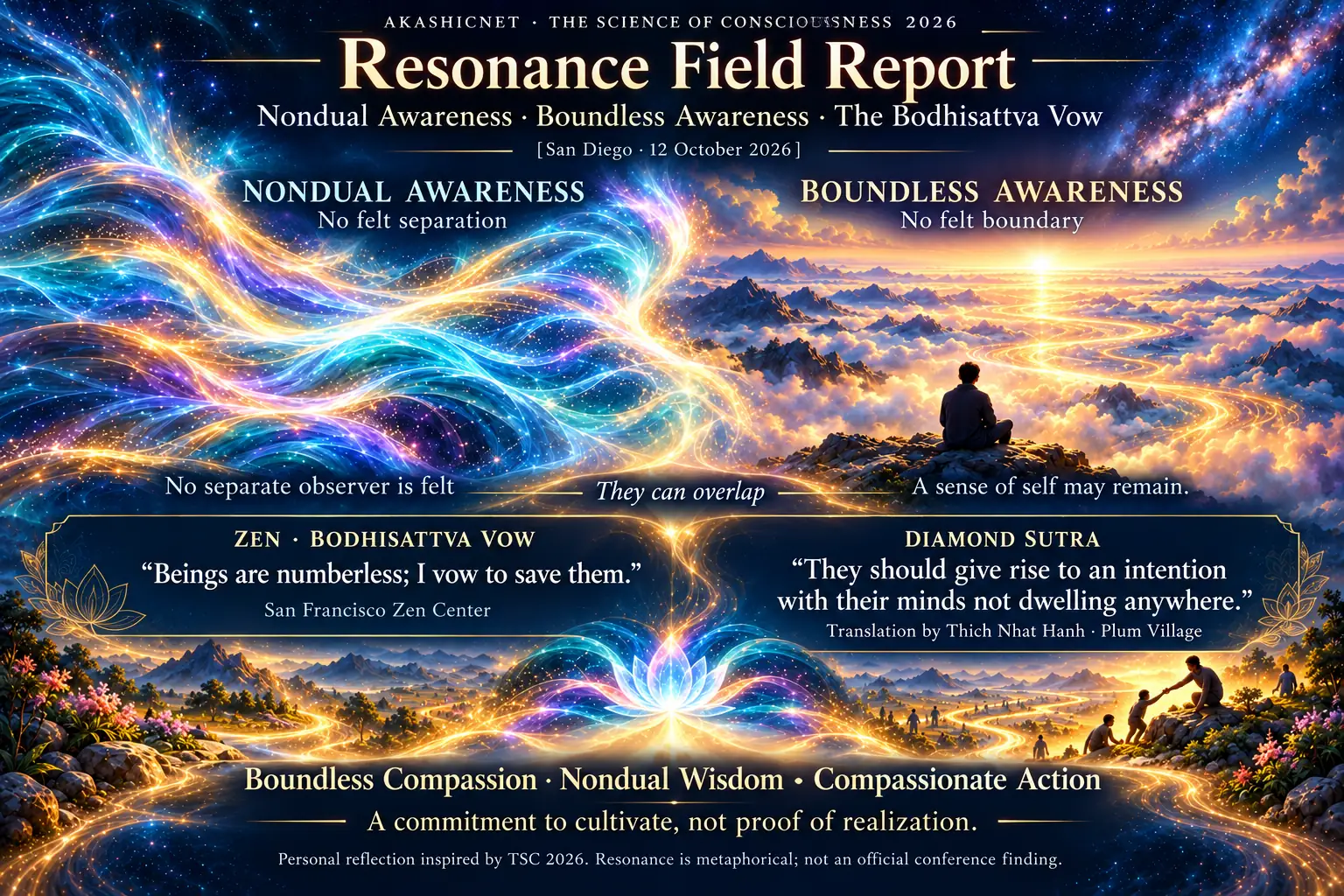
Nondual awareness describes experience without a felt observer–observed split. Boundless awareness describes openness without a discernible felt boundary; a sense of a separate observer may remain. These qualities can overlap, and terminology varies across traditions.
The Bodhisattva vows are commitments. Their boundless scope concerns compassion for all beings. Their relationship to nondual wisdom concerns releasing fixed ideas of self and other. Taking a vow expresses an intention to practise; it does not itself establish realization.
Zen · Bodhisattva Vow
“Beings are numberless; I vow to save them.”
Diamond Sutra
“They should give rise to an intention with their minds not dwelling anywhere.”
The Diamond That Cuts through Illusion · Translated by Thich Nhat Hanh · Plum Village ↗
The three-part synthesis is AkashicNET’s interpretation, not a traditional quotation. “Resonance” means a thematic connection, not a measured physical field. This personal reflection is not an official conference finding or a quotation from a TSC speaker. The artwork does not establish that consciousness is infinite or independent of the brain. Source wording checked on 12 October 2026.
Neuroscience of Consciousness · Terrence Sejnowski · The Science of Consciousness 2026
Travelling Brain Waves, Memory and Consciousness [12 October 2026, San Diego]
Explore the connection between measured sleep-spindle waves and Sejnowski’s proposed mechanism for long-term working memory. Switch between the two views to see which links are observed and which remain hypotheses.
Open the interactive visual on its own →
Observed: recordings from five clinical patients during stage 2 sleep revealed rotating spindle-wave patterns, some repeating precisely through the night. Their role in strengthening distributed memories was proposed, rather than directly demonstrated by those recordings.
Hypothesis: travelling waves coordinate spike timing through inhibitory basket cells, triggering spike-timing-dependent plasticity (STDP). The resulting temporary cortical network could support long-term working memory alongside ongoing sensory and motor processing. The conference slide extends this proposal to a global workspace for consciousness.
Question to test: does disrupting precise timing, while preserving average activity and basic sensory function, selectively impair memory? The further claim about consciousness requires evidence beyond memory performance or the presence of travelling waves alone.
Independent, AI-assisted AkashicNET educational synthesis of attendee-provided slides and primary publications, created 12 October 2026. The diagrams are schematic, not experimental recordings or simulations. This is not a transcript or speaker-endorsed account.
Sources
- Muller et al., eLife: Rotating waves during human sleep spindles organize global patterns of activity that repeat precisely through the night [15 November 2016]
- Sejnowski, Biological Cybernetics: Dynamical mechanisms for coordinating long-term working memory based on the precision of spike-timing in cortical neurons [13 May 2026]
Everyday Practice · Eric Garland · The Science of Consciousness 2026
MORE: Mindfulness, Reappraisal & Savouring for Everyday Life [Origins: 2006]
An interactive introduction to Mindfulness-Oriented Recovery Enhancement, Eric Garland’s therapeutic programme. Select each practice to explore how noticing, shifting perspective and attending to everyday pleasure can work together.
Open the interactive visual on its own →
From a Temporary State to Everyday Change
Garland’s TSC presentation explores whether meditative experiences of self-transcendence and nondual awareness contribute to lasting mindfulness and reduced suffering. His abstract also discusses psychedelics and interpersonal synchrony. These proposed mechanisms are distinct from evidence about the clinical outcomes of MORE itself; the programme does not require psychedelics.
Origins: 2006. Garland’s account traces the initial conception to 2006, followed by funding to develop and test MORE in 2008 and pilot results published in 2010. An origin month has not been verified.
Independent, AI-assisted AkashicNET educational visual, created 12 October 2026 from the published abstract and primary sources. This is an introduction to the programme, not its full treatment protocol or a transcript of the live talk. The state-to-trait pathway is a research model, not a guaranteed outcome.
Sources
Contemplative Philosophy · Eric Garland · The Science of Consciousness 2026
Awareness and Seamless Unity
“Awareness brings about the fusion of everything in complete nonduality, causing one to relish in all things as a seamless unity”
Kṣemarāja, Pratyabhijñāhṛdayam, approximately 1100 CE, as attributed on Eric Garland’s slide.
Quoted by Eric Garland during Self-Transcendence and the Brain: How Meditative- and Psychedelic Nondual States Transform Consciousness to Reduce Suffering.
The Science of Consciousness 2026 [San Diego, California | 12 October 2026]
Transcribed from an attendee’s photograph of the presentation slide titled “Self-Transcendence as a Mechanism of Mindfulness.” The English wording and approximate historical date reproduce the slide’s attribution; the translation edition has not been independently identified. This is a contemplative philosophical quotation, not an empirical finding.
The Science of Consciousness 2026 · San Diego, California · 12 October 2026
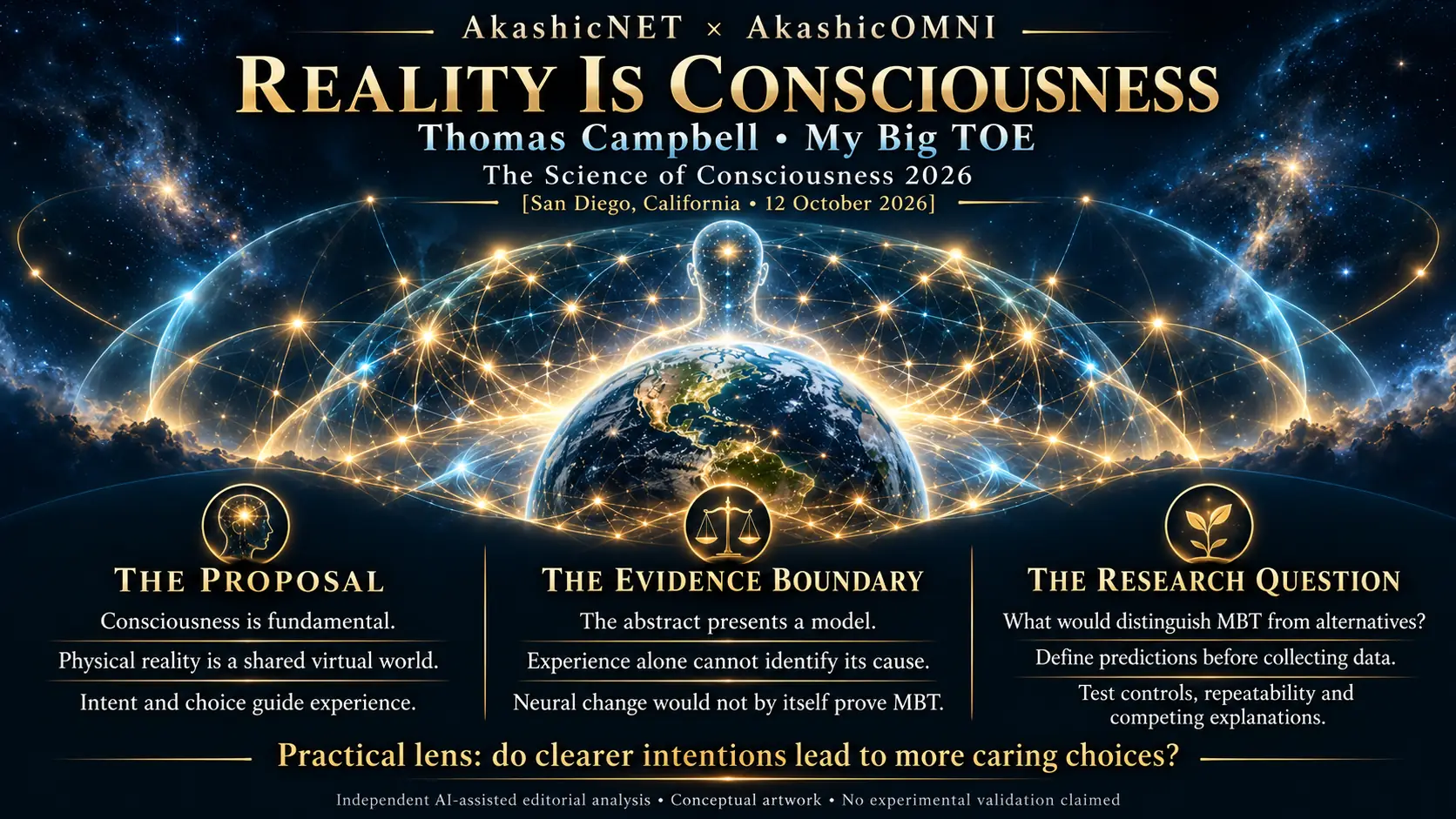
Thomas Campbell: Reality Is Consciousness
PL-2: Contemplation and Consciousness · Paradise Ballroom. The official programme lists Campbell with Francis Lucille in the session beginning at 11:10 am PDT. This is the session start, not an individual speaker time.
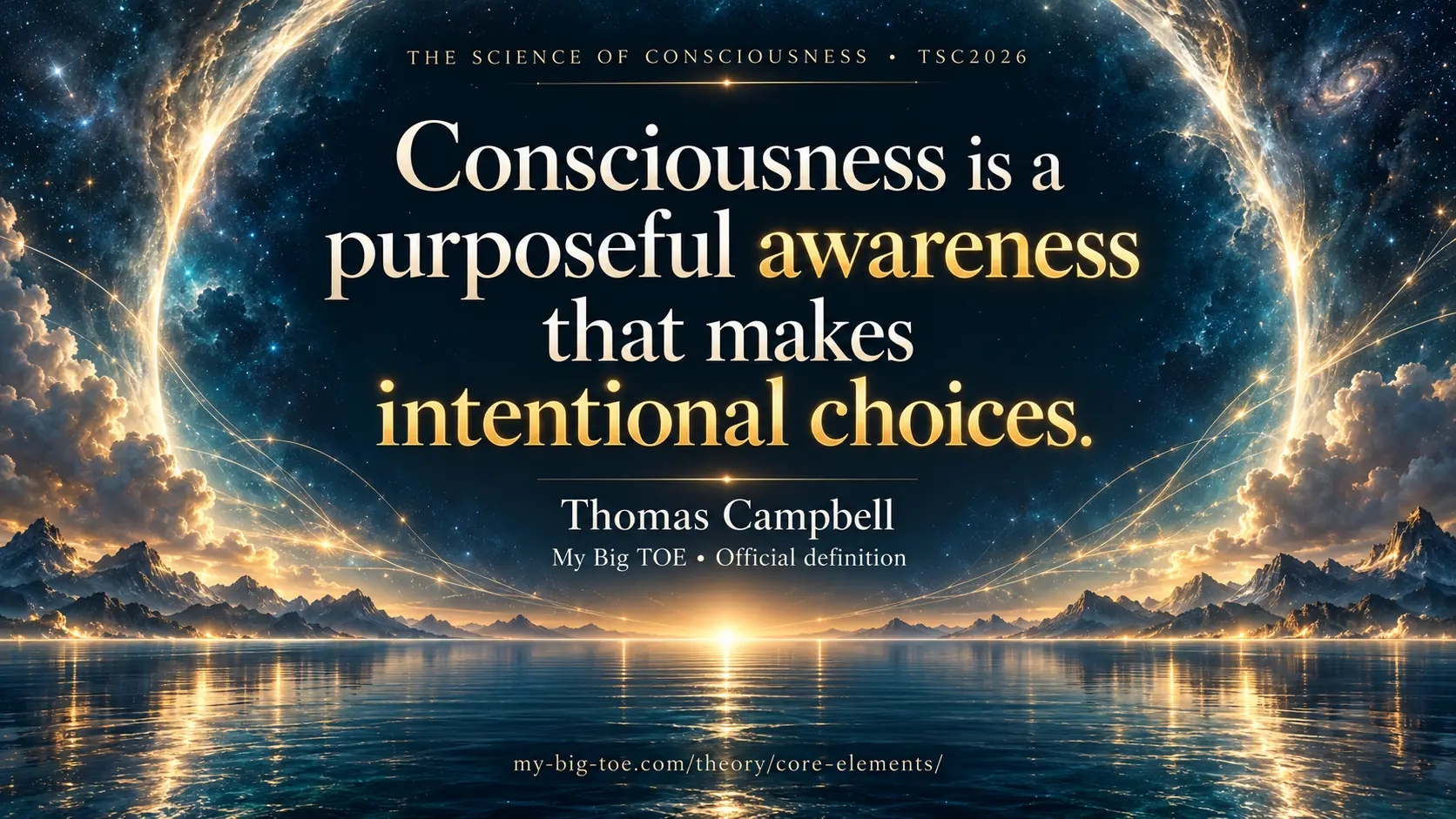
Awareness With the Ability to Choose
“Consciousness is a purposeful awareness that makes intentional choices.”
Definition published on the official My Big TOE website. It is not presented here as a verified verbatim quotation from the conference talk.
Four Ideas in the Model
- Consciousness first: the conference abstract proposes that consciousness is fundamental and the physical universe derives from it.
- Reality as information: physical experience is described as a shared virtual reality generated by a Larger Consciousness System.
- Awareness, intent and choice: individual consciousness makes purposeful choices; the model describes the brain as constraining the human experience.
- Growth through care: the wider My Big TOE account connects development with cooperation and love, using consciousness entropy as its explanatory language.
Open question: Which observations would distinguish this model from competing explanations of consciousness?
Analysis: The abstract outlines a proposed explanation. A felt change in awareness does not by itself identify its cause, and a measured neural change would not uniquely establish My Big TOE. A discriminating study would specify predictions in advance, compare alternatives, use appropriate controls and seek independent replication.
These are attributed propositions, not independently established findings. This entry synthesises the published abstract and website; it is not a transcript or a complete review of the live presentation. No speaker or conference endorsement is implied.
Programme and Primary Sources
- Official TSC2026 programme
- Campbell’s talk abstract: Reality is Consciousness
- My Big TOE: core elements and the quoted definition
- My Big TOE: consciousness evolution, cooperation and love
- How to engage with the model: open-minded skepticism
From My Big TOE to a Shared Research Question
AkashicNET × AkashicOMNI analysis · 12 October 2026. The most useful potential symbiosis is a concrete contribution: help make one specific prediction independently testable. The following is a preliminary review of public sources and a proposal for discussion with Thomas Campbell. It is not an agreed collaboration or an evaluation run by AkashicOMNI software.
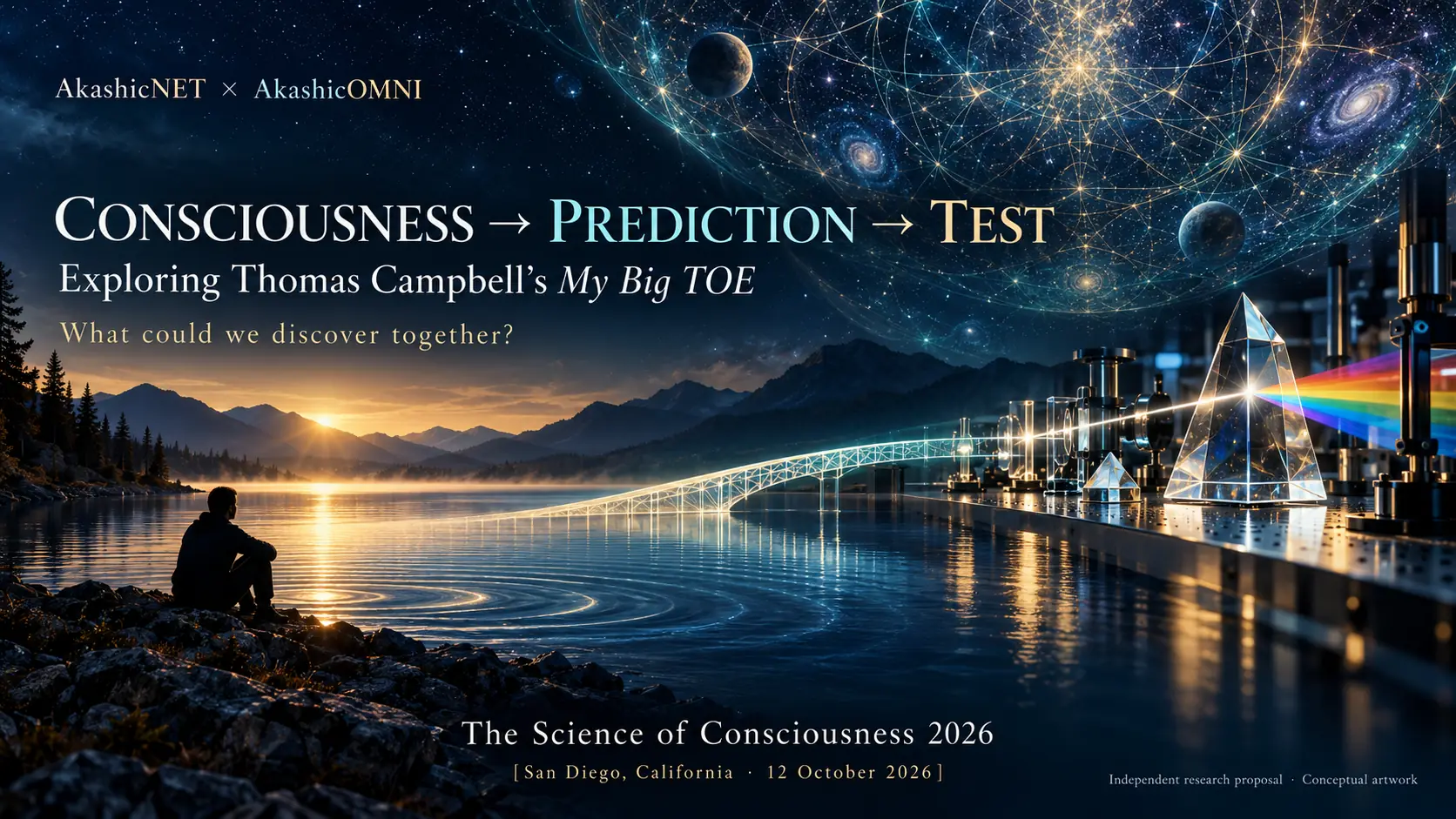
A Proposed Foundation for Future Physics
Campbell presents My Big TOE as a route toward physics grounded in consciousness. His TSC abstract proposes deriving physical reality, including quantum uncertainty and relativity, from a finite-resource simulation. Describing MBT as the future of physics expresses the ambition of this programme; it is not an established outcome or a verified verbatim quotation from the live talk. Read the abstract.
Our assessment separates three questions: Is the model conceptually coherent? Does it reproduce existing observations quantitatively? Does it predict something that competing accounts do not? An illuminating interpretation can be valuable without yet answering all three. A test becomes especially useful when the alternatives predict different observable outcomes under the same conditions.
What the Experimental Programme Asks
The 2017 paper On Testing the Simulation Theory, by Campbell, Houman Owhadi, Joe Sauvageau and David Watkinson, proposes wave–particle experiments under an assumption of limited computational resources. A central distinction is between detection by a machine and information becoming available to an observer. This is a proposed experimental framework, not itself a report establishing that reality is simulated.
The official experiments page describes conditional expectations and a research programme involving Cal Poly Pomona. It also allows that unexpected findings might mean the proposed rendering process needs revision. That makes an advance statement of what would change the theory particularly valuable. This website-level review has not independently audited the apparatus, raw data or complete mathematical derivations.
Our recommendation: distinguish an anomalous result from an explanation of that result. A departure from one prediction would not automatically identify consciousness as its cause or establish the whole MBT framework. Specify the candidate mechanisms, measurement uncertainties and alternative accounts before interpreting the outcome.
Where CUSAC and AkashicNET Could Meet
CUSAC is the Center for the Unification of Science and Consciousness, the organisation named on Campbell’s presentation slide. Its public initiatives include physics and consciousness research, PlayerMind and the MindSwan Prize. The possibilities below are our suggestions, not commitments from CUSAC.
| Existing work | Possible contribution | First question |
|---|---|---|
| PlayerMind: a planned platform for preregistered quantum-randomness studies within video games; the site says it is fundraising to build it. | Clear protocols, auditable data provenance, reproducible analysis and accessible explanations of both positive and null results. | Which documentation or analysis task would be useful now? |
| AI Guy: an existing MBT assistant providing references to books and video timestamps. | An evidence map connecting a claim to its prediction, protocol, supporting or conflicting results and unresolved questions. | Would that complement the existing assistant, and who could review its accuracy? |
| Consciousness evolution: MBT connects personal development with care and cooperation. | A modest study connecting reported contemplative changes with observable everyday choices. | How should we distinguish a powerful temporary state from durable behavioural change? |
AI Guy already addresses explanation and source discovery. A complementary contribution would therefore emphasise evaluation: what a source claims, what has actually been tested, what remains uncertain, and what would count against the claim. Faithfulness to an author’s position and independent scientific validation are different measures.
Questions to Ask Thomas in Person
Suggested opening: “Thomas, which specific prediction would you most like an independent team to test—and could we help make the protocol, data and competing explanations openly reviewable?”
- Define the observer. “Your proposed experiments distinguish machine detection from information becoming available to an observer. What precisely counts as observation, and how can we vary that without changing the physical apparatus?”
- Name the quantitative difference. “For one experiment, what does MBT predict numerically, what does the comparison model predict, and how large must the difference be to distinguish them?”
- Make revision possible. “What result would make you change a core assumption of MBT, rather than adjust how the simulation renders reality?”
- Find a useful contribution. “Would a source-grounded evidence map complement AI Guy—and who should we work with on a small pilot?”
- Connect practice to daily life. “How would you distinguish a quieter, absorbed state from lasting improvement in the quality of someone’s choices?”
- Enable independent checking. “Which protocol, dataset or paper can we examine, and what part of the work is ready for replication?”
These are proposed questions, not questions already answered by Campbell. A productive next step would be to leave the conversation with one prediction, one relevant paper or dataset and one named collaborator.
A Small First Project: One Prediction, Fully Traceable
We propose a bounded, jointly reviewed research package. Start with a single claim selected with the research team, and agree on the contribution before building anything substantial.
- Record the claim: exact source, date, scope and assumptions; separate Campbell’s words from our interpretation.
- Specify competing predictions: measurable outcomes, uncertainty, relevant alternatives and conditions that would change the conclusion.
- Freeze the plan before results: protocol, primary outcome, exclusions, stopping rule and analysis decisions.
- Make the analysis inspectable: a data dictionary, provenance record, versioned code and a reproducible notebook, with a clear distinction between synthetic examples and actual observations.
- Publish what happened: results, deviations, limitations and remaining disagreements; invite independent replication and report null findings as carefully as positive ones.
AkashicNET could potentially contribute explanation, source organisation and research communication. Any claim about additional AkashicOMNI capabilities would first need a working demonstration. No team, data access or experimental resources are assumed to be available.
A Separate Contemplative Research Track
A daily practice study could ask whether a quieter subjective state is associated with changes in attention, wellbeing or caring behaviour. An initial design could use a baseline period, a defined practice, repeated experience reports and prespecified behavioural measures, followed by a suitable comparison condition. Physiological measurements, if included with qualified collaborators, would answer additional questions about bodily correlates.
A personal diary could generate hypotheses; a controlled study would be needed for stronger causal conclusions. Changes in brain activity or nervous-system measures would not by themselves distinguish MBT from other explanations. Likewise, a mathematical entropy measure should not be equated with Campbell’s idea of consciousness quality without an explicit definition and validation.
Working principle: take experience seriously, make the interpretation explicit, and ask what observation could help different explanations diverge.
Research Sources and Public Discussion
- Campbell and colleagues: On Testing the Simulation Theory (2017)
- My Big TOE: experimental programme and expected outcomes
- CUSAC: current initiatives and development status
- AI Guy: existing assistant and source references
- My Big TOE: consciousness evolution
- Discuss the earlier visual on Reddit · View the earlier visual on X · Thomas Campbell: @TomCampbell_MBT
Human-directed, AI-assisted editorial synthesis. Sources reviewed 12 October 2026. This is a preliminary analysis of the linked public material, not a full literature review, a live-talk transcript, an established partnership or experimental validation.
11 October · Session Notes in Progress
NDEs, OBEs & Past Life Memories
Research at the Edge of Consciousness, from the Bay View Room. Follow an evolving photo-led record, with presentation findings, limitations, open questions and personal reflections kept distinct.
Sixteen photos received. Now includes a remote-viewing hero visual, Fleming’s proposed process, his definition, experimental framing and coordinate-viewing procedure. Detailed controls and results are pending.
Open The Session Notes →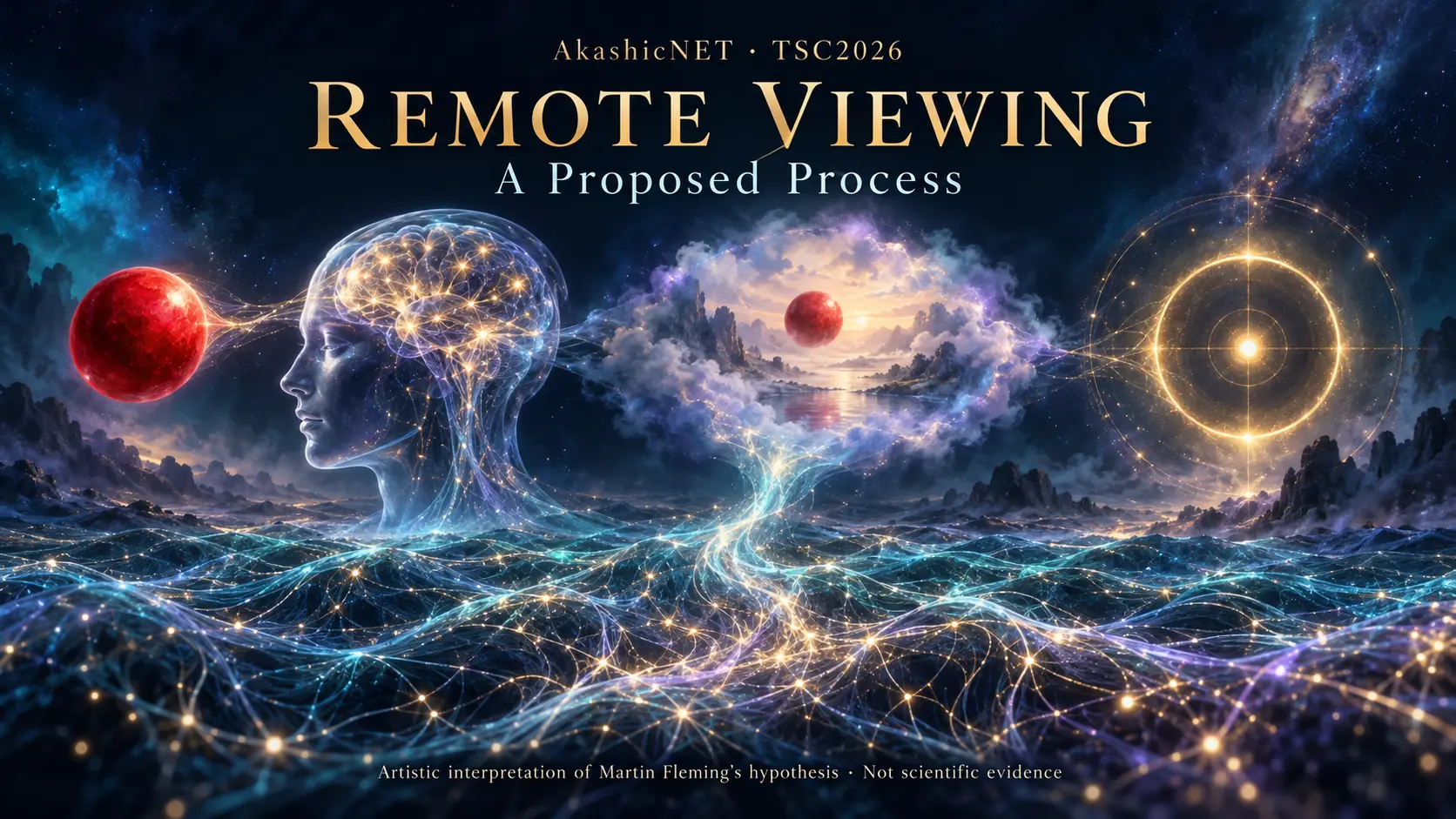
Updated 10 October · Review v1.1 · AkashicOMNI v0.5.0
Plasma & Consciousness: The Missing Jigsaw Pieces
A preliminary reading of Dana Kippel’s conference proposals, with all twelve public perspective roles, competing explanations and evidence still needed. New: a discussion invitation to revisit after hearing and reflecting on both talks.
What could distinguish self-organisation, intelligence and conscious experience? The update records the supplied poster and #experiential screenshot context while keeping the obscured Discord message unverified. Neither full talk has yet been reviewed.
Explore The Discussion Question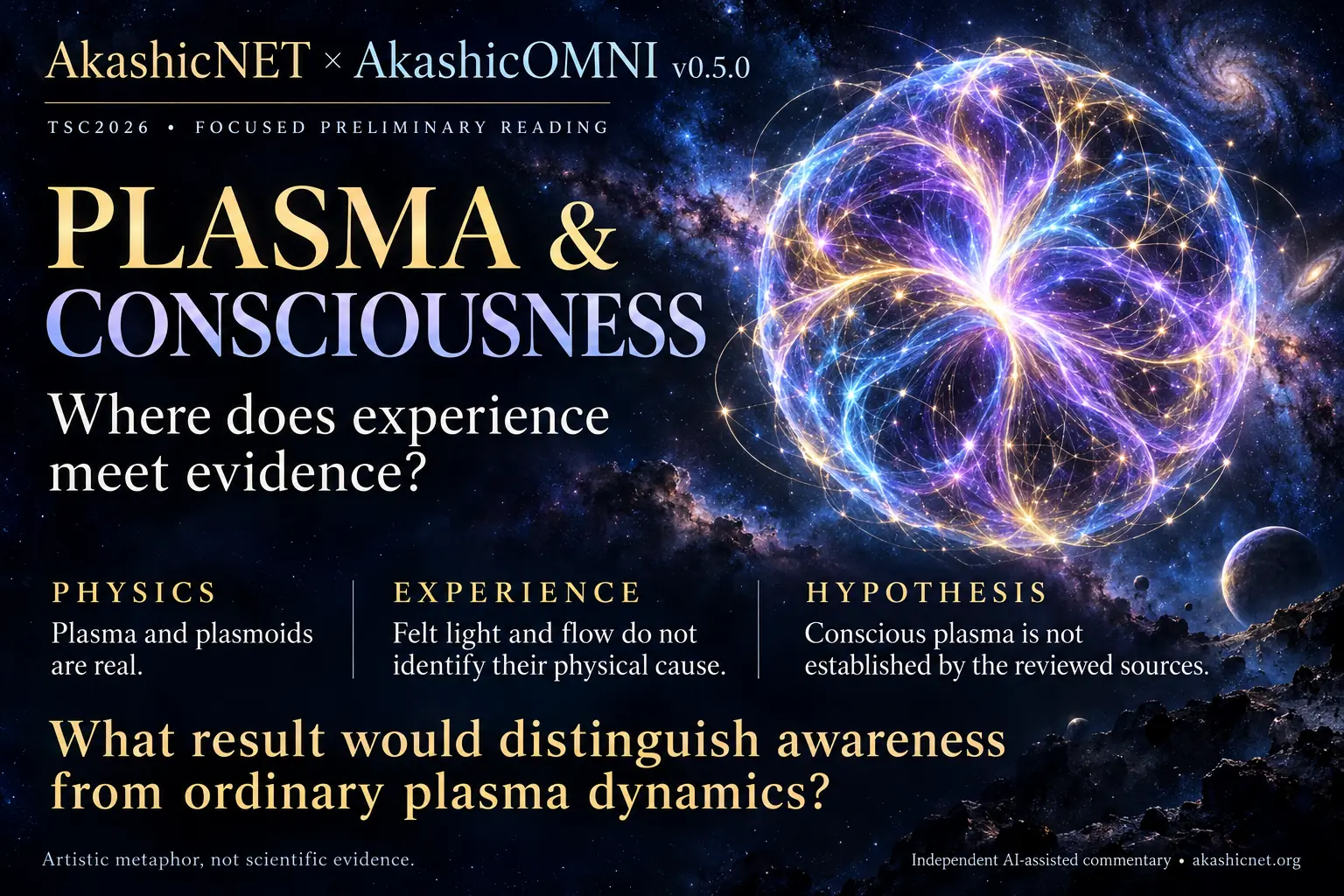
Conference discussion · AkashicOMNI
Is Consciousness Multiscale?
A question for Stuart Hameroff: which experiment could distinguish an Orch OR-specific contribution from conventional explanations? Read the evidence map and download the A4 handout or full report.
Explore the discussion and downloads