The Quantum Test
Recover the Bell Pair
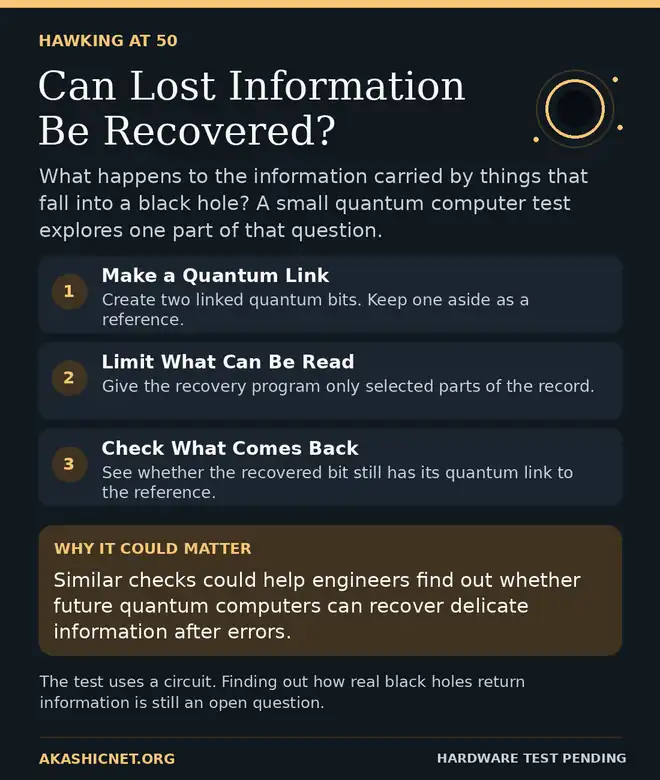
Prepare an entangled pair. Keep the reference untouched. Decode from the allowed registers and measure XX, YY and ZZ to estimate Bell-state overlap.



AkashicINQUIRY Special · 15 November 2026
Can we recover the quantum state? Fifty years after Hawking’s information-loss paper, this companion puts one part of the question to a circuit test. Can a decoder recover entanglement with an untouched reference qubit when it can access only selected registers?
Level 6/10 · Calibrated QPU Run and Independent Reconstruction Pending
Download the 12 Reference Circuits · Download the Results Intake · Help Run or Review the Test
The Quantum Test
Prepare an entangled pair. Keep the reference untouched. Decode from the allowed registers and measure XX, YY and ZZ to estimate Bell-state overlap.
What I Need to Support This
Next Steps & Requirements
Under the fixed protocol, the exchange decoder will restore Bell correlations with the untouched reference. The four arms compare exchange recovery, the SWAP validation control, QMM-inspired output-only access and a global inverse with broader access. Calculate Bell overlap as (1 + ⟨XX⟩ − ⟨YY⟩ + ⟨ZZ⟩) / 4.
Positive certification requires both exchange and SWAP overlap estimates to exceed 0.562 and calibration evidence supporting an additive witness-bias bound of 0.02 or less. The primary raw-shot error budget is α = 0.01. Carry uncertainty in the calibration bound into the decision.
A failed SWAP control or an unsupported calibration bound leaves certification unresolved. A valid run with adequate precision can count against the recovery prediction under the tested device conditions. Record uncertainty, inconclusive results and any deviations.
All twelve reference circuits matched their ideal expectations in software. The first hardware run and independent reconstruction are pending. Any gravitational interpretation needs a separate physical mapping from the circuit to black-hole degrees of freedom.
AkashicINQUIRY Addendum · 15 November 2026
A radiation entropy curve tracks how mixed the collected radiation is. Vardian’s preprint takes a further step in a specified gravity model by giving a mathematical way to represent a black-hole interior observable in the radiation. The circuit asks a hands-on version of the access question. Can you recover a known quantum link using only the pieces you are allowed to reach?
Compare recovery with limited access and recovery with broader access. If the outcome changes, which pieces the decoder can use are part of the explanation. A successful run would validate the test on that device. Similar checks could help engineers verify recovery in future quantum computers. Connecting the result to a black hole would require a physical model of the relevant radiation.
Read the Gravity Research and Its Assumptions
We’re looking for a lab that can run the 12 settings on a calibrated QPU and an analyst who can reconstruct the Bell overlaps and apply the fixed rule from the raw histograms.
QMM phase recovery. The revised pilot writes to a memory qubit, resets the original qubit and reads the memory back. It compares coherent storage with deliberately scrambled phase and erased memory. The ideal predictions have been checked in simulation. The revised design compares the usual 0 and 1 outcomes with two measurements that capture relative phase. The three kinds of measurements are labelled XX, YY and ZZ in the protocol. The first hardware run is pending. The earlier pilot is described in the QMM Research Review.
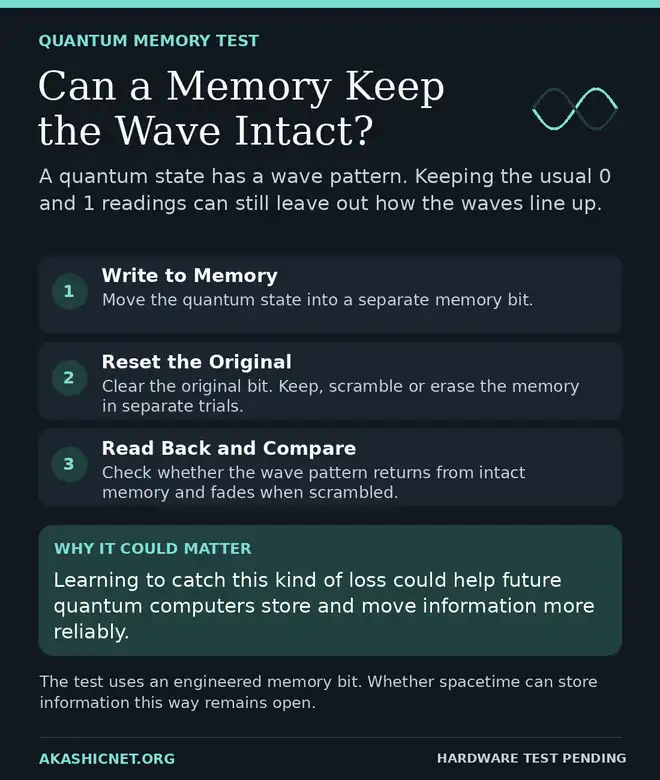
The read-back should preserve the usual bit readings and the wave pattern.
The usual bit readings can agree even as the wave pattern disappears from the pooled results.
Reset the memory and check whether the link to the untouched reference is lost.
Hoffman’s spacetime interface. To test whether his observer dynamics could give rise to QMM-like memory, derive a quantitative mapping to a phase-sensitive readout and a prediction that differs from a matched ordinary quantum memory. Hoffman–QMM Hypothesis