What It Adds
Different meanings of “information” are separated; QMM and white-hole mechanisms are compared; intuitive possibilities become explicit research questions; progress is recorded without declaring a metaphysical answer.


AkashicNET × N2N × AkashicOMNI v0.5.0
50th Anniversary Feature🌌🕳️ Stephen Hawking · Breakdown of Predictability in Gravitational Collapse
✨ 50th Anniversary · International Week of Science and Peace • 15 November 2026
A spiritual–scientific EXPAND² inquiry. Moving the questions forward through imagination, source comparison and proposals for the next useful test.
Published
On 15 November 1976, Physical Review D published Stephen Hawking’s paper asking what happens to information when a black hole evaporates. Fifty years later, the anniversary falls on the final day of the UN’s 2026 International Week of Science and Peace. The week began as a non-governmental initiative in 1986 and was formally recognised by the UN General Assembly in 1988.
Scientific cooperation can start with something as practical as sharing a method so someone else can try it. In that spirit, AkashicNET is marking the anniversary by revisiting Hawking’s question in plain English and sharing a proposed quantum-computing benchmark for others to examine and, if they have access to suitable hardware, run independently.
As Captain Jean-Luc Picard, Sir Patrick Stewart made room on the bridge for curiosity, diplomacy and compassion. On this anniversary, we remember what he brought to Star Trek and to generations of viewers. Rest in peace, Sir Patrick.

“You are me, and I am you,” wrote Thích Nhất Hạnh in Interrelationship. I hear an echo in Tat tvam asi, “You are that”, and in Sarbat da bhala, the Sikh prayer for the welfare of all. May that kinship guide how we treat one another.
Namaste 🙏🏽 · Om Shantih Shantih · Sat Sri Akal
Two companion readings carry the reflection further. See Shiva Nataraja at LACMA and CERN and read how Fermilab’s DUNE could test an extra-dimension hypothesis.

Imagine standing at the edge of what you can know. Something crosses a horizon. Its familiar form disappears from view. Has its history ended, or has your access to that history changed?
A spiritual perspective can make this question personally resonant: what do we mean by continuity, transformation and the relationship between a part and a whole? A scientific perspective asks us to name the system, specify the mechanism and identify observations that would distinguish possible answers.
What if moving forward begins by asking more precisely: what persists, where, in what form and accessible to whom?
This reimagining contributes a map between questions. It does not propose a new quantum-gravity theory. Its value will depend on whether that map exposes a missing assumption, a useful calculation or a better experiment.
Different meanings of “information” are separated; QMM and white-hole mechanisms are compared; intuitive possibilities become explicit research questions; progress is recorded without declaring a metaphysical answer.
No combined QMM–white-hole dynamics has been derived here. No result here demonstrates a cosmic memory accessible to minds, continued personal identity or a multiverse information channel.
On 15 November 1976, Stephen Hawking argued that black-hole formation and complete evaporation could turn a pure quantum state into a mixed final state. His proposed superscattering map replaced the usual unitary scattering description. A mixed state for an inaccessible subsystem is ordinary quantum mechanics; the challenge was whether information was fundamentally lost from the complete evaporation process. The fiftieth anniversary belongs to this paper.
The American Physical Society received Hawking’s manuscript on 25 August 1975. It appeared in the printed 15 November 1976 issue of Physical Review D, volume 14, number 10, pages 2460–2473. The original first page records both dates. Journal Record · Original Print Scan. The issue date is documented. The archive gives no hour of printing or mailing.
Hawking later changed his conclusion. In Information loss in black holes, published on 18 October 2005, he argued for information preservation using a Euclidean gravitational path integral, formulated in asymptotically anti-de Sitter spacetime. He attributed late-time preservation to contributions from topologically trivial geometries. This was a theoretical reassessment, rather than an experimental result or a general radiation-decoding procedure. 2005 publication · Author manuscript, §§III–VI.
Later island calculations recover radiation-entropy curves compatible with unitary evaporation in specified models. White-hole remnants and spacetime-memory mechanisms remain distinct proposals. Quantum-circuit experiments test their implemented information dynamics; they do not by themselves establish how an astronomical black hole preserves information. Island calculation · White-hole proposal · QMM circuit paper.
A pure state also has a density matrix: ρ = |ψ⟩⟨ψ|, with Tr(ρ²) = 1. Unitary scattering, ρout = SρinS†, preserves purity. The 1976 proposal instead allowed a mixed final state. Its quasistationary calculation and further argument against final-stage purification must be distinguished from a controlled account of the evaporation endpoint. These formulas use modern explanatory notation.
In 2005, Hawking argued that the full sum over geometries preserves coherence although black-hole contributions appear dissipative. He did not withdraw the radiation prediction. His argument assumes a Euclidean path integral; it does not supply generic asymptotically flat evaporation amplitudes or a practical decoder. Hawking’s reassessment.
Questions remain about the precise gravitational path integral, microscopic outgoing states and the endpoint of realistic evaporation. Computing entropy, reconstructing observables in a specified code space and implementing recovery with accessible radiation and feasible resources are separate tasks. The 2021 entropy review discusses its open mathematical questions in §11.2; separate reconstruction papers address state recovery in specified models. Entropy review · Petz-map reconstruction · Decoding complexity.
Evidence Status · 14 November 2026. The July 2026 Quantum Memory Matrix (QMM) paper reports IBM circuit experiments measuring computational-basis agreement. The underlying spacetime-memory proposal is a hypothesis. In AkashicNET’s ideal baseline analysis, the designated output gives identical states for opposite input phases. Read the QMM audit and proposed coherence test. AkashicNET’s four-qubit teaching values come from exact simulations. Its recovery benchmark awaits calibrated hardware and independent reconstruction. IBM Cloud access ended on 12 November 2026, and alternative devices are under assessment.
Liquid Soul · Inner Sphere Remix · 6:45 · Iboga Records · 25 March 2022. The rEVOLution graffiti is independent artwork. YouTube loads when you select Play. Watch on YouTube.
In Hawking’s semiclassical calculation, tracing outgoing wave modes back through a collapsing spacetime reveals that positive- and negative-frequency modes mix. The exponential redshift near the horizon gives the outgoing radiation a thermal occupation factor. The curvature outside the horizon filters that spectrum before it reaches a distant observer. For a neutral, non-rotating black hole, the Hawking temperature is inversely proportional to its mass: TH = ℏc³/(8πGMkB). Hawking’s 1975 calculation.
The outgoing modes are entangled with partners behind the horizon in the semiclassical description. Ignoring those partners leaves a mixed exterior state even when the combined state is pure. The paradox arises if the black hole disappears and the entire final state is mixed despite starting pure. Unitary evolution preserves global purity, and a nearly thermal spectrum can coexist with correlations among the outgoing quanta. The semiclassical approximation leaves the final stage of evaporation unresolved. Hawking’s 1976 argument.
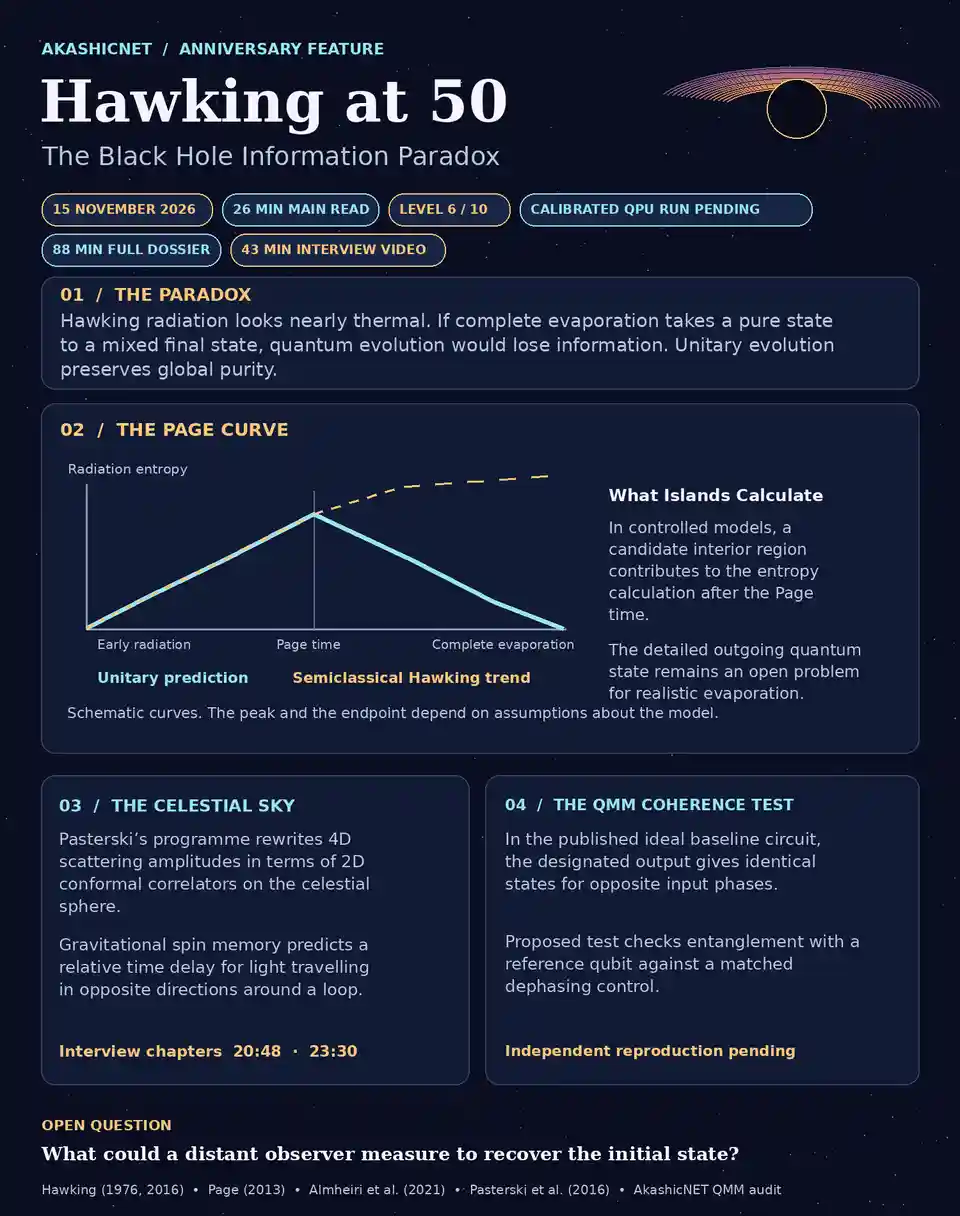
If an initially pure black hole evaporates completely through unitary evolution, the fine-grained entropy of all the radiation collected so far first rises as the radiation becomes entangled with the remaining black hole. It then falls and reaches zero once all the radiation has been collected. The peak is the Page time. Its location depends on the model. Don Page’s calculation.
Island calculations reproduce this behaviour in controlled models. They compare candidate generalised entropies, each combining a boundary-area term with the quantum entropy of the radiation and any candidate interior region. Early on, the calculation without an island gives the lower entropy. After the Page time, a candidate that includes an island can take over. The result gives the entropy of the radiation in those models. Deriving the outgoing quantum state for a realistic evaporating black hole calls for more. Review of Hawking radiation entropy.
For a normalised packet of outgoing modes, the Bogoliubov transformation combines incoming annihilation and creation operators. In the incoming vacuum the mean occupation is the sum of the squared mixing coefficients, ⟨N⟩ = Σ |β|². For late-time bosonic modes of angular frequency ω, the occupation factor takes the form [exp(ℏω/kBTH) − 1]−1, with a frequency- and angular-momentum-dependent transmission factor for propagation to infinity. Particle Creation by Black Holes.
The radiation entropy is S(R) = −Tr(ρR log ρR). The island prescription extremises the sum A(∂I)/(4GNℏ) + Sbulk(R ∪ I) over candidate island boundaries and selects the smallest extremal value, with c = kB = 1. Entropy Review.
A letter may be unreadable while its pieces remain. That illustrates the difference between destruction and difficult reconstruction. Quantum information also includes phases and correlations, so physical scraps are an incomplete analogy.
Being unable to enter a library does not mean the books have vanished. A horizon raises an access question, but whether information remains after complete evaporation requires a physical account of the whole process.
A recording can preserve a performance without preserving the musician as an experiencing person. This helps distinguish retained information, recoverable organisation and subjective continuity.
Water disappearing around a bend invites us to look for its next course. A black-to-white-hole proposal similarly asks whether a later outgoing phase exists. The river supplies an image; the spacetime model must supply the actual route.
These are explanatory analogies. None establishes a mechanism or maps perfectly onto quantum gravity.
On 15 January 1976, ten months before the anniversary paper, Hawking published Black Holes and Thermodynamics. He considered the internal configurations associated with black hole entropy and argued that quantum black holes behave time-symmetrically. For an external observer, he described them as indistinguishable from white holes. This is an argument within his thermodynamic treatment, with its own assumptions about statistical behaviour.
That earlier question gives this reimagining a historical starting point. Breakdown of Predictability in Gravitational Collapse, published 15 November 1976, asks what gravitational collapse implies for predicting a final quantum state. The anniversary belongs to that later paper. The modern transition proposals below ask how collapse, evaporation and a possible outgoing phase could fit into a specified quantum process.
The comparison has three tasks. Establish the geometry of the outgoing region, determine its stability and duration, then specify how the accessible radiation carries the initial quantum state. Each task calls for its own calculation.
Historical source depth · The January paper’s publisher abstract was checked on 7 November 2026. The selected full-text appraisal of the November paper is recorded in the Foundations Audit. The January argument and modern remnant proposals have distinct assumptions.
A white hole is the time reverse of a classical black-hole region. A physical transition from collapse to an outgoing phase is an additional hypothesis. An anti-trapped region, a small remnant and a quantum decoder describe different parts of the problem. None alone establishes that an arbitrary infalling quantum state can be recovered.
| Research Route | What Is Calculated or Proposed | Boundary of the Result |
|---|---|---|
| Haggard & Rovelli · 2015 | A collapse-to-bounce geometry, classical outside a bounded quantum region. | A scenario and boundary-value problem for quantum gravity, rather than a first-principles transition or matter-state decoder. De Lorenzo & Perez · 2016 address instabilities with an asymmetric scenario. |
| Han, Qu & Zhang · 2024 | A spin-foam transition amplitude with selected boundary data and a 56-vertex complex; orientation-changing contributions dominate their calculation. | Numerical geometric tunnelling is substantive progress. The amplitude is not an arbitrary-state recovery channel or a fully determined evaporation lifetime. Parameter dependence and computational demands remain open. |
| Bianchi and colleagues · 2018 | A small-horizon, large-interior white-hole remnant that could release correlations over a long period. | The proposal distinguishes interior state counting from states distinguishable outside. Its stability argument assumes the absence of trans-Planckian perturbations; this is not a general stability proof. |
| Hergott, Husain & Rastgoo · 2026 | A dynamical phenomenological geometry joining black- and white-hole phases. | A specified metric history does not derive its quantum dynamics or recover the infalling state. |
| Boyanov, Hilditch & Semião · 2026 | Semiclassical numerical evolution in a charged spherical setup, with disappearance of a trapped region and persistence of an anti-trapped region. | Approximation, scale separation and perturbative stability limit extrapolation to realistic rotating holes. |
| Bianchi and colleagues · May 2026 preprint, revised 26 October | A conditional energy–entropy lower bound on the minimum time required for purification. | A lower bound constrains a proposed release history; it neither predicts the actual lifetime nor proves that a remnant exists. See the reproduced time-bound check. |
Access: selected full-text sections of Haggard–Rovelli, Han–Qu–Zhang and Bianchi 2018 reviewed alongside the previously recorded 2026 appraisals. De Lorenzo–Perez is an abstract-level counterpoint. Donà and colleagues (2025) provide a further tunnelling lead in a 3D Euclidean Ponzano–Regge model; their abstract does not establish a complete 4D Lorentzian black-hole transition.
To connect these proposals with QMM, specify the input and memory Hilbert spaces, the transition map and the outgoing observables. Derive a normalised quantum channel, account for energy and causal access, then test recovery of entanglement with an external reference. A bounce amplitude supplies a geometric ingredient; the circuit benchmark supplies an operational control. A common physical coupling between them remains to be derived.
In The Black Hole Information Paradox: A Resolution on the Horizon, Netta Engelhardt’s 2023 MIT Physics Annual feature explains how quantum extremal surfaces led to Page-curve results in 2019. The change concerns how fine-grained entropy is calculated within a semiclassical description informed by quantum gravity. This institutional explainer is an accessible account by a researcher involved, rather than a new peer-reviewed result.
In specified gravity models, replica-wormhole contributions reproduce a Page curve compatible with unitary evaporation. An entropy curve alone does not determine the outgoing quantum state. Separate reconstruction results address recovery under stated assumptions.
Our comparison: an island account and a late-remnant account cannot simply share an entropy curve by assertion. Specify the same radiation algebra, initial state and accessible degrees of freedom before comparing their purification times. Neither this feature nor the amplitude papers establish a QMM–white-hole mechanism.
Wikipedia’s information-paradox article is retained as a coverage and bibliography map. Its discussion of remnants places this branch among competing approaches; scientific claims here are anchored to primary papers.
Haocheng Zhong’s April 2026 analysis uses approximate quantum error correction to describe the Page transition as a change in what a recovery channel can reconstruct. This gives the comparison a more precise question. Which information can be reconstructed from the radiation available to the observer, and under which model assumptions?
Ricardo Espíndola, Viktor Jahnke and Keun-Young Kim make the allowed operations explicit in a different calculation. In two-dimensional anti-de Sitter Jackiw–Teitelboim gravity with an external bath, they introduce a coupling between two radiation regions and calculate its effects on traversability and boundary correlations. Those results depend on the specified coupling and bath.
Even the shape of the entropy curve depends on the approximation. In a Physics Letters B paper published online on 24 September and assigned to the November 2026 issue, Snigdha Saha reports a smooth crossover in a finite-size model. The publication record and abstract support this description of the calculation. The timing and accessibility of a recoverable quantum state require a separate channel or decoder analysis.
Amit Vikram and colleagues’ October 2026 protocol uses Hayden–Preskill-style recovery to exchange quantum states. Their numerical study distinguishes transfer fidelity from the chance of successful postselection and examines imperfect reversal. For the AkashicNET benchmark, that reinforces the need to report which registers the decoder can reach and to disclose any conditioning or exclusions. The AkashicNET hardware run is pending.
Niloofar Vardian’s October 2026 preprint proposes an algebraic Petz map for reconstructing interior observables from the radiation algebra. The construction works at a specified time after the Page transition in a holographic model with a non-gravitating radiation bath. Its reconstruction depends on a chosen reference state, and the free-field example uses the leading-order approximation. It gives a mathematical representation of an interior observable in the radiation, while a practical decoder would also need access to the relevant radiation and operations. Preprint, §§III–V.
In a separate Nature Communications experiment, Felipe-Elizarraras and colleagues used a single photon to stimulate a Hawking-like single-photon output in optical fibre. This measures analogue emission. The recovery benchmark below measures entanglement in a designed quantum circuit.
Quanta’s coverage of 22 mergers describes a different observational test. Gravitational-wave measurements constrain departures from general relativity within the tested models.
Source Atlas discovery routes · arXiv (S024), Nature/Springer (S035) and Elsevier (S037). The papers address different gravity models or quantum protocols.
Hawking, Malcolm Perry and Andrew Strominger cited three papers Pasterski wrote or co-authored in their 2016 Soft Hair on Black Holes paper, including New Gravitational Memories. They showed how low-energy gravitational and electromagnetic degrees of freedom can encode some information at the horizon, with conservation laws relating certain outgoing states. A full account of how arbitrary infalling quantum states could be recovered remained open. Soft Hair on Black Holes, references 10, 12 and 52.
Celestial holography takes a related approach to radiation at infinity. A massless particle’s direction identifies a point on the celestial sphere. A Mellin transform re-expresses its energy dependence using a conformal scaling dimension. In this basis, four-dimensional scattering amplitudes transform like two-dimensional conformal correlators. The programme aims to build a full holographic dual for asymptotically flat spacetime, an idealisation for isolated systems. Computing the complete quantum state of radiation from a realistic evaporating black hole is still an open problem. Pasterski’s lectures on celestial amplitudes · Celestial holography review.
Gravitational memory gives the connection an observable form. Displacement memory is a lasting change in the separation of freely falling objects after a wave passes. Pasterski, Strominger and Alexander Zhiboedov predicted spin memory, a relative time delay for light travelling in opposite directions around a loop, sourced by angular momentum carried by gravitational waves. Detecting it would test that prediction of general relativity and its connection to low-frequency radiation. New Gravitational Memories.
Suvrat Raju’s related asymptotic-information proposal argues that gravitational observables near infinity already encode interior information under stated assumptions. That raises a practical question for comparisons with island calculations that collect radiation in a non-gravitating bath. Which observables can the distant observer access? Lessons from the Information Paradox.
Watch the full New Scientist interview · About 43 Min. The “Next Einstein” Says Physics Is Due for a Reckoning · Singularities (20:48) · Gravitational memory (23:30).
A candidate model needs to explain how an arbitrary input quantum state could be recovered from the outgoing information available to an observer. We can examine that question in a small mathematical example before attempting a gravitational theory.
The early–late example splits the outgoing information across two registers. Two inputs with opposite relative phases look identical when either register is inspected alone. Joint access can reveal their difference. An additional inaccessible record can reduce how much phase information survives in the accessible output.
The example supplies an encoding, a decoder and a measure of recovered entanglement with an external reference. It gives the larger proposal a precise question to answer. Which degrees of freedom play those roles, and which dynamics preserve their correlations through evaporation and a possible outgoing phase?
Open the Worked Early–Late Example or Inspect the Recovery Benchmark for the equations, assumptions and controls.
Read the integrated white-hole comparison and the deeper assessment of two proposed solutions.
Conceptual pathways, not a unified theory. Arrows summarise each proposal’s narrative and do not demonstrate a physical connection between proposals.
| Connection | Useful Question | Current Boundary |
|---|---|---|
| QMM ↔ white holes | Could memory imprints survive a transition and influence outgoing correlations? | Proposed research bridge. No common Hamiltonian, geometry or state mapping has been derived here. |
| White holes ↔ islands | Do the models describe compatible information histories and entropy curves? | Different assumptions and calculational frameworks. Similar conclusions do not make mechanisms interchangeable. |
| Penrose ↔ unitary models | Must quantum evolution remain unitary at all gravitational scales? | Potential disagreement at the level of dynamics; an information-preserving theory and objective reduction cannot simply be combined without specifying their regimes. |
| Cosmic / multiverse view | Could a larger system preserve correlations absent from a local description? | A larger Hilbert space, evolution law and causal account must be specified. “Elsewhere” does not provide a retrieval mechanism. |
| Information ↔ consciousness | What additional organisation would support memory, agency and an experiencing subject? | Four separate targets: persistence, accessibility, organisation and subjective continuity. |
A subsystem can have a mixed state while the complete system remains pure: tracing out its partner removes access to correlations. This is a useful mathematical possibility. To apply it to an evaporating black hole, a model must identify the full system and explain what remains after evaporation. Invoking the quantum, the cosmic or a multiverse does not alone settle that accounting.
1729 = 1³ + 12³ = 9³ + 10³. The same number appears through two different sums of positive cubes. As a Ramanujan-inspired mathematical motif, it encourages looking for an alternative representation of an apparent obstacle. The numerical identity is exact; its connection to the information paradox is an analogy. Intuition may suggest a route, while derivation and testing decide what that route achieves.
After examining white hole geometry and early–late recovery, the SAMĀDHI001 companion invites a change of perspective. Its focus remains Samadhi Part 1 — Maya, the Illusion of the Self. The film explores conditioning, identification and the relationship between a representation and what it represents. Here those themes inspire questions about how we frame an observer, a boundary and a continuing identity.
The film companion asks what a viewpoint reveals and leaves outside its frame. In the recovery example, choosing access to E alone, L alone or their joint state changes which correlations can be read. The mathematical model specifies that access. The contemplative analogy prompts us to examine the choice of boundary.
Reconstructing a quantum state requires a defined input, output and recovery criterion. A question about the continuity of a person also needs an account of memory, embodiment and subjective identity. SAMĀDHI001 helps bring those assumptions into view. BQ001 considers the separate question of consciousness continuing beyond the individual.
The companion’s reading of conditioned roles suggests a research practice. State the favoured explanation, identify an alternative and record the observation that would make us revise our account. For white hole models, the tasks above concern stability, release time and recoverable correlations.
SAMĀDHI001’s editorial synthesis connects reflection with compassionate action. A research community can express that through careful attribution, open correction, respectful disagreement and shared access to findings. BQ011 asks how experiences of connection become sustained care.
Role in This Reimagining. This section contributes a philosophical reading and questions for research practice. The physical assessment rests on the source arguments, explicit models and recovery calculations described earlier. The proposed connection between selfhood and a quantum description remains an open interpretive question.
Reading scope · The current SAMĀDHI001 sections on transcript-informed analysis, conditioning, viewpoints and everyday care were inspected for this integration. The film remains the subject of its own Part 1 companion.
Local inquiry labels below organise this essay; they do not create new official BQ numbers or change existing BQ ratings.
For the 2026 QMM circuit, distinguish basis agreement from arbitrary-state transfer. Next: audit the input preparation and reduced output states, add phase-sensitive tomography and entangled-input controls, then reproduce the reported runs.
For QMM plus a white-hole scenario, specify a shared state space and evolution across the transition. Next: test whether correlations are recoverable without double-counting memory degrees of freedom or assuming the desired answer.
Compare radiation correlations, entropy histories and timescales across QMM, white-hole and island models. Next: identify a prediction that is both distinctive and observationally accessible, or document why access is presently out of reach.
For cosmic or multiverse proposals, define what “outside” means and what can be observed. Next: select an exact mathematical model. Until then, this is a framing question rather than an evaluated mechanism.
BQ001 connects through the distinction between information persistence and personal continuity. BQ002 connects through the distinction between a thought’s felt arrival, its content and its source. These are methodological links; this essay supplies no new evidence for either BQ’s metaphysical conclusion.
The Part 1 Samādhi companion now explores ancient texts and living Indigenous knowledge, including Buddhist loving-kindness, a Sikh interpretation of Māyā and Native-led stewardship. Its contribution here is to ask how inquiry relates to care, responsibility and knowledge holders’ authority. The CARE Principles for Indigenous Data Governance provide a concrete research-governance framework. These connections do not derive quantum dynamics or establish that a tradition anticipated QMM, white-hole transitions or the resolution of Hawking’s paradox.
Open a section to follow the sources, inspect a calculation or check the development record. Links to individual topics open their containing appendix automatically.
Open the Technical Decision Flowchart · See the EXPAND² and Collective Benefit Visuals
About 5 Min Including the Analytical Follow-Up · Research Roadmap [7 November 2026]
The analytical work can proceed while a replacement hardware route is assessed. It asks what an observer can recover from the collected radiation in a specified model. The hardware workstream asks whether a fixed circuit preserves entanglement with an untouched reference qubit under controlled conditions. Each route has its own evidence and review record.
8 November update. The four-qubit teaching example now has exact simulation results and a runnable notebook. Device access is optional for the teaching example. The formal Level 7 benchmark still requires its own execution and reproduction record. See Hidden or Erased?
| Result or Constraint | Next Action |
|---|---|
| Device access or calibration pending | Continue the analytical route. Independently reproduce the decoder bound, then test mixed inaccessible records and partial access to late radiation. Preserve the fixed hardware protocol for execution. |
| Recovery and SWAP pass within the calibration budget | Archive the raw counts, native circuits, layouts and calibration evidence. Reproduce the result independently and take the scoped circuit finding to specialist review. |
| Recovery falls short, with valid SWAP and calibration | Use the uncertainty bounds to distinguish an inconclusive run from a precise challenge to the prediction. An inconclusive run calls for a prospectively revised design or more data. A precise challenge calls for a circuit and noise audit before revising the candidate. |
| SWAP fails, calibration exceeds budget or records are incomplete | Archive the run as diagnostic evidence. Repair the control, calibration or recording problem and repeat the relevant checks before interpreting recovery. |
| The analytical bound survives an extension | State the wider assumptions under which it holds. Publish the derivation and reproduction checks for independent review. |
| An extension gives a counterexample | Preserve the smallest reproducible example, identify the assumption that matters and state the narrower result. A well-supported negative finding can progress to Level 10. |
The operational benchmark is at Level 6. The analytical and hardware routes can advance on their own evidence.
| Progression | Analytical Route | Quantum Hardware Route |
|---|---|---|
| 6 → 7 · Reproduce | Freeze the two encodings, accessible registers and expected fidelities. Supply a derivation, runnable code and expected outputs. Record an independent reproduction of the calculation. | Select a backend and verify native circuits, layout and calibration. If these checks pass, execute the fixed protocol and preserve raw counts, controls and job records for independent reproduction. |
| 7 → 8 · Review | Have an independent quantum-information specialist check the channel reconstruction and decoder optimality. Record objections, responses and any corrections. | Have an independent specialist reconstruct the result from raw counts and assess the calibration, SWAP control and uncertainty. Record objections and corrections. |
| 8 → 9 · Stress-Test | Vary access to late radiation, phase knowledge and the inaccessible record. Record which assumptions change recoverability and preserve counterexamples. | Check sensitivity to backend, layout and drift. Compare replications and document which explanations the evidence can distinguish when runs disagree. |
| 9 → 10 · Publish the Synthesis | Release a versioned derivation, code, reproduction and review records, counterexamples and scope limits. State what a gravity model would still need to derive. | Release the versioned protocol, circuits, raw data, calibration and analysis with a scoped conclusion. A precise negative result can also complete the route. |
Next Level 7 deliverable. A one-command reproduction package with the expected fidelity table and a proof of each limit. The internal four-state cross-check below is complete. Independent reproduction is pending.
About 2 Min · Internal Calculation Check [7 November 2026]
Matching the inaccessible records for the two basis inputs |0⟩ and |1⟩ is insufficient to establish quantum recoverability. In the two toy encodings below, E and L are collected qubits, M is inaccessible and |Φ±⟩ = (|00⟩ ± |11⟩)/√2 on L and M.
| Encoding | Input |0⟩ | Input |1⟩ | Best Fidelity |
|---|---|---|---|
| A | |0⟩E|Φ+⟩LM | |1⟩E|Φ+⟩LM | 1 · Keep E. |
| B | |0⟩E|Φ+⟩LM | |0⟩E|Φ−⟩LM | ½ · Apply a Hadamard to L. |
For either basis input, both encodings leave M maximally mixed (I/2). With the phase inputs |+⟩ and |−⟩, M still gives the same state in A but distinguishes the two inputs perfectly in B. In B, the collected output carries only a classical record of the input’s X-basis measurement. Its state with the reference is separable, so any deterministic decoder on E and L is capped at a Bell overlap of ½. The stated decoder attains that cap. This is a finite-dimensional channel result. A physical application would require a model that derives the encoding from gravitational dynamics.
Four-state cross-check. An internal reconstruction using |0⟩, |1⟩, |+⟩ and (|0⟩ + i|1⟩)/√2 agreed with direct partial traces for E, L, E and L jointly, and M. It reproduces the channels in the table below. A constant output gives Bell-reference fidelity ¼ for any deterministic decoder. A gives the identity channel on E. B gives an X-basis measurement with a classical outcome on L, reaching ½ after decoding.
| Encoding | Early Only | Late Only | Early and Late |
|---|---|---|---|
| A | 1 | ¼ | 1 |
| B | ¼ | ½ | ½ |
Independent review target. Reproduce both calculations and check the optimality proofs. Bény and Oreshkov on recovery and complementary channels gives the broader quantum error-correction context.
Questions for technical forums. Ask whether the 1 versus ½ bound follows from the two encodings, and separately what an island entropy calculation would need to specify an actual decoder. Quantum Computing Stack Exchange on entanglement fidelity · Physics Stack Exchange on black-hole islands.
Companion reflection. SAMĀDHI001 invites a parallel question about what can be experienced, reported and independently checked. This belongs to the editorial and noetic workstream, with first-person reports assessed using methods appropriate to lived experience. SAMĀDHI001 · IONS qualitative study.
Read the early–late model · Check the fixed hardware protocol · Open the results-intake checklist
Source-linked summaries below distinguish a theoretical proposal, a hardware experiment, a retrospective review and an editorial interpretation. Expand again for the relevant limits.
Hawking argued that formation and evaporation could take a pure initial quantum state to a mixed final state. His superscattering operator describes a proposed departure from ordinary unitary scattering. The issue concerns the complete evaporation process, beyond merely ignoring an inaccessible subsystem.
The boundary between a reduced description and fundamental loss is central. The publisher abstract and publication record were checked. A scanned reprint subsequently enabled the recorded central-argument appraisal in the Foundations Audit. Complete independent reproduction of the paper’s derivations remains pending. The 11 November refresh checked the central text through a reprint with imperfect OCR; the publisher PDF remained inaccessible.
QMM proposes Planck-scale memory degrees of freedom that retain imprints and interact with quantum fields. It offers a proposed information reservoir and retrieval mechanism during black-hole processes.
These memory cells are postulated physical structure. A unitary combined model needs a justified coupling to realistic evaporation, suitable capacity and a complete account of the eventual accessible outputs. Its terminology does not establish a store of autobiographical memories or psychic access. Source access updated: selected full-text foundations and retrieval sections were inspected in the publisher PDF hosted by INSPIRE. See the formal clarification below.
The authors report five three- to five-qubit circuit experiments. The measured quantity is basis-matched retrieval probability. The study supports a circuit-level write-and-read primitive; it does not reproduce Planck-scale spacetime.
The paper separates basis-level agreement from quantum-state fidelity and identifies tomography as a next step. A phase-sensitive test, entangled inputs, suitable control circuits and independently reproducible execution records would strengthen the appraisal. Global gate unitarity alone does not show that an arbitrary input state has been transferred intact to a selected output. The publisher’s HTML and Eq. (8) were inspected; an ideal channel audit is now reproduced below. No hardware execution, QASM audit or raw-data reproduction was performed here.
The proposed spacetime has collapsing matter enter a black-hole phase and emerge in a white-hole phase. Quantum effects accumulating over a long interval motivate a transition. This offers a possible change in the causal story behind the information puzzle.
This is a theoretical black-to-white transition scenario, not an observation of two separate holes exchanging messages. A route for matter to emerge is not by itself a full calculation of quantum information recovery. Transition amplitudes, lifetime, stability, correlations and observational signatures require detailed evaluation. Publisher abstract inspected; no independent derivation or stability calculation performed.
Roger Penrose’s “The Big Bang, quantum gravity and black-hole information loss” supplies a directly relevant historical counterposition: information loss may reflect necessary changes in fundamental physics. His 2014 paper on gravitational quantum-state reduction argues for changing quantum mechanics under gravitational considerations. These are related but distinct proposals, not endorsements of QMM.
The targeted search did not establish a new 2025–2026 Penrose paper specifically revising Hawking’s 1976 argument. This is a search limit, not proof that no newer statement exists.
These are selected primary-author sources and reviews, not an exhaustive literature survey. Except where stated otherwise, assessments use abstracts or publisher summaries; no claim of complete technical review is made.
Level 5 foundations milestone completed; the latest rating is recorded in the development tracker. The original-paper access gap is closed through a scanned reprint. Selected central equations and the assumptions linking them to the comparison have now been audited. This does not mean all derivations are verified, the proposed bridges work or the paradox is resolved. Independent expert review remains a later milestone.
Hawking (1976), Physical Review D 14, 2460–2473: the reprint preserves the original pagination. Technical checkpoints were p. 2463, §§II–III, the pair-state discussion in §IV and §V. The calculation treats a massless scalar field on an approximately quasistationary Schwarzschild background, with the initial scalar vacuum. Equation (3.13) includes the transmission probability through the exterior barrier. Section V argues against final-stage purification using an energy/information budget. Equations (5.7) and (5.8) impose distinct conditions; the latter receives additional equilibrium and CPT arguments. The final page discusses white holes through time reversal. That discussion is not a derived dynamical black-to-white transition.
Source depth: a third-party-hosted scan of the collected-paper reprint, book pp. 112–125, PDF pages 119–132. Original title, pagination and equations were inspected; key formulas on pp. 2463, 2467 and 2472 were checked visually against the scan. Publisher metadata confirms the citation. The scan has not been certified against a publisher master. No source PDF is redistributed. This is a targeted central-argument audit, not every integral or appendix independently reproduced. Hashes and access provenance appear in the version record.
Using x = exp(−2πω/κ) and Γ = |t|², rewrite Eq. (3.13) as:
P(n) = (1−x)(Γx)ⁿ / [1−(1−Γ)x]ⁿ⁺¹
Σₙ P(n) = 1 · ⟨n⟩ = Γx/(1−x)
Our reconstruction: start with a geometric occupation law (1−x)xᵐ and independently transmit each of its m particles with probability Γ. Summing the binomial probabilities gives this expression. Twelve parameter cases reproduce normalisation, the mean and the explicit thinning sum to numerical tolerance below 10−12. This checks the single-mode probability algebra; it does not reproduce the Bogoliubov integrals or establish exact independence of every mode during complete evaporation.
In modern channel notation, a useful reconstruction is E(ρ) = Σᵣ KᵣρKᵣ†. The hidden-state index labels the terms after a partial trace. Trace preservation requires Σᵣ Kᵣ†Kᵣ = I; unitality requires Σᵣ KᵣKᵣ† = I. These are the respective channel analogues of the two contractions in Eqs. (5.7) and (5.8), rather than a transcription of Hawking’s index convention. Neither condition alone establishes a unitary scattering operator.
Our amplitude-damping counterexample preserves trace but is not unital. Our dephasing example satisfies both conditions yet changes |+⟩ into a mixed state of purity ½. These elementary counterexamples separate the logical requirements. They are not black-hole models, are not claimed to conserve the relevant gravitational energy and make no claim about CPT. Complete positivity is a modern consistency requirement when a reference system is allowed; the partial-trace construction supplies it for an isometric dilation, not for an arbitrary four-index tensor merely constrained to preserve trace.
Our two-qubit example compares √(1−x)|00⟩ + √x|11⟩ with the classical mixture of those two alternatives. Their individual marginals coincide; their joint purities differ. At x = 0.37, the joint purities are 1 and 0.5338. Therefore small-subsystem observations alone cannot decide whether the full state is pure. This illustrates a logical distinction; it does not overturn Hawking’s stronger multi-mode calculation within its stated approximation.
The load-bearing question is how that approximation extends to the full evaporation endpoint. A proposed recovery account must specify the surviving degrees of freedom, the correlations, the release time and the accessible output. Saying “the larger system stays pure” leaves that physical work to be done.
| Dependency | Audit Outcome | Consequence |
|---|---|---|
| Quasistationary field theory → complete endpoint | Approximation boundary identified; final Planck regime is outside the controlled fixed-background calculation. | Specify endpoint dynamics before inferring either fundamental loss or recovery. |
| Thermal probabilities → quantum recovery | Probability algebra checked; phases and reference entanglement are additional requirements. | QMM basis retrieval cannot alone close the state-recovery question. |
| Finite QMM cell → exact canonical algebra | Trace obstruction documented in the preceding audit. | An effective truncated representation has been clarified; its boundary term and validity under the proposed evolution must be checked. |
| Transition geometry → information channel | No common state map or Hamiltonian follows from the compared metrics. | Keep the QMM–white-hole bridge as an unestablished proposal. |
| Purification bound → specific scenario | Conditional inequality reproduced; state, entropy, asymptotic output and emission history must match. | No universal lifetime or experimentally confirmed endpoint follows. |
| Time reversal → black-to-white evolution | Logical distinction recorded. | CPT language alone does not specify a bounce, its stability or a decoder. |
What this adds: the reimagining now has explicit consistency requirements and counterexamples that reject several shortcuts. It remains a research comparison with an open candidate bridge, rather than a new model of quantum gravity.
Download the Foundations Audit · Read Its Results. Python 3.10+, standard library. Earlier circuit and time-bound scripts remain separately available.
This pass is complete: a targeted technical appraisal of the five shortlisted works, with assumptions, equation-level checkpoints and comparison limits recorded below. Full texts were retrieved and selected technical sections inspected. This is not a line-by-line verification of every appendix, an independent peer review or a reproduction of gravitational path integrals. The original 1976 central-argument audit has since been added above using a scanned reprint.
The useful advance is a more demanding question: can a proposed mechanism specify the state it preserves, the output that recovers it, the physical cost and the assumptions that make the calculation valid?
The Entropy of Hawking Radiation, Reviews of Modern Physics (2021). Author manuscript 2006.06872v1; technical checkpoints: §§4–6, 9–11.2.
The review distinguishes fine-grained from coarse-grained entropy and explains island and replica-wormhole calculations. Section 11.2 explicitly separates successful entropy calculations from computing individual radiation-state or scattering-matrix elements. Its semiclassical path-integral treatment and boundary assumptions matter.
Appraisal: use this as an entropy benchmark. Recovering a Page curve does not itself supply a practical decoding circuit. A QMM proposal must specify what additional state-level prediction it provides; this review does not validate QMM.
Black Hole Interior and Quantum Error Correction With Dynamical Gravity, JHEP (7 August 2026). Author manuscript; checkpoints: §§2.1, 2.7, 3.1, 3.4 and 4.
The analysis uses doubled two-dimensional PSSY/JT models, a gravitating bath and a Rényi-two decoupling diagnostic. Its discussion gives a scaling-dimension threshold, Δ > ½ log din, for the protected regime, where din is the interior code-subspace dimension. It leaves the physical interpretation and generalisation open.
Important qualification: the authors distinguish the microstate-independent error channels studied from recovery operations that can depend on microstates. Their result cannot simply be applied to every decoder. Topology-changing backreaction and broader settings need further work.
Appraisal: an operational recovery proposal must include its own energy and gravitational backreaction. This is a model-specific constraint, not a universal demonstration that information is always accessible or inaccessible.
Information Paradox and Island of Covariant Black Holes in LQG, Physical Review D (23 February 2026). Author version v2, revised 7 March 2026; checkpoints: §§II–V.
Two effective metrics give different late-time behaviour. The island calculation is on an eternal background; it must be distinguished from the separate evaporation-rate analysis. Section V leaves the persistence and dominance of quantum extremal surfaces on time-dependent backgrounds open and identifies dependence on the assumed interior state count.
Appraisal: choose the geometry, state-counting assumption and observer algebra before combining conclusions. A result on an equilibrium background is not a completed calculation of an evaporating black-to-white transition.
Dynamical Model for Black Hole to White Hole Transitions, Physical Review D (22 January 2026). Author version v2; checkpoints: §II, especially Eqs. (2.1), (2.7)–(2.9), and §III.
A smooth sign change in the shift function produces trapped and anti-trapped regions, separated by a short gap. The metric is phenomenological. The authors discuss dominant-energy-condition violations and explicitly leave derivation from an effective quantum-gravity theory open.
Appraisal: this is a geometry on which to formulate further questions, not an observed white hole, a derived QMM coupling or a complete quantum-state recovery map. Effective stress, stability and a compatible information channel must be evaluated separately.
Minimum Lifetime of a Black Hole, preprint v2, 26 October 2026. Checkpoints: §§II, IV–V and VII; Eqs. (3), (5), (19)–(21).
The bound concerns an asymptotically semiclassical, spherically symmetric conformal-vacuum model and expectation values. It assumes eventual purification accessible at future null infinity. The authors do not impose a turnover at the usual Page time. Exponential lifetimes require an additional metastability assumption; the lower bound is not a lifetime estimate.
Appraisal: apply its energy and entropy budget only after matching the proposed release history. It does not calculate QMM dynamics or establish a white-hole population observationally.
Author manuscripts were retrieved for all five appraisals. Published venue and date were checked separately. The 2021 review was read through its 2020 author version; the 2026 papers were checked against their available author versions, not assumed identical to every version of record. Selected assumptions, defining equations and discussions were reviewed; all appendix derivations were not independently recalculated.
The 2024 QMM publisher PDF was retrieved through INSPIRE, allowing the formal check below. The 2026 QMM publisher HTML supplied Eq. (8). The 1976 publisher PDF request was denied; a reprint subsequently enabled the targeted foundations audit above. A complete line-by-line verification remains outside scope. Access and version record.
Yasunori Nomura, “Have We Solved the Black Hole Information Paradox?” is an author-opinion article dated 30 January 2020, not a new 2026 report. It presents a layered account of microscopic evolution and an observer’s coarse-grained description. The article was read in full.
The linked primary work, Reanalyzing an Evaporating Black Hole, Physical Review D 99, 086004 (2019), models hard modes, soft modes and early radiation with a tripartite entanglement structure. Selected interior-reconstruction and concluding sections were inspected. Its effective interior description has a limited domain; it is not just the ordinary statement that a distant clock appears to slow down.
What it adds: ask exactly which degrees of freedom and observables an account retains. That is a useful comparison with our access/persistence distinction. Coarse-graining alone is not a derivation of an information-preserving evaporation law, and this proposal supplies no QMM–white-hole or consciousness mechanism. Nomura’s further paper on spacetime and soft modes is linked for onward reading; its abstract was checked, with no new full technical appraisal claimed.
Editorial judgement: a title claiming a solution is a claim to assess. Distinguish a useful mechanism, a conditional mathematical result, a complete evaporation model and an independently tested account of nature. The following checks are our analysis, not a published referee report or an author response.
ScienceDaily’s report covers the same Pinčák–Pigazzini–Pudlák–Bartoš model already linked through Popular Mechanics and SciTechDaily. These are multiple reports of one study. The primary article is General Relativity and Gravitation 58, 29 (19 March 2026).
The proposal halts evaporation using seven-dimensional Einstein–Cartan torsion and stores information in remnant modes. Its conclusion acknowledges an unfinished first-principles entropy count, while Appendix B claims to supply one. The displayed algebra needs clarification: writing x = v/MPl, B.8 gives S = πx³/3. Applying the stated substitution MBH = v²/MPl to B.9 gives S = 4πx⁴. These expressions agree only for x = 1/12 (or the trivial zero case), rather than the quoted electroweak-to-Planck ratio.
Our check: with v = 246 GeV and MPl = 1.22 × 10¹⁹ GeV, x ≈ 2.02 × 10⁻¹⁷ and the two expressions differ by a factor of about 4.13 × 10¹⁵. This may involve notation or missing steps; the printed argument does not establish the claimed equality. A storage-capacity estimate also needs a state-transfer dynamics before it certifies recovery.
Arraut’s 2024 preprint was published on 3 January 2025 as A Possible Solution to the Black Hole Information Paradox, AppliedMath 5, 4 (MDPI). The institutional copy of the published version, especially Section 5, was checked as well as the preprint.
It proposes vacuum degeneracy and spontaneous symmetry breaking, then argues for recovery by summing order-parameter values. Equations 17–18 treat antiparticle emission as negative particle number. Ordinary particle and antiparticle number operators are both non-negative; a signed charge is a different observable. A precise redefinition is needed.
Our counterexample: the orthogonal states |+⟩ = (|0⟩ + |1⟩)/√2 and |−⟩ = (|0⟩ − |1⟩)/√2 both satisfy ⟨n⟩ = 1/2. Matching number expectations therefore cannot reconstruct the state or its phase. Equation 16 also needs a specified tensor factorisation to justify the claimed partial trace. The paper’s argument does not supply the phase-sensitive recovery test required here.
Count physically distinguishable states under a declared energy budget. Separate an assumed entropy law from a derived microscopic count.
Identify the accessible output and decoder. Preserve reference entanglement across arbitrary inputs, rather than reconstructing one average quantity.
Specify whether information emerges during evaporation, during a transition or in a long remnant phase. Calculate the same observables before merging explanations.
Development status: provisional Level 6/10 remains the status of the executable operational programme. These appraisals improve its assumptions and rejection criteria. Level 7 still requires calibrated device execution, released raw counts and independent reproduction; no quantum hardware run has been performed.
Targeted reading and elementary algebra checks, 6 November 2026. Not an exhaustive audit of either theory. Reproduce the numerical substitutions and state counterexample. The Google redirect supplied for review resolves to Research Outreach’s explainer; it is a discovery source, not additional independent validation.
The following are additional, clearly bounded reading leads. Published venue does not make their differing conclusions interchangeable. The MDPI pages were rate-limited and PMC retrieval presented a verification screen; indexed publisher abstracts and available introductions were checked. These entries do not claim a full-text technical audit.
Calmet, Casadio & Hsu, The Black Hole Information Problem (31 May 2025) is a special-issue editorial and a route to further papers, not an additional experiment or a consensus vote.
Yangting Liu, Research on the Application of Loop Quantum Theory Model in Black Hole Quantum Information (3 March 2025), volume 24, article 75. The publisher abstract describes Hamiltonian-constraint approximations and model comparisons. It motivates checking approximation order before comparing proposed transfer dynamics. Main text is subscription-restricted; this is an abstract-level lead, not a completed appraisal. The date above follows the publisher, not an aggregator’s differing date.
Wikipedia’s information-paradox page was used to check the breadth of proposed resolutions and trace references. It is a tertiary navigation aid, with no independent evidential weight in this review. The following primary review abstracts were checked; their complete technical arguments have not been newly audited here.
These arguments address different assumptions and observables. Their inclusion does not imply agreement, and no full mathematical reconciliation is claimed.
Atlas routes: S024 arXiv, S035 Nature/Springer, S037 Elsevier and S099 Wikipedia; APS/Physical Review and MDPI are additional primary publication routes in this pass. Provider families are not independent studies, and the Atlas census has not been silently changed.
Four additions to this comparison, not four established solutions. Full texts were retrieved and selected setup or discussion sections inspected. No numerical evolution, gravitational path integral or theorem proof was independently reproduced. Each model supplies a different ingredient; their assumptions cannot be combined merely because they concern the same paradox.
Boyanov, Hilditch and Semião, Semiclassical Evolution of a Dynamically Formed Spherical Black Hole With an Inner Horizon, Classical and Quantum Gravity 43, 025007 (2026). The publisher PDF gives 23 January 2026; a university record instead lists 28 January. This review uses the PDF date. Their numerical spherical Einstein–Maxwell model includes scalar-field backreaction through the Polyakov approximation. A trapped region disappears and an anti-trapped region persists. Section 4 identifies likely perturbative instability, unrealistic scale separation and limitations of the stress-tensor approximation, including a flux-sign discrepancy away from near-extremality. It does not calculate arbitrary-state recovery.
Our use: investigate an evolving candidate geometry and its stability before adding any memory interaction. An anti-trapped region is not itself a decoder.
Wang, Mann and Yeom, Unitary Evolution of an Evaporating Black Hole in Canonical Quantum Gravity, preprint v1, 11 September 2026. The authors construct a toy account using a relational clock, coherent gravitational states and fine-grained unitary evolution with coarse-grained evaporation. They allow a violation of the entropy-bound relation. Section V explicitly leaves the infalling-observer problem incomplete; field-theoretic generalisation is also future work. This is not a derived QMM interaction or an established horizon-crossing solution.
Our use: test whether a proposed information history quietly assumes a state count or clock choice that this alternative changes. The trade-off must remain visible.
Haocheng Zhong, An Algebraic Description of the Page Transition, JHEP 04 (2026) 160, 20 April 2026. Approximate quantum error correction and complementary recovery describe the transition through recovery properties and relative-entropy probes. A qualification in §5 matters: although algebraic relative entropy is defined in type III factors, a direct proof of the proposed transition criterion there remains to be established. Explicit type I/II probes do not by themselves close that extension.
Our use: make the accessible algebra and recovery conditions explicit. This supplies a mathematical comparison language, not a dynamical black-to-white metric or a laboratory decoder implementation.
Lowe and Thorlacius, Breakdown of Semiclassical Gravity in Four-Dimensional Black Hole Evaporation, JHEP 07 (2026) 226, 24 July 2026; author version 2605.00780v1. Their anomaly-induced, backreacting collapse model develops a thunderbolt instability. The authors interpret it as failure of the effective description, rather than a prediction that nature contains this singularity. Their conclusions acknowledge omitted conformally invariant terms and possible changes from additional corrections or initial-data constraints.
Our use: check where the assumed background evolution ceases to be controlled. An approximation failure can challenge a paradox’s formulation without supplying the replacement theory or proving information recovery.
| Missing Ingredient | Candidate to Examine | Still Required |
|---|---|---|
| Evolving transition geometry | Boyanov et al. | Robustness, applicable stress tensor and a quantum state-transfer calculation |
| Explicit unitary toy evolution | Wang, Mann and Yeom | Justified entropy assumptions and a consistent infalling-observer account |
| Recovery criterion and observable algebra | Zhong | Applicable hypotheses, physical encoding and implementation |
| Semiclassical validity boundary | Lowe and Thorlacius | Robustness to omitted terms and a controlled replacement dynamics |
For this project, the most useful next comparison is the dynamical geometry question alongside the algebraic recovery question. This is a proposed division of research tasks, not a claim that those papers already share a consistent model. None of these inspections establishes a physical QMM–white-hole coupling, an observed white hole or a resolution of the information paradox.
Source Versions, Access Depth and PDF Hashes. The copyrighted PDFs are not redistributed here. The existing torsion/remnant, island and QMM proposals remain separate alternatives. More candidate papers do not automatically increase the development rating.
Read contrasting technical accounts before adopting a common mechanism. These are selected routes, not a ranking of journals or an endorsement of every published conclusion.
Access depth is unchanged: selected full-text appraisal for the Almheiri review; abstract and bibliographic screening for the Raju and Unruh–Wald reading routes. A journal publication is not, by itself, independent validation of a proposed resolution.
Popular Mechanics (23 April 2026) and SciTechDaily (1 June 2026) cover the same seven-dimensional remnant proposal. Two reports do not constitute two independent studies.
The primary paper by Pinčák, Pigazzini, Pudlák and Bartoš, General Relativity and Gravitation 58, 29 (19 March 2026), proposes that torsion in a seven-dimensional Einstein–Cartan framework halts evaporation and leaves an information-bearing remnant. This is a theoretical candidate with substantial geometric assumptions, not an observed remnant or a consensus resolution. The publisher abstract and model setup were checked; no independent equation-by-equation verification is claimed.
What it adds: compare three proposed information carriers: QMM memory degrees of freedom, a black-to-white-hole transition and a long-lived remnant. Ask each model where information resides, how it is encoded, whether and how it can be retrieved, and which observation could distinguish it. These alternatives have not been unified here. Extra geometric dimensions do not establish an Akashic archive or a consciousness mechanism.
Our conditional mathematical check, not a hardware replication. Use Eq. (8) of the 2026 QMM circuit paper with input/control Q0 in a|0⟩ + b|1⟩, memory Q1 and output Q2 both initially |0⟩. Apply only the stated gate sequence; supply no extra decoder, measurements or side information. In basis order Q0,Q1,Q2, direct gate application gives:
|Ψ_final⟩ = a|000⟩ + b cos(θ/2)|100⟩ + b sin(θ/2)|101⟩The compensated phase cancels in this setup. Tracing out Q0 and Q1 gives:
ρ_out = |a|²|0⟩⟨0| + |b|²|χ_θ⟩⟨χ_θ|
|χ_θ⟩ = cos(θ/2)|0⟩ + sin(θ/2)|1⟩
This output depends on input populations, with no dependence on their relative phase. Consequently |+⟩ and |−⟩ give identical output states. The full three-qubit operation remains unitary and can be inverted globally. That does not imply that Q2 alone contains an arbitrary unknown input state.
Reproducibility Update · 14 November 2026. In the paper’s ideal baseline circuit with the memory and output initialised to zero, the designated output has the same density matrix for the opposite-phase inputs |+⟩ and |−⟩. The full circuit can be reversible while the output alone loses access to the input’s phase. The published computational-basis correlations therefore leave coherent recovery untested. AkashicNET recovered the five circuit designs and published summary statistics. Recalculating the reported hardware results requires the original shot records, executed circuits and analysis inputs. The proposed follow-up uses entanglement with a reference qubit and a matched dephasing control to test coherence recovery. The hardware pilot and independent replication are pending. AkashicNET QMM Audit · QMM Theory Paper · QMM Hardware Paper.
The downloadable standard-library Python script compares the direct gate calculation with this analytic channel over 128 seeded random cases. Maximum channel discrepancy was below 10−12; unitarity and global inversion passed. An unconditional SWAP provides a phase-preserving control. A Bell-reference check at θ = π gives overlap ½ with the target Bell state for the audited output channel and 1 for the SWAP control, despite perfect computational-basis transfer in that ideal limiting case.
This audits one precisely specified ideal channel. It does not reconstruct the authors’ input preparation, QASM, compilation, device noise or measured retrieval probabilities, and is not a refutation of every QMM implementation. The paper already distinguishes basis retrieval from state fidelity. Any new decoder or use of additional registers defines a different channel that must be assessed explicitly.
Download the Reproduction Script · Read the Numerical Results · Run with Python 3.10+; no third-party packages required.
The 2024 Entropy paper, §2.1.1, assigns a finite-dimensional space Hx to each cell, then states an exact canonical commutator on Hx in Eq. (3). For one coordinate–momentum pair on dimension d > 0, cyclicity of the matrix trace gives:
tr(XP − PX) = 0
tr(iℏ I_d) = iℏ d ≠ 0
Our algebraic appraisal: these exact finite-cell statements cannot both hold as written. A finite approximation, a modified algebra or suitably specified collective infinite-dimensional operators could change the formulation; the required representation must be stated and checked. This is a mathematical clarification request, not a blanket verdict on QMM or on the separate circuit experiment. The existing QMM review records an author clarification: Eq. (3) is intended as an effective canonical structure, with a truncated-oscillator boundary term retained. The earlier version of this Hawking draft incorrectly said no author response had been obtained; this corrects that statement. The finite-dimensional trace obstruction remains valid for an exact unrestricted canonical identity, while the effective interpretation must be judged on its own domain. Independent expert review remains outstanding.
Within Bianchi and colleagues’ stated model, the release-phase constraints are ∫k du = −SC/(4πα) and ∫k² du = MC/(αℏ). Cauchy–Schwarz yields their Eq. (21):
τ_C ≥ ℏ S_C² / (16π² α M_C)Here SC is the initial radiation entropy of that phase, MC its remaining mass/energy budget and α the field-dependent coefficient; the paper sets c = G = kB = 1. This is a conditional lower bound on expectation-value behaviour, not a universal black-hole lifetime prediction.
The reproduction script checks the two integral constraints using a constant profile that saturates the inequality and smooth profiles that exceed it. This reproduces a small mathematical consequence of the paper, not its full gravitational analysis. A future combined model must derive its own state, flux and release history before applying this bound.
Prepare a reference R and message M in a Bell state and two key qubits KX and KZ in |+⟩. Apply a controlled-Z from KZ to M and then a controlled-X from KX to M. Decode with the inverse sequence and score the overlap of the resulting R–M state with the original Bell state.
For the withheld-keys control, trace out the original keys and supply fresh independent keys before decoding. For the erasure control, replace M with |0⟩ independently of R before encoding. The notebook verifies that M has the same maximally mixed state in the hidden and erased cases before decoding, then evaluates the three recovery scores.
Download the Runnable Jupyter Notebook Python 3 and NumPy
A hardware follow-up for this teaching circuit would compare Bell-state fidelity across the same three arms, with raw counts, calibration and uncertainty reported. The dossier’s separate Level 7 gate applies to its fixed recovery benchmark.
Black-to-white hole scenarios open a question about what an outgoing phase can carry. We can make that question precise in a finite-dimensional example. Let E and L denote radiation collected at earlier and later times, M a remaining inaccessible record and R an untouched reference. These register labels are the interpretation we assign to the example. A physical model must supply their emission history and energy budget.
V|0⟩ = |00⟩EL|m₀⟩M
V|1⟩ = |11⟩EL|m₁⟩M
|m₀⟩ = |0⟩; |m₁⟩ = g|0⟩ + √(1 − g²)|1⟩; 0 ≤ g ≤ 1
Here g is the real overlap of the two final record states. Orthogonal radiation codewords make V an isometry for every allowed g. It can therefore be extended to a unitary operation with suitable ancillas. The map specifies where the correlations reside.
The phase inputs |+⟩ and |−⟩ produce identical E-only states and identical L-only states, each I/2. Their joint radiation states retain an off-diagonal term proportional to ±g. Collecting both registers gives the observer access to this phase information. This statement concerns these two inputs. Other input populations can already be distinguished from one register.
After collecting E and L, apply CNOT with E controlling L. The logical state is recovered on E, while L is reset to |0⟩. Tracing over M leaves a dephasing channel whose diagonal elements are preserved and whose off-diagonal elements are multiplied by g. Starting with a Bell pair between R and the input gives the following exact entanglement fidelity.
ρ01 → gρ01
D(ρEL,+, ρEL,−) = g
Fe = ⟨Φ|ρRE,out|Φ⟩ = (1 + g)/2
D is half the trace norm of the difference between the two radiation states. Fe compares the decoded reference–output state with the original Bell pair. Its value measures recovery of reference entanglement in this channel.
| Record Overlap g | Joint Radiation Phase Distinguishability D | Decoded Entanglement Fidelity Fe |
|---|---|---|
| 0 | 0 | 0.50 |
| 0.5 | 0.5 | 0.75 |
| 1 | 1 | 1.00 |
When g = 0, M carries a perfectly distinguishable record of the two branches and the observer’s decoded state is completely dephased. When g = 1, M has the same state for both branches and the joint radiation permits exact recovery of every input qubit. Global evolution can be reversible throughout this family even though recovery from the selected radiation varies.
The executable recovery benchmark already tests preservation of reference entanglement. This example adds an explicit distinction between separately collected outputs, their joint decoding and an inaccessible residual record. The parameter g offers a controlled way to quantify partial recovery. It is a standard quantum-information construction applied here as an organising example.
Download the standard-library reproduction script and the calculated results. The script constructs the four-register states, takes partial traces and verifies the decoder for eleven overlap values, with a grid of input populations and phases. It also checks the two single-register marginals and the Bell-reference fidelity.
Identify the infalling code states and outgoing matter modes within one chosen geometry. Derive the evolution of their amplitudes and relative phases through the transition. Calculate the residual record overlap and the accessible radiation channel from that dynamics. Then compare the predicted recovery with causal access, stability, energy and release-time constraints. The g used above is freely specified, so deriving it from a gravitational model remains the central open step.
Analytical example and numerical matrix checks completed 7 November 2026. Register dimensions, real overlap and ideal decoder are declared assumptions. Generalising to many modes, complex overlaps or an evolving geometry requires additional modelling.
| Proposed Connection | What Must Be Matched | Outcome of This Review |
|---|---|---|
| QMM ↔ quantum-state recovery | Input, ancillas, retained registers, decoder and phase-sensitive observables. | The audited output-only channel loses relative phase. A larger recovery protocol needs a separate derivation. |
| QMM ↔ black-to-white geometry | Cell algebra, matter coupling, effective stress, causal structure and output state. | No common dynamics is supplied by the reviewed works. Juxtaposing them is not a combined model. |
| Islands ↔ a late remnant release | The same radiation algebra, initial state and entropy turnover history. | Do not silently impose an early Page turnover and a different late-purification history on the same entropy. First show their descriptions match. |
| QEC ↔ a physical decoder | Channel dependence on microstates, implementation energy and backreaction regime. | A recovery operation is not automatically covered by a theorem about a different error class. |
| Global purity ↔ observer access | Which outputs and correlations remain accessible after evaporation. | Purity in a larger space alone does not establish recovery by the specified observer. |
These compatibility questions are our synthesis. They are not a published no-go theorem covering every model. The mathematical checks identify boundaries that a proposed bridge must meet; they do not derive quantum-gravity dynamics.
Can an explicitly specified encoding, transition and decoding channel preserve entanglement with an external reference, while satisfying its chosen geometry’s causal and energy constraints? A useful toy construction would report the complete channel, its reference-state fidelity and a physical accounting of all retained degrees of freedom. An ordinary SWAP is a circuit control, not a black-hole model.
Protocol draft with ideal predictions, not a registered or executed hardware experiment. A reference qubit R is entangled with a logical input L in |Φ⁺⟩ = (|00⟩ + |11⟩)/√2. R is never acted on. Every candidate maps L to a named output O, with auxiliary registers initially in |0⟩. The accessible registers, decoder, phase convention and output location must be fixed before collecting outcomes. A decoder cannot use R.
| Specified Channel | Available Registers | Ideal Bell Overlap F |
|---|---|---|
| Audited 2026 Eq. (8), θ = π/2 | Output Q2 only; original input/control and memory discarded | 3/8 |
| Same circuit, θ = π | Output Q2 only | 1/2, despite perfect basis transfer |
| Phase-corrected excitation exchange, γt = π/2 | Outgoing mode only after coherent exchange from the input memory | 1 |
| Unconditional SWAP control | Input and output during the gate; output afterwards | 1 |
| Global inverse followed by SWAP | All three circuit registers during decoding; output afterwards | 1 |
| Complete dephasing / complete replacement by I/2 | Output only | 1/2 / 1/4 |
These are distinct laboratory channels with different access assumptions. They are not competing derivations of black-hole evaporation. The global inverse is a control showing what full register access permits; it cannot be used to claim output-only recovery. An observer restricted to O cannot distinguish fundamental destruction from information retained solely in inaccessible registers.
The QMM review’s public paraphrase of the author clarification gives Hexchange = ℏγ(a†⊗σ− + a⊗σ+). In its resonant single-excitation toy sector, memory excitation transfers to the outgoing mode with amplitude −i sin(γt). A predetermined phase correction removes −i. The reduced output is an amplitude-damping channel with transfer probability η = sin²(γt); its Bell overlap is F = (1 + √η)²/4 for 0 ≤ γt ≤ π/2.
For the separately audited Eq. (8) channel, our calculation gives F = [1 + sin²(θ/2)]/4. That channel is measure-and-prepare from the input to the selected output, so it cannot transmit reference entanglement. The two formulas do not contradict each other: the interactions, input registers and retained degrees of freedom differ. The ideal script verifies these predictions by state propagation and partial trace.
Measure the R–O correlators XX, YY and ZZ in three settings:
F̂ = (1 + ⟨XX⟩ − ⟨YY⟩ + ⟨ZZ⟩)/4A separable R–O state has F ≤ 1/2: a product state has squared overlap at most 1/2 with |Φ⁺⟩, and mixtures preserve the bound. Thus a valid lower confidence bound above 1/2 certifies entanglement transmission under trusted preparation and measurements. It does not establish perfect transfer or a gravitational mechanism. Horodecki et al. (1999) provide primary background on singlet fraction and teleportation fidelity; the fixed-channel witness and statistical rule here are our specified benchmark, not a reproduction of their full theorem.
Proposed primary arm: phase-corrected exchange at γt = π/2. Use 4,096 independent shots per setting, 12,288 per arm. For one fixed primary test at α = 0.01, a union-bound Hoeffding radius gives ε = √[2 ln(6/α)/N] for each ±1 correlator and a witness margin 3ε/4 = 0.0419163 (rounded upwards). If independent calibration establishes an additive witness-bias bound b ≤ 0.02, require F̂ > 0.562. The value 0.02 is a proposed acceptance budget, not a measured calibration result. Without a justified bias bound, the certification is inconclusive. This is a witness threshold, not a Bell-nonlocality test.
Randomise and interleave measurement settings and controls, fix the shot budget in advance and release all raw counts, gate definitions, decoder code, calibration records and exclusions. No outcome-dependent postselection, decoder optimisation on the test data or early stopping is allowed. Require the SWAP control also to satisfy the same lower-bound criterion above 1/2; it is a validation condition, not a second discovery claim. A failed SWAP control, uncontrolled drift, reference leakage or invalid shot-independence assumptions invalidates this decision rule. Treat extra θ values and controls as exploratory unless multiplicity is separately specified. A non-significant result does not prove fundamental information loss.
The Eq. (8) reference test requires four logical qubits including R; the exchange toy needs three. Compiled gate counts, connectivity, error rates and execution cost remain device-dependent. In the resonant ideal exchange model, N = nout + nmemory commutes with the interaction, so excitation number and the corresponding free energy ℏωN are conserved. Transfer takes π/(2γ). Preparation, coupling control, phase correction, readout and cooling have additional costs that have not been measured or budgeted here. A laboratory compiler and feasible calibration plan are required before execution; no hardware job has been submitted.
A black-hole bridge additionally needs a common state space, a causal interaction law, transition geometry, stability analysis and an asymptotic output definition. It must match any purification-time bound’s state and energy assumptions. Neither the laboratory witness nor an ideal coherent exchange establishes those gravitational ingredients.
This is a prepared reviewer brief. No reviewer has been appointed or contacted in this step.
Download the Ideal Benchmark Script · Predictions and Statistical Parameters. The script imports the earlier phase-and-time audit; download both into the same folder. Standard-library Python 3.10+.
Milestone judgement: the circuit-level proposal now has a compiled reference-architecture package below. Actual device feasibility and calibrated error budgets remain unverified; the Level 6 milestone records an executable specification and its limits. A physical QMM–white-hole prediction remains undefined. Ideal baseline calculations alone do not close the hardware-reproduction milestone.
Completed now: the proposed shot budget, observable and ideal channel predictions are specified. Still unavailable: a selected device’s compilation, execution-time estimate, calibration records and raw phase-sensitive results. IBM’s backend documentation distinguishes coupling maps, instruction durations, gate errors and readout-assignment properties; the qubit count alone cannot establish feasibility.
Our illustrative calculation assumes only independent, symmetric classical readout flips, each bounded by r on the measured reference and output, with otherwise perfect preparation and axes. A correlator is attenuated by (1−2r)2. Consequently the worst-case additive witness bias is bounded by b ≤ 3r(1−r). To allocate at most 0.02 to this error alone, the sufficient symmetric threshold is r ≤ 0.0067117, approximately 0.67% per measured qubit. This is an assumption-dependent design requirement, not a measured device performance. State-preparation errors, axis errors, crosstalk and drift need their own bounds within the same total budget.
Readout mitigation does not automatically establish that residual bound. The simple independent-shot Hoeffding rule cannot be applied unchanged to arbitrary mitigated quasi-probabilities or correlated calibration errors. A revised analysis must propagate calibration uncertainty and validate the relevant assumptions before claiming certification.
The 2026 circuit paper describes backend calibration and QASM in a project repository. Its displayed data-availability statement says no datasets were generated or analysed, despite its reported hardware analysis. The relationship needs clarification. This inspection did not establish an identifiable raw-calibration and QASM download that closes our benchmark requirements. That does not prove no repository exists. Existing basis-match statistics do not substitute for the reference-entanglement measurements specified above.
Outcome: a paper-level feasibility requirement can be quantified now; device feasibility and calibration cannot yet be certified. No hardware job was run and no request was sent. The later Level 6 section supplies a compiled reference-architecture specification. Actual hardware certification remains open. Calculation Inputs and Limits.
New check in this inquiry: energy conservation, global unitarity and recovery from a selected output are distinct requirements. The example below is standard finite-dimensional quantum mechanics. It sharpens a condition on proposed mechanisms; it is not a new theorem, an experiment on a black hole or a derivation of QMM.
Take a system qubit S and a two-dimensional memory E, initially |0⟩. Define HS = Δ|1⟩⟨1|, with Δ > 0, and a degenerate memory Hamiltonian HE = 0. Set H0 = HS⊗IE. A controlled-NOT from S to E is unitary and commutes with H0. Thus it preserves this specified energy observable. Its action is:
(a|0⟩ + b|1⟩)|0⟩ → a|00⟩ + b|11⟩
ρ_S → diag(ρ_00, ρ_11)
After excluding E, the output retains populations and its energy distribution but loses access to the relative phase. The |+⟩ and |−⟩ inputs give identical local states, while the corresponding joint states remain orthogonal. Apply the same controlled-NOT again with joint access and the original state returns. Information has not been fundamentally destroyed in this dilation; its recoverability depends on access to correlations.
With an untouched Bell reference R, the R–S Bell overlap falls to 1/2 after the memory is excluded. The global inverse restores it to 1. The reproduction script checks the commutator and unitarity directly, tests 128 seeded random inputs and verifies the local and reference-state results. It is an ideal calculation, not hardware data.
Boundary: a degenerate two-level memory is an explicit assumption here. This example does not supply an infinite information capacity, a gravitational energy definition, a causal path through an event horizon or a budget for apparatus and switching work. A black-hole application must justify those ingredients separately.
Consequence for the reimagining: add three questions to every proposed carrier: which charge or energy is conserved, which complete quantum state evolves unitarily, and which observer can implement the stated recovery operation? A conserved energy expectation cannot substitute for a phase-sensitive recovery test.
Download the Conservation and Recovery Check · Read the Results. Python 3.10+, standard library. IBM’s quantum-channel documentation supplies background on dephasing and other noise channels; no IBM experiment was executed here.
These prompts are devised for this article, drawing loosely on the listed scientists’ broad contributions. They are not claims about what those people would conclude about modern black-hole physics, and the names do not count as evidence for this proposal.
| Inspiration | Question Applied Here |
|---|---|
| Newton · quantitative laws | Are units, limiting cases and approximation regimes consistent? |
| Einstein · geometry and observers | Which geometry and observer define the accessible output? |
| Maxwell · coupled fields | Do the proposed field, memory and geometry equations form a consistent closed system? |
| Darwin · explanatory comparison | Which differing predictions could discriminate competing mechanisms? |
| Galileo · observation | Which specified measurement could actually bear on the claim? |
| Archimedes · mathematical reasoning | Can the proposed connection be derived from explicit definitions? |
| Curie · experimental investigation | Which controls and calibration bounds distinguish an effect from the apparatus? |
| Faraday · physical interactions | What local interaction writes a record and makes its correlations accessible again? |
| Noether · symmetry and conservation | Which symmetry yields which conserved quantity, and what does that leave undecided about recovery? |
| Turing · computation | What decoder is permitted, and what access, time and resources does it require? |
The English translation of Noether’s 1918 paper is a primary historical route into symmetry and conservation. The quantum-channel counterexample above is our separate present-day illustration; it is not attributed to that paper. The other rows are methodological analogies, not historical-text appraisals.
IONS describes noetic science as bringing inner knowing into dialogue with outer investigation. Its science position statement includes a nonlocal-consciousness research premise. That premise is an institutional research position, not an established conclusion of quantum gravity.
The Noetic Signature Inventory study (2022) develops a way to characterise reported noetic experiences. Such a questionnaire can help describe how an insight feels. It does not establish the insight’s physical origin or the accuracy of its content.
Useful contribution: keep a prospective record of an intuitive idea, its exact prediction and what would count against it. Compare successful predictions with misses and ordinary routes to the information. If performance becomes reproducible under suitable controls, identifying a mechanism remains a further question. No IONS, Levin, Penrose or QMM-author review or endorsement of this essay is implied.
7.83 Hz is a commonly quoted approximate fundamental Schumann-resonance frequency in the Earth–ionosphere electromagnetic cavity. It is an environmental resonance reference, not a measured frequency of love or a signal generated by this page. Similar frequency values do not establish a coupling mechanism.
Cahn, Delorme and Polich’s Vipassana study (2010) reported reduced frontal delta power and increased parieto-occipital gamma power during meditation relative to a comparison condition. Changes in two frequency bands do not themselves demonstrate delta–gamma phase-amplitude coupling.
A 2024 EEG analysis examined infra-slow activity and phase-amplitude coupling in meditation, including Vipassana. That is a related but different frequency pairing. The specific delta–gamma–Schumann–QMM bridge remains an untested proposal in this essay.
Next useful test: define frequency bands, phase-amplitude metric and control conditions in advance; distinguish neural signals from muscle, eye and cardiac artefacts; use surrogate analyses and independent replication. Testing Earth–brain coupling additionally requires simultaneous calibrated environmental and EEG measurements with controls for shared interference. This page carries a research question, not a brain-entrainment protocol.
References: NASA’s Schumann-resonance explanation · Satellite observation study · WMO variable definition. Abstract-level EEG appraisal; raw recordings and analysis code have not been reproduced here.
The original October census listed 155 source families. The current registry contains 158, including arXiv and Nature/Springer. Read the additional papers and the CERN and IBM Quantum background resources.
| Atlas Entries | Contribution Here | Boundary |
|---|---|---|
| S021 OpenAlex · S022 Crossref/Crossmark · S024 arXiv | Find citing work, exact versions and corrections. | Indexing or deposit does not certify a claim. |
| S035 Nature/Springer · S103 Royal Society | Primary papers, reviews and Penrose-related sources. | A publisher’s reputation does not replace appraisal. |
| S050 Tufts Levin Lab · S064 TSC2026 | Question mapping, agency and scientific context. | Conference participation and conceptual resemblance are not corroboration. |
| S001 IONS · S026 OSF | Noetic research questions and possible preregistration routes. | No demonstrated QMM–noetic mechanism follows. |
| S109 SuttaCentral · S111 Sikh Research Institute | Future source-specific contemplative work on self, continuity and interconnectedness. | Discovery leads only in this draft; no particular teaching has been appraised here. |
Planned editorial integration · 11 November 2026 at 11:11 CET (10:11 UTC). Bring the plain-English explanations, source distinctions and future research questions into the HOMESENSE conversation. This is an editorial connection, with no claim of a physical event or scientific result at that time.
As a poetic image, the “veil of māyā” invites reflection on how appearance, interpretation and reality relate. Its meanings vary across Indian philosophical traditions. Experiences described as a veil lifting may feel profound; that felt revelation does not by itself establish what physical reality lies beyond the familiar view. Here the frog motif belongs to the symbolic artwork and spiritual inquiry, with no substance-use recommendation or claim of privileged access to quantum information.
The #HOMESENSE888♾️👁️🥶 Love Pulse
7.83 Hz · Earth-resonance reference
Delta–Gamma · Vipassana · An Open Research Question
A symbolic loving signal. The slow visual glow is decorative, with no audio, EEG input or physical transmission.
A moment of shared intention: love felt through the heart and body, imagined as ripples from the quantum to the cosmos. Thought bubbles, memories and toroidal forms become symbols of connection, inviting care across distance and difference.
“Psychic love pulse” is used here as a spiritual and artistic motif. Chills, bodily warmth and experiences described as kundalini can be recorded as first-person experiences. Neither those sensations nor shared timing demonstrates transmission through QMM, entangled particles or a cosmic toroidal field. A torus is a geometric form; its presence in an image does not establish a mechanism.
A possible research question is whether a shared-intention practice changes reported connectedness or measurable synchrony relative to suitable controls. A stronger claim of information transfer would require concealed, prospectively specified targets, blinded evaluation and independent replication. Any connection to QMM would need an additional physical model.
Align the questions with the relevant HOMESENSE material, preserve source provenance and highlight where a spiritual reading and a physical mechanism ask different things.
The anniversary edition marks 50 years since Hawking’s paper. The bounded editorial inquiry reached Level 5 through its foundations audit and provisional Level 6 through its executable benchmark on 6 November. Further advancement depends on explicit, feasible predictions.
This is a stated editorial plan and conditional forecast, not a guaranteed advancement, an automated release or a confirmed event booking.
Levin-inspired working method: question → connections → evidence → outline → prose → refinement. The outline-and-figure-first writing approach inspires this organisation. TAME supplies a separate conceptual prompt about system boundaries and scales of agency. Transferring these questions to black holes is this essay’s methodological extension, not a claim that Levin’s biological framework provides quantum-gravity dynamics.
Manual, AI-assisted application of the Public Review Specification. All twelve perspectives are considered below, followed by synthesis. The descriptions apply public perspective roles; they do not claim execution of every underlying component framework.
| Perspective | Status | Contribution or Reason |
|---|---|---|
| AWAKEN | APPLIED | Notice the difference between an insight and its proposed explanation. |
| HIERATIC | APPLIED | Locate spiritual symbols and the 1729 motif as interpretation. |
| HOMESENSE | APPLIED | Use everyday analogies with explicit limits. |
| ADAPT | APPLIED | Preserve theory changes and revise with new evidence. |
| REGENERATE | NOT_RELEVANT | No biological repair or flourishing mechanism is evaluated. |
| TRANSCEND | APPLIED | Explore wider descriptions while stating their assumptions. |
| #METAD | APPLIED | Expose model boundaries and incompatible commitments. |
| ACTC | APPLIED | Check conceptual consistency without treating agreement as evidence. |
| CUT · Past | APPLIED | Trace the 1976 argument and later responses. |
| CUT · Present | APPLIED | Record current source access and limitations. |
| CUT · Future | APPLIED | Specify calculations and observations that could advance inquiry. |
| UMASC | APPLIED | Separate physical, experiential and cultural claims. |
Information persistence, information recovery, organised agency and subjective continuity ask different questions. QMM and white-hole research offer distinct ways to develop parts of that map. Noetic inquiry can make the generation and testing of ideas more explicit. Moving forward means discovering which connections survive precise definitions, calculations and independent checks.
Provisional 6/10 for this page’s research programme. The operational proposal now has compiled circuits, verified exports, resource counts, a quantitative noise envelope and a prospective calibration acceptance rule. This closes the reference-architecture specification milestone. It does not certify a real QPU, a physical QMM–white-hole mechanism or a resolution of Hawking’s paradox.
The distinction from the previous 5/10 checkpoint is concrete: the circuit proposal has now been compiled and checked on a declared target, with the resources and conditional pass region recorded. Actual calibration and hardware results belong to execution and reproduction, which remain open. This applies the published local rubric’s Level 6 criterion—discriminating predictions with feasibility limits—rather than treating a proposed requirement as an already measured result.
Using Python 3.12.14, Qiskit 2.6.2 and NumPy 2.3.5, four arms were compiled to a bidirectional nearest-neighbour line with the portable {u3, CX} basis, identity initial layout, basic routing and optimisation level 0. This is a reference architecture, not a calibrated IBM backend or a claim that these are native gates on a selected device.
All twelve XX, YY and ZZ OpenQASM 2 exports were re-imported. Full-operator checks account for layout permutations and compare the entire matrices up to one global phase. Every compiled two-qubit gate follows the line connectivity. Correlators from the re-imported measured circuits reproduce the stated ideal predictions. The maximum operator discrepancy was below 10−12. This verification does not use hardware shots.
| Arm | Qubits | Single-Qubit Gates | CX Gates | Depth | Ideal Bell Overlap |
|---|---|---|---|---|---|
| Exchange | 3 | 12 | 5 | 13 | 1 |
| Swap | 3 | 1 | 4 | 5 | 1 |
| Qmm Output | 4 | 14 | 23 | 30 | ½ |
| Global Inverse | 4 | 27 | 45 | 59 | 1 |
Counts include Bell preparation and the channel, excluding measurement-basis rotations and measurements. Each export’s full resource count is also recorded. These are this benchmark’s target-specific counts, not a reproduction or correction of the QMM paper’s hardware gate counts. The global-inverse arm assumes access to all channel registers. Level-zero compilation is reproducible here and is not claimed to be optimal.
For the primary exchange arm, assume stochastic fault events bounded by p1 for each of its twelve single-qubit operations and p2 for each of its five CX operations. If no fault occurs the preparation and channel give the ideal target. A union bound then gives the sufficient lower bound F ≥ max(0, 1 − 12p1 − 5p2). Under the illustrative bounds p1 = 0.001 and p2 = 0.01, F ≥ 0.938.
With the previously specified 4,096 raw shots per setting, the decision F̂ > 0.562, α = 0.01 and a valid additive bias allowance b ≤ 0.02, a sufficient true overlap for at least 99% success is F > 0.6239163, rounded upwards. The illustrative stochastic region therefore leaves a nonzero margin. This is a conditional analytic guarantee, not measured power or a simulation of a specific processor. Backend average gate infidelities cannot simply be substituted for these fault-event bounds. Idle noise, coherent errors and calibration uncertainty need additional treatment.
A sufficient prospective bias budget is bprep + (εXX + εYY + εZZ)/4 + bdrift ≤ 0.02. The first term bounds initial-reference-state trace distance; the ε terms bound effective observable errors in operator norm; the last term covers drift. Appropriate calibration data, confidence bounds and trusted preparation are required to justify these quantities. No device has yet satisfied this contract in this project.
The four-arm plan uses 49,152 measurement shots before calibration, diagnostics or independent replication. The exchange arm is the single primary claim; SWAP is a validation control and the other arms are comparisons. Preserve the fixed decoder, output mapping, raw-shot analysis and exclusions before data collection. Mitigated quasi-probabilities require a revised uncertainty analysis. No hardware job, provider login or paid execution has occurred.
Device binding, native-gate translation, gate and idle durations, calibration results, execution time and monetary cost remain unestablished. A hardware run must pass those checks before it can support the later reproduction milestone. A physical black-hole application also still needs a common geometry, Hamiltonian, causal account and energy budget.
Download the Executable Benchmark Package · Compilation Results and Feasibility Grid · Reproduction Instructions · Checksums
The package contains pinned dependencies, the build script, twelve QASM programs and their hashes, numerical results and the prospective acceptance plan. Primary API references: OpenQASM interoperability and device properties. It is an AI-assisted research artefact, not independent expert review.
Pending · Execution and Controlled Reproduction
The current operational route advances from a verified specification to a calibrated execution and reproducible result. This stage has two separate decisions. First assess whether the evidence meets the protocol’s quality requirements. Then assess what the result says about the recovery prediction. A valid negative finding can complete the evidence milestone and redirect the research.
Use the hardware access update to assess replacement devices against the fixed protocol. Device selection requires equivalent native circuits and measured support for the witness-bias bound.
| Requirement | Required Record | Current Status |
|---|---|---|
| Fixed question and protocol | Named input, output and accessible registers, predetermined decoder, primary witness, shot budget, controls, exclusions and decision rule. | Specified in the benchmark protocol. |
| Executable source | Versioned circuits, compilation target, resource counts and reproducible software environment. | Reference-architecture package available. Device binding is pending. |
| Calibration and uncertainty | Justified preparation, measurement and drift bounds, plus an analysis that handles the actual sampling and calibration uncertainties. | Pending measured evidence. |
| Execution and controls | Fixed-protocol results, calibration records, raw counts and all exclusions. The SWAP validation control must satisfy its specified acceptance condition. | Pending device access and execution. |
| Reproduction and assessment | An analyst independent of design, execution and initial analysis reconstructs the witness and uncertainty from all twelve raw histograms and checks calibration and the SWAP control. Discrepancies and adverse results remain in the record. | Pending raw results. |
A local standard-library tool now validates the fixed four-arm raw-count format and reconstructs the XX, YY and ZZ witness calculation. It rejects missing settings, incorrect shot totals, duplicate JSON keys and non-integer or negative counts. It checks required evidence-file hashes, identifies incomplete calibration records and applies the SWAP validation condition.
The report distinguishes numerical threshold crossing, completeness of the submitted records and the pending gate assessment. Experiment attestations and calibration derivations still require substantive review. The uncertainty record includes the raw-shot failure probability plus the declared joint calibration-bound failure probability. Any overall confidence claim must use a justified total allocation.
Nine software regression tests pass. Two explicitly synthetic fixtures produce primary Bell-overlap estimates of 1 and ½, with both leaving the hardware milestone pending. A complete mock record also retains pending assessment. The current task has produced preparation and analysis software. Device access, measured calibration and execution records remain required.
Download the Level 7 Results-Intake Package · Read the Run Checklist and Analysis Instructions · Incomplete Run Template · Standalone Analysis Script
Intake v0.1.0 · Python 3.10+ · Fixed protocol h50-fixed-4096-v1. The package makes local calculations and file checks. The stage gate records the resulting scientific assessment.
| Evidence Assessment | Meaning for the Candidate | Next Route |
|---|---|---|
| Quality criteria met and primary recovery criterion satisfied | Support for the stated operational prediction within the calibrated regime. | Record Level 7 completion for that scope and submit the result to Level 8 critical review. |
| Quality criteria met and a sufficiently precise result challenges the prediction | Revise or reject the affected candidate within the tested regime. | Record the controlled finding at Level 7. Take its interpretation and any replacement candidate into Level 8 review. |
| Valid observations but uncertainty cannot discriminate the proposed outcomes | Inconclusive for the target claim. | Keep this gate pending. Explain the information shortfall and prospectively revise resources or design at Level 6. |
| Calibration, control or protocol requirements fail | The planned inference is unsupported by that run. | Archive the diagnostic result, repair the identified cause and repeat the relevant checks before reassessment. |
| Execution access remains unavailable | The evidence milestone is blocked. | Keep the gate pending and assess an alternative route below. |
Failure to cross a significance threshold alone is insufficient to reject the candidate. A negative interpretation needs uncertainty bounds or an equivalence criterion that distinguishes a small effect from an underpowered test. Any revised criterion must be fixed before analysing the corresponding new results.
Assess an existing dataset for matching inputs, phase-sensitive observables, accessible registers, controls and calibration. Adopt a versioned reanalysis plan before inspecting outcome statistics. If the dataset supports the same inference, document this route’s criteria and scope before using it for Level 7. Missing calibration or basis-only counts leave the gate pending.
Choose a separate theory target, such as deriving a radiation channel from a specified matter–geometry model. Advance it through its own assumptions audit, explicit predictions and controlled reproduction of the relevant calculation. Its milestone record must identify the derivation or simulation reproduced and the physical assumptions tested. Our current finite-dimensional example supplies a starting comparison.
Changing route requires a dated question, scope, criteria and reason for the change. Preserve the earlier prediction and outcome so that an unfavourable result remains visible. A new physical model progresses through the milestones appropriate to its own evidence.
Compare the analytical and hardware routes level by level.
| Level | Status | Completion Requirement |
|---|---|---|
| 7 · Controlled reproduction | Pending | Meet the stated evidence-quality and reproduction requirements and record the scientific outcome. |
| 8 · Independent critical review | Planned | Obtain and incorporate a qualified independent assessment, with a visible response to objections and corrections. |
| 9 · Robustness and conflicting results | Planned | Repeat the fixed benchmark under fresh calibration or on another suitable layout. Use a different processor to test portability across hardware. Resolve or document consequential discrepancies. |
| 10 · Reproducible synthesis | Planned | Release the versioned protocol, source and executed circuits, raw counts, calibration, analysis code, repeat results and independent review record alongside the scoped conclusions and next research questions. |
Level 10 can conclude that a proposed mechanism fails within its tested scope or that the central question remains open. The milestone records a completed research cycle with an inspectable outcome. The combined QMM–white-hole physical model retains its own development record alongside the operational benchmark.
6/10
Provisional research-programme maturity · 7 November 2026. Level 6 records explicit operational predictions, verified compilation and export, resource counts and conditional feasibility limits. The original-paper audit and prior checks remain available. Actual hardware calibration, data reproduction, a physical QMM–white-hole coupling and independent expert review remain open. This is the local maturity of the research programme, not a probability of truth, a field-wide physics grade or a claim that Hawking’s paradox is resolved.
These are provisional editorial assessments using the milestones below. Each rating applies to the stated workstream. The overall programme is at Level 6 because its operational benchmark has specified predictions and feasibility limits.
| Workstream | Milestone Reached | What Supports It | Next Requirement |
|---|---|---|---|
| Editorial and literature synthesis | Level 5 · assumption appraisal | Primary sources, competing accounts and selected equation checks are documented. | Independent specialist appraisal and incorporation of corrections. |
| Operational quantum-information benchmark | Level 6 · executable specification | Compiled circuits and resources, conditional feasibility limits and the reproducible early–late channel example. | Selected calibrated device, fixed-protocol execution and reconstructable raw results with controls for Level 7. |
| Combined QMM–white-hole physical model | Level 2 · scope defined | Proposed systems, information targets and compatibility requirements are distinguished. | A common matter–geometry–memory evolution law, followed by derived predictions. |
This is a proposed local rubric inspired by the BQs’ maturity approach. Level 10 can still have an unresolved conclusion. Extra prose, attractive visuals or additional speculative connections do not automatically raise the level; corrections can lower it.
Level 7 is pending. The stage gate and conditional routes to Level 10 specify what qualifies, how positive, negative and inconclusive findings affect the next action and how an alternative route can be adopted prospectively.

Reddit and Social-Media Discussion [Checked 6 November 2026]
These links map public discussion and communication. They are not additional experiments, independent replications or evidence that a proposal is correct. The search was bounded, not exhaustive; Reddit material below was available in search-index extracts, while direct retrieval was unavailable.
The existing QMM review also records r/NeuronsToNirvana’s earlier posts. Those belong to this project’s discussion history and are not independent corroboration. No indexed X, Bluesky or Mastodon discussion supplying a technical review of these exact works was established in this search; this does not show that none exists.
What to extract: questions about phases, access, boundary terms, raw counts and the limitations of the semiclassical endpoint. Do not use repost totals, awards, reactions or repeated headlines as a scientific confidence score. No social-media messages or posts were sent in this step.